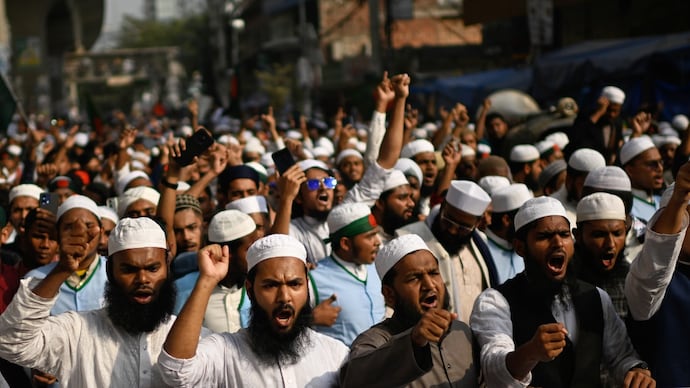
Emotions remain high in Bangladesh following the daylight shooting of anti-India radical leader and Dhaka-8 candidate Sharif Osman Hadi. Despite an ongoing police investigation, authorities have so far failed to produce concrete findings. As Bangladesh moves closer to national elections scheduled for February, a central question dominates public discourse: who truly stands to gain from Hadi’s murder?
Political analysts argue that neither the now-banned Awami League nor the poll-front-running Bangladesh Nationalist Party (BNP) benefits meaningfully from the killing. Instead, they point toward actors who thrive on instability, communal tension, and the derailment of democratic processes.
Meanwhile, BNP leader and former MP Nilofer Chowdhury Moni alleged that Mohammad Shishir Monir—a prominent Jamaat-e-Islami leader and Supreme Court lawyer—had twice secured bail over the past two years for Faisal Karim, the man accused of shooting Osman Hadi.
Monir, a former central secretary of Jamaat-e-Islami’s student wing, Islami Chhatra Shibir, is contesting the Sunamganj-2 seat on a Jamaat ticket in the upcoming February elections.
Islamists Push Anti-Hasina and Anti-India Narrative After Hadi Killing
Osman Hadi was known as a radical leader with strong anti-India views and served as spokesperson for the anti-Sheikh Hasina platform Inquilab Mancha. On December 12, he was shot by masked gunmen riding motorcycles.
Following the attack, Islamist organizations, radical leaders, and anti-India voices in Bangladesh began claiming that the alleged shooter, Faisal Karim, had fled to India. This narrative persisted despite repeated statements by Dhaka Police that they had no evidence of his departure or his current whereabouts.
These groups further exploited Karim’s alleged past links with the banned Awami League to fuel anti-Indian sentiment. Despite the lack of evidence, the Muhammad Yunus administration formally approached New Delhi, requesting assistance if the suspect was found in India and seeking his extradition.
After Hadi succumbed to his injuries days later, Islamist groups escalated their rhetoric. Protests intensified, slogans were raised, and Indian diplomatic missions—particularly in Dhaka—were targeted. Days later, Bangladesh’s Special Branch and Detective Branch admitted they lacked credible information regarding Karim’s location or proof that he had entered India.
On Monday, Inquilab Mancha issued a warning to the Yunus administration, threatening a large-scale uprising if justice was not delivered.
Was Hadi Killed? Experts Point to Jamaat’s Chhatra Shibir
Despite mounting pressure on the interim administration, experts maintain that neither the Awami League nor the BNP stands to gain politically from Hadi’s murder.
Paris-based geopolitical scholar Nahid Helal, of Bangladeshi origin, stated that the “real beneficiaries appear to be Jamaat and allied radical factions.”
“The killing provided them with exactly what they needed: a pretext to target minorities, an excuse to intimidate media outlets, an opportunity to attack Awami League activists, and—most critically—a mechanism to disrupt or derail the election altogether,” Helal wrote on his blog.
In a related YouTube analysis, Helal explained that Hadi was contesting as an independent candidate, while senior BNP leader Mirza Abbas was running for the Dhaka-8 seat.
“Hadi and Mirza Abbas were not political rivals. Hadi was largely irrelevant electorally, while Mirza Abbas is a heavyweight. However, Islami Chhatra Shibir’s central leader Md. Abu Shadik Kayem also has ambitions in Dhaka-8. Strategically, Hadi’s removal creates space for Jamaat-Shibir to strengthen its position,” Helal said.
He added that blaming India for the murder “does not withstand serious scrutiny” and noted that post-incident developments point toward Islamist collaboration.
Geopolitics and national security expert Raja Muneeb echoed this view, stating that non-traditional political actors such as the NCP and Jamaat benefited the most. “So it’s anyone’s guess who is eliminating these second-rung leaders,” he wrote on X, suggesting extremist groups prefer chaos over electoral politics.
A recent survey by the US-based International Republican Institute showed that 33 percent of respondents would “very likely” vote for the BNP, while 29 percent favored Jamaat. Jamaat recorded a 53 percent favorability rating, slightly higher than BNP’s 51 percent, highlighting its growing political leverage following the ban on the Awami League and the marginalization of the Jatiya Party.
BNP Leader Links Jamaat Figure to Hadi’s Death
The BNP has also raised concerns over Jamaat’s possible involvement in Osman Hadi’s murder. Nilofer Chowdhury Moni alleged that Mohammad Shishir Monir repeatedly helped secure bail for the accused shooter months before the attack.
“We must examine the background of the man who tried to kill Hadi. Who secured his bail twice? It was Mohammad Shishir Monir,” she said during a Bangladeshi television program. “I am saying this responsibly.”
Her remarks suggest that legal support linked to Jamaat may have indirectly enabled the crime.
In an opinion column published in Dhaka-based daily Desh Rupantor, ITC Events Limited CEO Marufa Yasmin highlighted the broader pattern of pre-election violence in Bangladesh.
“The air in Bangladesh feels heavy with an unfamiliar fear. Why does citizen safety become secondary during a so-called democratic festival?” Yasmin wrote, hinting at an unnamed “third, anti-democratic force” that emerges whenever trust between the two main political camps collapses.
Former Indian ambassador to Bangladesh Veena Sikri recently claimed that Jamaat-e-Islami was acting at Pakistan’s behest and attempting to influence the Bangladeshi military. She criticized Muhammad Yunus for remaining silent amid rising anti-India rhetoric and described the unrest as part of a broader, externally backed strategy.
According to multiple experts, the primary beneficiaries of Osman Hadi’s murder are extremist groups such as Jamaat Shibir and allied factions like the NCP—actors who exploit chaos, undermine democratic processes, and weaponize the failure of authorities to spread anti-India and anti-Awami League narratives.
Ultimately, these assessments provide critical insight into who may be seeking to profit from Osman Hadi’s assassination in the months leading up to Bangladesh’s national elections.
For breaking news and live news updates, like us on Facebook or follow us on Twitter and Instagram. Read more on Latest World on thefoxdaily.com.






COMMENTS 0