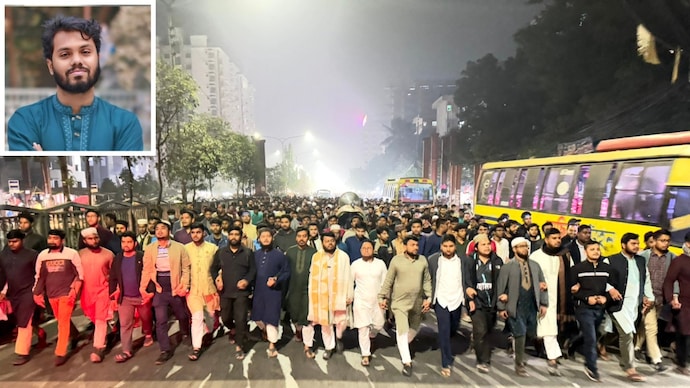
Bangladesh’s capital, Dhaka, was jolted by a brazen and violent attack on Friday, just a day after the country’s election schedule was announced. In a chilling incident that unfolded in broad daylight, three assailants riding motorcycles opened fire on Sharif Osman Hadi, an independent candidate from the Dhaka-8 constituency and the spokesperson of the Anti-Sheikh Hasina Inqilab Manch.
Hadi sustained a gunshot wound to the head and remains in critical condition. According to sources familiar with his medical status, he is currently in a coma and is expected to be airlifted to Singapore on Monday for advanced treatment. The attack has heightened political tensions and raised serious questions about Law and Order in the run-up to the elections.
Two days after the shooting, on Sunday, the interim administration headed by Nobel laureate Muhammad Yunus reached out to India, urging New Delhi to detain and extradite the attackers if they were found to have entered Indian territory. The appeal, however, came despite the Dhaka Metropolitan Police (DMP) stating that it had no verified evidence to support claims that the suspects had fled across the border.
According to a report by Dhaka-based news outlet Jagonews24, the DMP clarified on Sunday that “there is no verified evidence that the attackers have crossed into India.” The police emphasized that the investigation remains active and multi-layered.
DMP Deputy Commissioner Muhammad Talebur Rahman said several teams, including officers from the Detective Branch, are following multiple leads. “At this stage, we have no confirmed information indicating that any suspect has left the country,” he said, as quoted by Jagonews24.
Despite these official statements, speculation gained traction on social media after a journalist based in Qatar claimed on Facebook that two suspects—one allegedly a former leader of the now-banned Chhatra League—had crossed into India on December 12 and were staying in Guwahati, Assam.
The journalist alleged that former Chhatra League leader Faisal Karim Masud, also known as Daud Khan, was the gunman behind the attempt on Hadi’s life. According to the post, Masud crossed the Haluaghat border in Mymensingh along with his accomplice, motorcyclist Alamgir Hossain. The post further claimed that after entering India, Masud used an Indian phone number provided by an associate and shared selfies allegedly taken in Guwahati.
The journalist also claimed that when the phone number was checked on a caller ID application, it displayed a Bangla label translating to “This terrorist’s son is the murderer of Hadi.” These claims, however, have not been independently verified by Bangladeshi authorities.
In the aftermath of escalating violence, the Yunus administration formally banned the Awami League’s student wing, the Chhatra League, under the Anti-terrorism Act, citing National Security concerns.
Bangladesh’s law and order situation remains fragile, marked by political assassinations and attacks on prominent institutions, including those associated with Yunus himself, such as Grameen Bank. The atmosphere of instability has also kept key political figures away. BNP acting chairman Tarique Rahman continues to remain in exile, citing “uncontrollable factors,” even as his mother and former prime minister Khaleda Zia battles critical illness.
New Delhi has reiterated that the responsibility for maintaining domestic law and order rests squarely with Dhaka, particularly during a sensitive pre-election period.
Dhaka Summons Indian High Commissioner, Seeks Cooperation
According to the Dhaka-based English daily Daily Sun, Bangladesh’s foreign ministry summoned Indian High Commissioner Pranay Verma on Sunday morning. During the meeting, Dhaka formally requested India’s assistance in detaining and handing over the perpetrators if they were found on Indian soil.
The interim government also raised concerns over statements allegedly made by former prime minister Sheikh Hasina, who currently resides in India. Dhaka claimed that her remarks were provocative and could incite unrest ahead of the parliamentary elections.
“The Ministry of Foreign Affairs summoned the Indian High Commissioner today to convey the Government of Bangladesh’s serious concern to the Government of India for allowing fugitive Sheikh Hasina to continue to make incendiary statements calling upon her supporters to engage in terrorist activities in Bangladesh, aiming to thwart the upcoming parliamentary elections,” the foreign ministry said, as quoted by news agency PTI.
India Responds, Urges Dhaka to Ensure Stability
India swiftly rejected the allegations, reaffirming that it has never allowed its territory to be used for activities detrimental to the interests of the people of Bangladesh. New Delhi also emphasized that it expects the interim government to take all necessary measures to ensure internal law and order and conduct peaceful, credible elections.
While social media claims about suspects entering India continue to circulate, Bangladeshi police have reiterated that no such movement has been officially confirmed.
The broader political environment in Bangladesh remains volatile, with repeated incidents of violence, including crude bombings and targeted killings across Dhaka. Members of student-led groups, Jamaat-e-Islami, and the Bangladesh Nationalist Party (BNP) have all been linked to various episodes of political violence.
In November, attackers detonated homemade bombs outside the headquarters of Yunus’ Grameen Bank, further underscoring the fragile security situation. The ongoing unrest has cast a shadow over the Yunus administration’s promise of a free and fair election scheduled for February 2026.
Reflecting on the broader implications, former journalist and documentary filmmaker Asif Bin Ali wrote in the Dhaka Tribune that such attacks are never isolated incidents. “When a prominent political voice is assaulted in broad daylight during the height of election season, it is never just about that individual. It is about fear, control, and the message it sends to everyone else,” he observed.
Ali further noted that while many hoped Yunus’ appointment as Chief Advisor would usher in stability and a clean transition of power, the reality on the ground continues to reflect uncertainty and insecurity.
Echoing similar concerns, Khaled Saifullah, Joint Convenor of the student-led National Citizen Party (NCP), told ANI that political violence tends to intensify as elections approach, stressing that genuine concern for law and order is essential for a credible democratic process.
Who Is Sharif Osman Hadi?
Sharif Osman Hadi is a controversial and polarising figure in Bangladesh’s political landscape. Known for his strong anti-India and anti-Sheikh Hasina stance, he serves as the spokesperson of the Inquilab Mancha and has consistently positioned himself against the Awami League and what he describes as pro-India politics.
According to Asif Bin Ali, Hadi built a following by projecting himself as a sharp critic of both India and the Awami League, often using provocative rhetoric to mobilize supporters.
Recently, Hadi attracted further attention after releasing a map of a so-called “Greater Bangladesh” that reportedly included parts of Indian territory, triggering diplomatic sensitivities.
Running as an independent candidate from Dhaka-8, Hadi has openly called for the Awami League to be constitutionally barred from politics. He has also criticized the BNP, claiming it would not survive even two years in power if it reverted to what he termed “old-style” governance.
The attempt on his life has intensified anxieties in Bangladesh’s already tense pre-election environment. Hadi remains in critical care at Evercare Hospital in Dhaka, where former prime minister Khaleda Zia is also undergoing treatment, symbolizing the fragile and uncertain state of Bangladesh’s political moment.
For breaking news and live news updates, like us on Facebook or follow us on Twitter and Instagram. Read more on Latest World on thefoxdaily.com.





COMMENTS 0