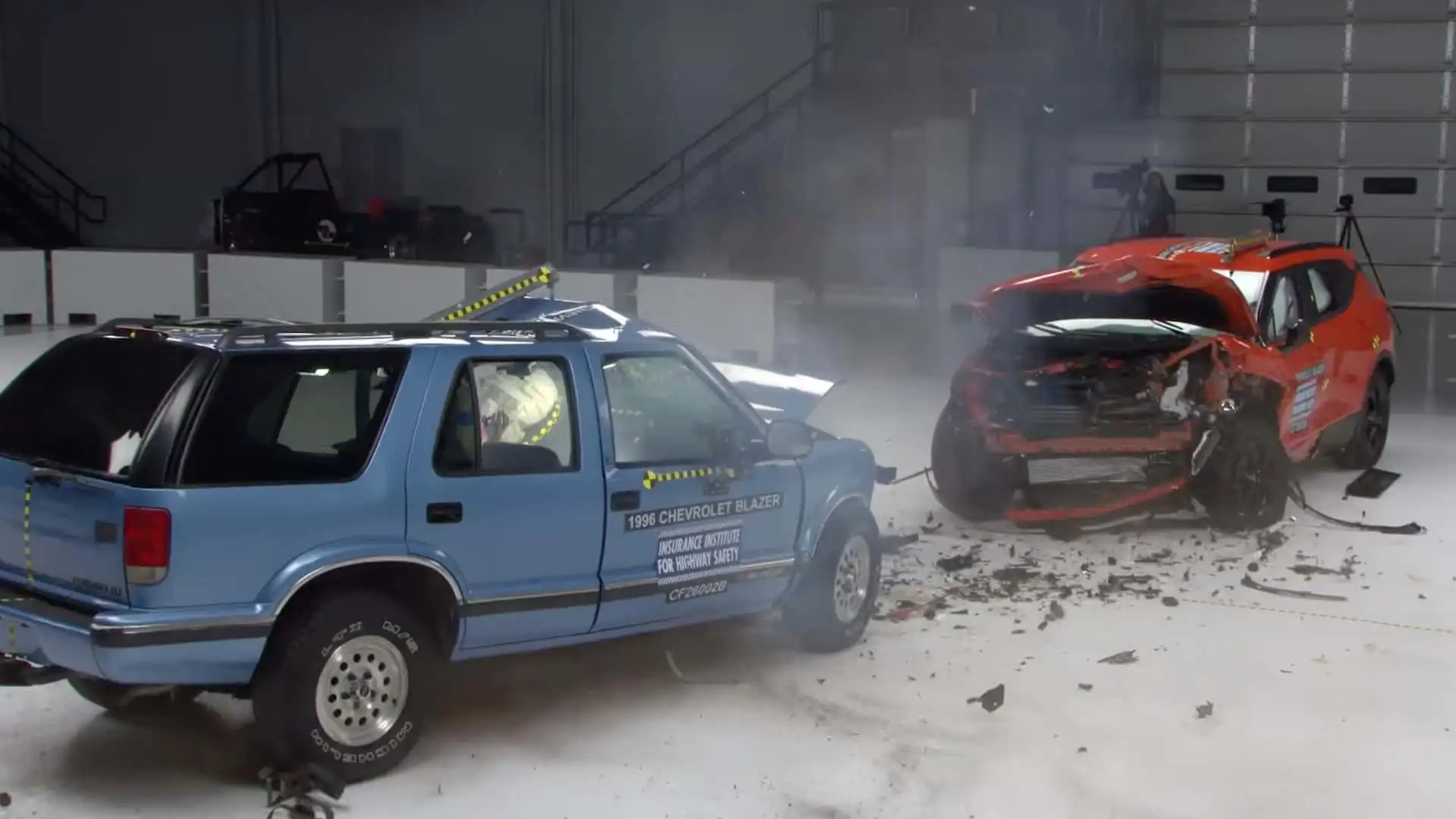
Vehicle safety has evolved dramatically over the past three decades, and a new crash test conducted by the Insurance Institute for Highway Safety (IIHS) provides one of the clearest demonstrations yet. In a controlled moderate overlap frontal crash, a 2026 Chevrolet Blazer was pitted against a 1996 Chevrolet S-10 Blazer to showcase how advancements in engineering, structural design, and occupant protection have transformed modern vehicles.
The results leave little room for debate. While the occupants of the modern Blazer would likely survive the crash with relatively minor injuries, the driver of the older SUV would face a significantly higher risk of severe or even fatal injuries. The comparison serves as a powerful reminder that today’s vehicles are designed not just to withstand impacts, but to actively protect occupants during some of the most dangerous types of collisions.
Why IIHS Conducted This Unique Crash Test
The IIHS organized this demonstration to illustrate how far automotive safety has progressed since the organization introduced standardized crash testing programs roughly 30 years ago.
Many drivers still believe that older vehicles were built stronger because they used more metal and appeared more rugged. However, modern crash safety focuses less on preventing vehicle damage and more on protecting the people inside.
Instead of building vehicles that remain rigid during an impact, engineers now design them to absorb and redirect crash energy away from passengers.
2026 Chevrolet Blazer vs 1996 Blazer: Crash Test Comparison
| Safety Category | 2026 Chevrolet Blazer | 1996 Chevrolet S-10 Blazer |
|---|---|---|
| Passenger Compartment | Maintained structural integrity | Severely compromised |
| A-Pillar Strength | Remained stable | Bent significantly |
| Roof Structure | Minimal deformation | Collapsed inward |
| Airbag Performance | Protected occupant effectively | Caused excessive head movement |
| Expected Driver Injury | Minor lower leg injury possible | High risk of head, neck and leg injuries |
The differences highlight how modern structural engineering dramatically improves occupant survival during frontal collisions.
What Happened During the Crash?
During the moderate overlap frontal impact, the modern Chevrolet Blazer absorbed much of the crash energy through carefully engineered crumple zones. These areas are specifically designed to deform during an accident, reducing the force transmitted to occupants.
The passenger safety cell remained largely intact, allowing airbags and seatbelts to function exactly as intended.
By contrast, the 1996 Blazer experienced extensive structural intrusion.
The A-pillar bent noticeably, the roof structure deformed, and major dashboard components were forced into the driver’s seating area. These structural failures significantly increased the likelihood of life-threatening injuries.
Why Modern Vehicles Perform So Much Better
The improvements seen in the crash test are the result of decades of continuous research, engineering, and stricter safety standards.
Key advancements include:
- Advanced crumple zone engineering.
- High-strength and ultra-high-strength steel construction.
- Reinforced passenger safety cages.
- Multiple strategically positioned airbags.
- Improved seatbelt pretensioners and load limiters.
- Better steering column collapse mechanisms.
- Advanced crash simulation using computer modeling.
Each innovation plays an important role in reducing injury severity during real-world collisions.
Understanding Crumple Zones
One of the biggest misconceptions about vehicle safety is that a stronger vehicle should remain undamaged during a crash.
In reality, controlled deformation is a critical safety feature.
Crumple zones absorb kinetic energy by collapsing in predetermined ways, reducing the forces that reach the passenger compartment. This controlled energy absorption greatly improves survival chances.
While the front of a modern vehicle may appear heavily damaged after an accident, that damage often represents energy that was prevented from reaching the occupants.
Airbags Have Become Much Smarter
Airbag technology has evolved significantly since the mid-1990s.
In the older Blazer, the airbag deployed but was unable to adequately protect the crash-test dummy because the collapsing structure altered occupant positioning. The impact caused excessive neck movement, increasing the likelihood of serious injuries.
Modern vehicles combine airbags with sophisticated electronic sensors that calculate crash severity, seat position, occupant weight, and impact direction before determining deployment characteristics.
This coordinated approach provides substantially better protection than earlier airbag systems.
How High-Strength Steel Changed Vehicle Safety
Today’s vehicles use carefully engineered combinations of high-strength steel, ultra-high-strength steel, and other advanced materials.
These materials allow manufacturers to create vehicles that are simultaneously:
- Stronger.
- Lighter.
- More fuel efficient.
- Better at absorbing crash energy.
- More resistant to passenger compartment intrusion.
The 2026 Blazer benefits from these engineering improvements, helping preserve survival space even during severe impacts.
Safety Technology Goes Beyond Crash Protection
Modern vehicles are designed not only to protect occupants during accidents but also to help prevent crashes altogether.
Many current SUVs include advanced driver assistance technologies such as:
- Automatic Emergency Braking.
- Forward Collision Warning.
- Lane Keeping Assist.
- Blind Spot Monitoring.
- Rear Cross Traffic Alert.
- Adaptive Cruise Control.
These systems significantly reduce the likelihood of collisions before airbags or structural safety features ever need to intervene.
Thirty Years of Progress in Numbers
According to the IIHS, improvements driven by crash testing and evolving vehicle design have produced remarkable real-world benefits.
| Impact of IIHS Safety Programs | Estimated Benefit |
|---|---|
| Lives Saved | Nearly 50,000 |
| Societal Economic Benefits | Approximately $500 Billion |
| Years of Continuous Crash Testing | 30 Years |
These figures demonstrate how improvements in vehicle engineering translate into measurable public safety outcomes.
Why Heavy-Duty Truck Safety Is the Next Challenge
Although passenger vehicle safety has improved dramatically, the IIHS believes further progress is needed in other areas.
One major focus is expanding standardized crash testing and safety ratings for heavy-duty trucks and commercial vehicles.
Collisions involving larger trucks continue to result in thousands of fatalities each year, making enhanced safety evaluation an increasingly important priority for regulators and manufacturers alike.
What This Means for Used Car Buyers
The crash test also provides an important lesson for consumers considering older used vehicles.
While classic SUVs and older models may offer rugged styling and mechanical simplicity, they often lack many of the structural safety features now considered standard.
For families and daily commuters, newer vehicles generally provide substantially higher levels of occupant protection, making safety one of the strongest arguments for choosing a more modern model whenever possible.
Key Takeaways
- The IIHS compared a 2026 Chevrolet Blazer with a 1996 Chevrolet S-10 Blazer in a moderate overlap crash test.
- The modern Blazer maintained passenger compartment integrity and significantly reduced injury risk.
- The older SUV experienced severe structural collapse, increasing the likelihood of life-threatening injuries.
- Advances in crumple zones, airbags, high-strength steel, and structural engineering have dramatically improved vehicle safety.
- IIHS estimates its crash testing programs have helped save nearly 50,000 lives over the past three decades.
Conclusion
The 2026 Chevrolet Blazer versus 1996 Blazer crash test serves as a compelling demonstration of how far automotive safety has advanced over the past 30 years. Modern engineering is no longer focused solely on building stronger vehicles—it is designed to protect human life through intelligent structural design, advanced restraint systems, and sophisticated safety technology.
For consumers, the results reinforce an important reality: while older vehicles may still have nostalgic appeal, newer models offer dramatically higher levels of crash protection. As safety standards continue to evolve and manufacturers adopt even more advanced technologies, future generations of vehicles are expected to become even better at preventing injuries and saving lives.
For breaking news and live news updates, like us on Facebook or follow us on Twitter and Instagram. Read more on Latest Automobile on thefoxdaily.com.

COMMENTS 0