For nearly a decade, buyers with Rs 35-40 lakh to spend on a three-row executive SUV in India have faced a familiar dilemma: choose a rugged ladder-frame SUV for its reputation for durability and resale value, or opt for a European monocoque offering better driving dynamics but potentially higher maintenance costs.
The Kia Sorento aims to offer an alternative to this established choice. Positioned as a premium three-row SUV, it brings Kia’s focus on contemporary design, technology and everyday usability to a segment where buyers increasingly expect comfort and sophistication alongside practicality.
Rather than following the traditional ladder-frame formula, the Sorento takes the monocoque route. This construction is generally associated with better on-road handling and a more car-like driving experience. It could therefore appeal to buyers who spend most of their time commuting in cities or travelling on highways rather than tackling demanding off-road conditions.
Design: A More Contemporary SUV
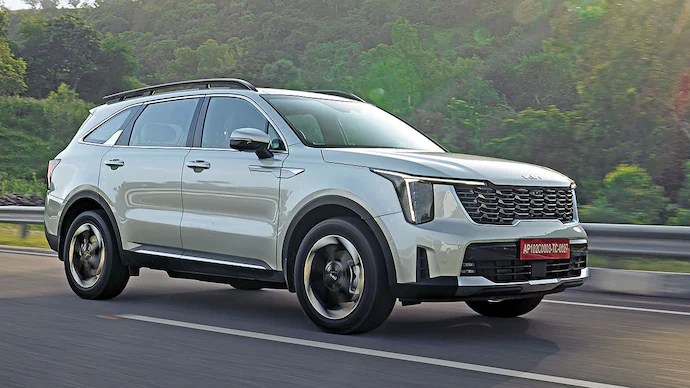
The Sorento’s design plays an important role in establishing its executive SUV credentials. Its proportions give it a substantial road presence, while Kia’s contemporary styling approach helps distinguish it from more conventional three-row SUVs.
For buyers moving up from a midsize SUV, the Sorento’s larger dimensions and premium positioning could make it an attractive upgrade. Its design also reflects the changing expectations of this segment, where an SUV is increasingly expected to make a statement without sacrificing everyday practicality.
Interior and Comfort: The Three-Row Challenge
In a three-row SUV, cabin space and seating comfort are just as important as exterior styling. Buyers in this category often expect to carry family members across all three rows, making access, legroom and overall cabin flexibility important considerations.
The Sorento’s executive positioning places particular emphasis on the cabin experience. Kia has built a reputation for offering feature-rich interiors, and the Sorento is expected to appeal to buyers looking for a modern, technology-focused environment.
However, the real test for any three-row SUV is how comfortably it accommodates passengers during longer journeys. The usability of the third row, luggage space when all seats are occupied and ease of access will be important factors in determining its everyday practicality.
Driving Experience: Monocoque Advantages
The Sorento’s monocoque construction sets it apart from traditional ladder-frame SUVs. This architecture generally offers a more composed on-road driving experience, with handling characteristics closer to those of a large passenger car.
For buyers who primarily use their SUVs in urban environments and on highways, this could be a significant advantage. A monocoque platform can offer a more comfortable balance between ride quality and handling than the traditional body-on-frame construction commonly associated with rugged SUVs.
That does not necessarily mean the Sorento will match every rival in terms of off-road ability or rough-road durability. Instead, its appeal is likely to lie in offering a more balanced package for buyers who prioritise everyday comfort and driving refinement.
Can the Kia Sorento Disrupt the Executive SUV Market?
The Sorento enters a segment where buyers have traditionally had to choose between the rugged appeal of ladder-frame SUVs and the road-focused character of European monocoques. Kia’s opportunity lies in offering a compelling middle ground, combining premium positioning with modern design, technology and family-friendly practicality.
Its success will ultimately depend on factors such as pricing, powertrain options, equipment, ride comfort and after-sales support. Buyers in the Rs 35-40 lakh bracket are also likely to consider long-term ownership costs and resale value before making a decision.
The Kia Sorento therefore has an interesting proposition to make. It does not need to replace the established strengths of ladder-frame SUVs or European monocoques. Instead, it needs to demonstrate that buyers can have a sophisticated, comfortable and practical three-row SUV without simply following either of those traditional routes.
For now, the Sorento represents a calculated attempt by Kia to challenge the established choices in India’s executive SUV space. Its final positioning and real-world performance will determine whether it can become a serious alternative for buyers looking to move upmarket.
For breaking news and live news updates, like us on Facebook or follow us on Twitter and Instagram. Read more on Latest Automobile on thefoxdaily.com.

COMMENTS 0