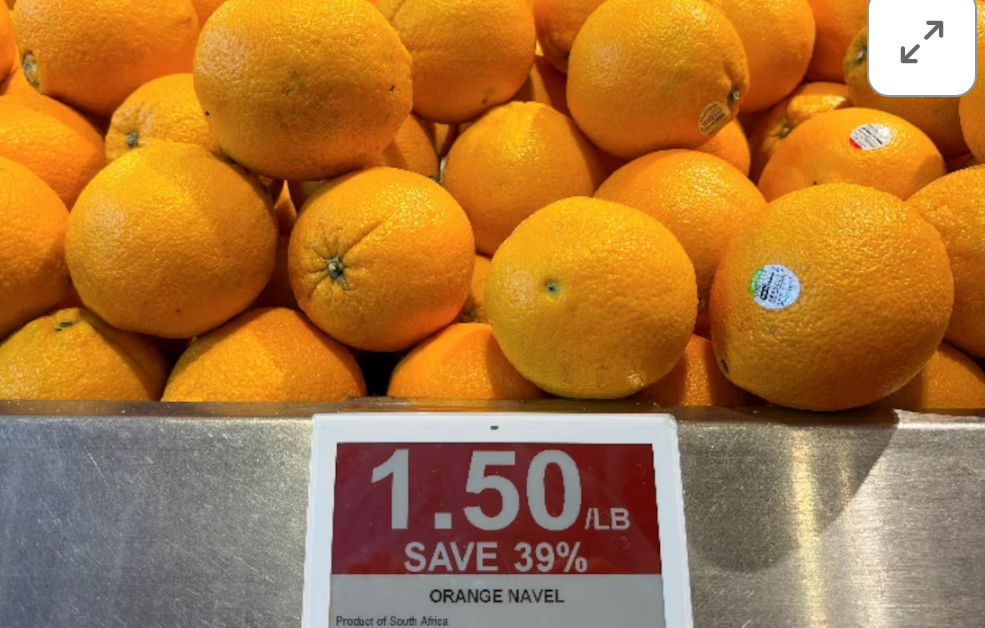
Canada’s trade relationship with the United States is increasingly influencing how consumers and grocery retailers make food-buying decisions. Fresh produce, one of the categories most dependent on cross-border trade, is becoming a visible part of that shift as Canadian shoppers show stronger interest in domestic products and alternative international suppliers.
The change is not simply about tariffs or prices. It reflects a broader change in consumer sentiment toward the United States, with some Canadians deliberately choosing Canadian brands and retailers while grocery companies reconsider how dependent they should be on a single foreign market.
Canada’s Dependence on U.S. Fresh Produce Is Changing
Canada is the world’s fifth-largest importer of fresh vegetables by value, making international supply chains essential to keeping grocery shelves stocked throughout the year. The United States remains Canada’s largest supplier of fresh produce, followed by Mexico.
However, government data indicates that the U.S. share of Canada’s vegetable imports declined to 62.6% in July, compared with 69% in the same month of 2023, before Donald Trump’s return to the White House.
More than half of Canada’s fruit imports still came from the United States as of July. Nevertheless, the decline in the American share of vegetable imports suggests that retailers are increasingly willing to look beyond their traditional supply relationships.
Why Canadian Consumers Are Changing Their Shopping Habits
Trade tensions have moved beyond government negotiations and into everyday consumer decisions. Some Canadian shoppers are now paying closer attention to where products are made and which companies they support.
John Ambard, a 27-year-old software engineer in downtown Toronto, said he tries to avoid American products when alternatives are available. He checks product labels and researches companies online to determine whether products are Canadian-made.
This behavior reflects a broader phenomenon: consumers can respond to geopolitical tensions even when doing so may not always be the cheapest option. For some shoppers, purchasing Canadian goods has become a way to support domestic businesses during a period of strained Canada-U.S. relations.
“I’m a little bit mad with America right now with how things are going. The attitude has just not been that of a friend.”
Such sentiment can have lasting commercial consequences. Once consumers become accustomed to identifying domestic brands and alternative suppliers, some of those purchasing habits can continue even after political tensions ease.
Trade Talks Add Pressure to an Already Changing Relationship
The latest shift follows renewed trade tensions between Canada and the United States. Trade talks broke down on August 21, triggering another round of tariffs and counter-tariffs.
For grocery companies, tariffs can affect procurement costs, transportation decisions, inventory planning and ultimately retail prices. But the strategic response can extend beyond simply passing higher costs on to consumers.
Retailers may instead diversify suppliers, renegotiate contracts, increase purchases from domestic producers or develop relationships with suppliers in countries that were previously less important to their business.
Canada’s Harsh Winters Make Food Independence Difficult
Canada faces a unique challenge when attempting to reduce dependence on imported fresh food. Its harsh winters limit the ability to produce many fruits and vegetables domestically throughout the year.
Grocers therefore traditionally depend on a combination of greenhouses, stored root vegetables and imports. Imported produce can also be significantly more cost-effective than expanding domestic production for certain crops.
This means that replacing U.S. imports is not simply a matter of telling retailers to buy Canadian. Canada needs sufficient agricultural capacity, greenhouse production, transportation infrastructure, storage and processing capabilities to make domestic supply more competitive and reliable.
Government Pushes for a More Self-Reliant Food System
The Canadian government is investing approximately C$3 billion over 10 years to expand greenhouse production. The objective is to increase domestic food production during Canada’s difficult winter months while strengthening the country’s food supply resilience.
The initiative also connects with a wider effort to reduce food inflation. Increasing domestic supply could help Canada become less vulnerable to external disruptions, although domestic production itself can involve higher labor, energy, land and infrastructure costs.
In other words, food security and low food prices do not always point in exactly the same direction. A more diversified supply chain may be safer, but the cheapest supplier may still be located outside Canada.
Grocers Are Already Finding New International Suppliers
Some Canadian retailers have already started changing their sourcing strategies. Gordon Dean, owner of Mike Dean Local Grocer, which operates stores in rural Ontario and Quebec, said his stores are now selling more produce from countries such as Spain, Brazil and Honduras than they previously did.
This illustrates how quickly supply chains can change when retailers have a strong reason to diversify.
Once a retailer establishes new relationships with international suppliers, the business may become less dependent on its previous supplier even if political tensions later ease. New contracts, logistics networks, shipping arrangements and procurement knowledge can create a more diversified system.
That is why the current changes could have effects lasting well beyond the immediate tariff dispute.
Why Supply-Chain Diversification Matters
Supply-chain diversification reduces the risk associated with depending heavily on one country. If a particular supplier becomes more expensive or unavailable, retailers with established alternatives can switch more easily.
For Canadian grocery companies, this could mean a future supply network that combines domestic farms and greenhouses with imports from the United States, Mexico, Latin America and Europe.
| Supply Strategy | Potential Advantage | Key Challenge |
|---|---|---|
| Canadian production | Greater domestic control and resilience | High winter production costs |
| U.S. imports | Established logistics and competitive pricing | Exposure to bilateral trade tensions |
| Mexican supply | Geographic proximity and established produce trade | Weather and logistics risks |
| European suppliers | Greater geographic diversification | Longer transportation routes |
| Latin American suppliers | Access to additional growing regions | Shipping and regulatory complexity |
Domestic Trade Barriers Could Limit Canada’s Food Resilience
There is an important problem within Canada itself: moving food between provinces can be complicated by different regulations and restrictions.
Gordon Dean said these differences make it harder for retailers to move food products across the country. That can leave some grocers dependent on suppliers in the United States even when Canadian alternatives exist elsewhere in the country.
This creates a paradox. Canada may have the agricultural capacity to produce more food domestically, but regulatory fragmentation and transportation challenges can prevent that supply from reaching consumers efficiently.
Improving interprovincial trade could therefore be as important as increasing agricultural production if Canada wants to build a stronger domestic food system.
Nationalism Is Beginning to Compete With Price
Normally, grocery purchasing is strongly influenced by price, quality, availability and convenience. Political sentiment can change that calculation.
Mike von Massow, professor of Food Agriculture and Resource Economics at the University of Guelph, described the current situation as one where nationalism is influencing economic decisions to a greater degree.
This matters because Canadian consumers may be willing to pay somewhat more for domestic or non-U.S. products if they believe their purchases support Canadian businesses or reduce dependence on the United States.
However, there is a limit to how far this behavior can go. Grocery budgets remain important, particularly when households are already dealing with elevated food costs. If American products become significantly cheaper than alternatives, some consumers may eventually return to them.
Could Canadian Consumers Return to U.S. Products?
The answer may depend on how long the political and economic tensions continue.
If Canada-U.S. relations improve, American produce could regain some market share because U.S. suppliers already have established transportation networks, business relationships and competitive pricing advantages.
But the relationship may not return completely to its previous state. The current period has encouraged retailers to explore alternatives and consumers to become more conscious of product origins.
That creates a possible long-term structural change: even if American produce becomes attractive again on price, Canadian retailers may continue maintaining diversified supplier networks rather than relying as heavily on the United States as before.
What This Means for Canadian Food Prices
The biggest short-term question for consumers is whether diversification will make groceries more expensive.
Replacing an established U.S. supply chain with more distant suppliers can introduce additional transportation, logistics and procurement costs. Domestic production can also be expensive, particularly for fresh produce during Canada’s winter months.
At the same time, diversification can reduce the risk of sudden shortages or price shocks caused by a disruption in one major supply corridor.
Therefore, the economic value of diversification is not necessarily visible through the lowest price on a single grocery item. Its larger benefit may be greater resilience when trade relationships, weather conditions or global supply chains are disrupted.
Canada’s Food System Is Entering a New Phase
The shift away from U.S. produce is best understood as part of a broader transformation rather than a simple consumer boycott.
Canada is simultaneously trying to expand domestic agricultural production, develop greenhouse capacity, control food inflation and diversify international suppliers. Consumers are also becoming more attentive to product origins and the businesses they support.
The result could be a Canadian food system that is more geographically diversified than it was before the latest trade tensions.
The Bigger Canada-U.S. Trade Picture
Food is only one part of the much larger Canada-U.S. economic relationship. The two countries have deeply integrated supply chains across agriculture, manufacturing, energy, transportation and consumer goods.
That makes a complete separation economically difficult and potentially costly. Yet the current dispute demonstrates that even highly integrated trading relationships can change when political trust weakens.
For Canadian businesses, the lesson may be that efficiency alone is no longer enough. Resilience, diversification and political risk are increasingly becoming part of procurement decisions.
Future Outlook: Diversification Could Outlast the Tariff Dispute
The most significant long-term consequence may not be the immediate reduction in American produce imports. It could be the creation of alternative supply chains that did not previously exist at scale.
If Canadian grocers establish reliable relationships with suppliers in Europe, Latin America and other markets, those connections are unlikely to disappear immediately if Canada-U.S. relations improve.
At the same time, the United States retains major advantages in proximity, infrastructure and cost. A future improvement in relations could therefore lead to some recovery in U.S. market share, particularly if American produce becomes considerably cheaper.
Canada’s challenge will be finding the right balance between affordability and resilience. A food system that depends entirely on domestic production may be expensive, while one that depends too heavily on a single foreign supplier can be vulnerable to political and economic shocks.
Conclusion
Canada’s changing attitude toward U.S. produce shows how geopolitical tensions can influence everyday consumer behavior and reshape business strategy. American suppliers remain essential to Canada’s food system, but their dominant position is facing greater scrutiny as consumers and grocers seek alternatives.
Government investment in greenhouses, greater international sourcing and efforts to strengthen domestic food production could gradually create a more diversified Canadian food supply chain.
The biggest question is whether this transformation will be temporary or permanent. If new supply relationships become established and consumers continue prioritizing Canadian products, the current trade dispute could leave a lasting mark on Canada’s grocery industry—even if political relations with the United States eventually improve.
For breaking news and live news updates, like us on Facebook or follow us on Twitter and Instagram. Read more on Latest Business on thefoxdaily.com.

COMMENTS 0