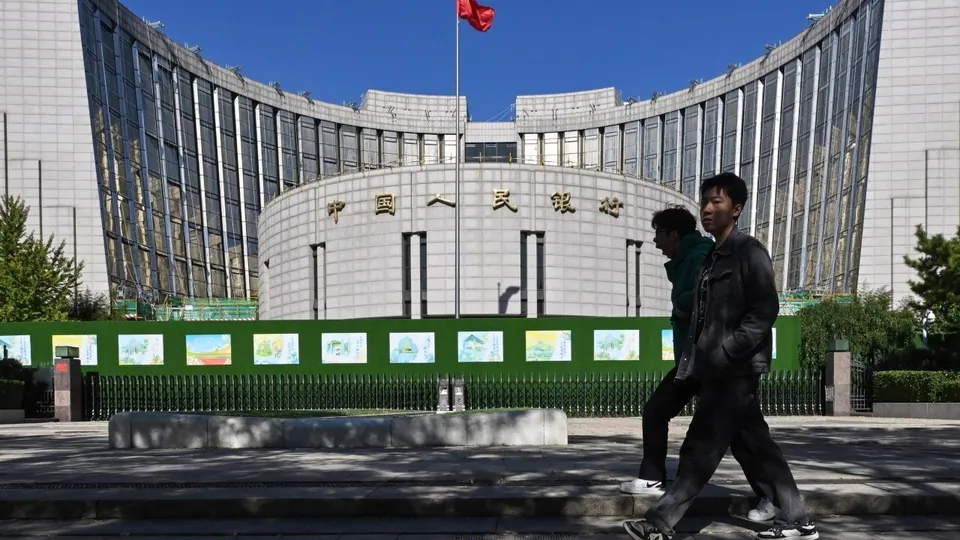
China’s central bank has signalled a cautious approach to further monetary easing, suggesting that additional interest-rate cuts may not be imminent even as policymakers maintain a pro-growth stance. The People’s Bank of China (PBOC) reiterated its commitment to supportive Monetary Policy in its latest quarterly report but also warned about the risks associated with excessively low interest rates.
Analysts believe the current round of policy easing may have largely run its course. The assessment comes as China’s economy remains on track to meet its official growth target, supported by strong exports, although domestic consumption continues to show weakness.
The central bank’s latest comments indicate that policymakers are increasingly focused on financial stability, capital market confidence and targeted support rather than relying on broad interest-rate reductions.
Key Highlights
- The PBOC reiterated its commitment to a pro-growth and accommodative monetary policy.
- Analysts see limited scope for immediate interest-rate cuts following the latest quarterly report.
- Strong exports are helping China remain on track to meet its official economic growth target.
- The central bank remains concerned that excessively low interest rates could threaten financial stability.
- Policymakers may increasingly rely on targeted monetary tools and financial reforms to reduce borrowing costs.
PBOC Signals Cautious Approach to Further Rate Cuts
In its third-quarter report, the People’s Bank of China maintained its commitment to an accommodative policy stance while highlighting concerns about the risks of keeping interest rates too low.
Analysts at Citic Securities said the latest language suggests that the current round of monetary easing has probably reached its limit for now. They pointed to a change in wording compared with the previous report.
The earlier report referred to the timely planning and rollout of practical and effective incremental policies. The latest report instead emphasised leveraging the combined effect of existing and incremental policies.
This shift suggests that policymakers may prefer to make better use of measures already introduced rather than announce another broad package of monetary stimulus immediately.
China’s Economic Growth Reduces Pressure for Immediate Easing
China’s economic performance is another reason the central bank may have limited urgency to cut interest rates. The world’s second-largest economy remains on track to achieve its official growth target, supported by robust exports.
However, the recovery remains uneven. Domestic consumption is weak, and economic momentum is concentrated in selected sectors rather than spread evenly across the economy.
This creates a challenge for policymakers. They need to support areas of the economy that remain under pressure without providing excessive stimulus that could create new financial risks.
Strong exports have helped support overall growth, reducing the immediate need for broad monetary easing. However, weak household spending remains an important concern for China’s longer-term economic outlook.
Inflation Is Not Forcing the PBOC to Change Policy
Inflation is also not creating significant pressure for immediate monetary action. Price growth in China has strengthened partly because of higher oil prices linked to the conflict in the Middle East.
However, inflation remains far from levels that would require the central bank to tighten monetary policy aggressively. This gives the PBOC room to maintain an accommodative stance while deciding how much additional support the economy needs.
The situation differs from that of several other major central banks, which face the challenge of controlling inflation without weakening economic growth through higher interest rates.
Why China Is Concerned About Extremely Low Interest Rates
While many central banks are concerned that raising interest rates could slow economic activity, the PBOC faces a different challenge. It has warned that excessively low rates could threaten financial stability and weaken confidence in the economy.
Chinese bond yields are already near historic lows, moving against the broader global trend of rising sovereign bond yields in several major economies.
Very low interest rates can reduce borrowing costs for companies and households, but they can also put pressure on banks’ profitability. When lending rates fall faster than deposit costs, banks may face a narrower net interest margin, making it harder to generate income from their lending activities.
The PBOC’s cautious approach reflects the need to balance economic support with the financial health of the banking system.
Why Further Interest-Rate Cuts May Be Delayed
Economists at Citi believe any additional monetary easing is more likely to happen next year and may be introduced gradually. They noted that domestic interest rates are already low, with loan and mortgage rates around 3%.
Citi analysts also said further policy rate reductions should be linked to deposit rate cuts to help preserve banks’ net interest margins.
This means the central bank may need to consider the impact on commercial banks before lowering benchmark rates further. A reduction in deposit rates could help banks manage the pressure on their lending margins if loan rates also decline.
For borrowers, this approach suggests that the cost of credit may not fall significantly through immediate benchmark rate cuts. Any reduction in financing costs could instead come through more targeted policy measures and financial reforms.
PBOC Focuses on Financial Stability and Regional Banks
The latest quarterly report suggests that stabilising capital markets and reducing financial risks remain important priorities for Chinese policymakers.
The central bank indicated that it may increase the use of targeted monetary instruments to direct support towards specific areas of the economy. Such tools can help lower financing costs for selected sectors without requiring economy-wide interest-rate reductions.
The PBOC also pledged to strengthen the capital base of struggling regional lenders. Regional banks play an important role in providing credit to local businesses and households, but weaker financial positions can limit their ability to support economic activity.
Improving their capital strength could help reinforce confidence in the banking system and reduce risks associated with financial institutions under pressure.
China May Rely More on Targeted Monetary Tools and Reforms
Analysts at China International Capital Corporation (CICC) expect the central bank to use structural monetary tools and market-based interest-rate reforms to reduce financing costs across the economy.
Rather than depending only on broad rate cuts, these measures can provide support to selected sectors and improve the way interest rates are determined in financial markets.
The approach also aligns with recent efforts to stabilise China’s stock market and manage the rapid rise in the yuan. Policymakers have introduced several measures in recent months to address market volatility and financial risks.
Targeted tools could allow the central bank to support credit availability while avoiding some of the side effects associated with prolonged, broad-based monetary easing.
What the PBOC’s Policy Signals Mean for Markets
The central bank’s cautious language may influence expectations across China’s bond, currency and equity markets. If investors expect fewer near-term rate cuts, they may adjust their expectations for borrowing costs and the returns available on financial assets.
At the same time, the PBOC’s focus on financial stability and targeted support indicates that policymakers are not abandoning economic stimulus. Instead, they appear to be placing greater emphasis on the effectiveness and financial consequences of individual measures.
For businesses and borrowers, the direction of future financing costs will depend not only on policy rates but also on deposit rates, lending conditions and the availability of targeted credit support.
Conclusion
China’s central bank is signalling a more cautious approach to monetary easing as economic growth remains supported by strong exports. Although weak consumption continues to challenge the recovery, the PBOC appears to see limited urgency for immediate broad-based interest-rate cuts.
Its concern about excessively low rates, pressure on bank profitability and financial stability suggests that future support may increasingly come through targeted monetary tools and structural reforms. Analysts expect any additional easing to be gradual, with the timing and scale depending on economic conditions and the health of China’s banking system.
For breaking news and live news updates, like us on Facebook or follow us on Twitter and Instagram. Read more on Latest Business on thefoxdaily.com.






COMMENTS 0