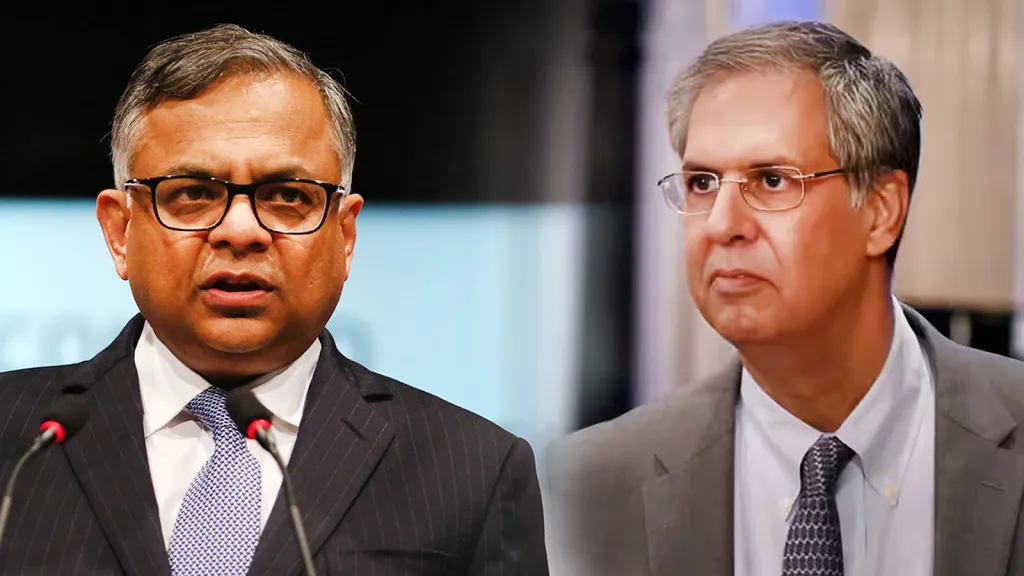
Tata Trusts Chairman Noel Tata has challenged the process through which N Chandrasekaran was reappointed as Executive Chairman of Tata Sons for another five-year term, demanding audio and video recordings of a key board meeting and detailed disclosures about the decision. His objections also concern the filing of the reappointment resolution with the Ministry of Corporate Affairs, the role of director Venu Srinivasan and reported commercial dealings between TVS Motor Company and a company associated with Chandrasekaran’s immediate family.
In a letter dated October 26 addressed to Tata Sons Company Secretary Suprakash Mukhopadhyay and copied to all directors, Noel Tata alleged that the reappointment resolution had been treated as a concluded board decision despite unresolved objections and unsettled meeting minutes. He said the company had not provided recordings of the September 17 board meeting, during which directors approved Chandrasekaran’s five-year extension and decided to pursue a listing of Tata Sons.
The letter gives Tata Sons seven days to provide the requested records and disclosures. Noel Tata warned that failure to produce the material could lead to adverse inferences regarding the circumstances surrounding the decision.
The dispute raises questions about Corporate Governance, board procedures, conflict-of-interest disclosures and the documentation required to establish the validity of a major corporate decision. However, the allegations and procedural objections in the letter represent Noel Tata’s position and should not be treated as established findings of wrongdoing.
Why Noel Tata Is Challenging Chandrasekaran’s Reappointment
At the centre of the dispute is the procedure followed during the September 17 Tata Sons board meeting. Noel Tata has argued that neither the original agenda nor the revised agenda explicitly identified Chandrasekaran’s reappointment as a proposed resolution.
According to his letter, agenda item 7 was described as a “Debriefing from Nomination and Remuneration Committee”. The revised agenda also included discussion of a September 11 letter from the Reserve Bank of India (RBI) and related caveat applications, but it still did not expressly mention the proposed reappointment.
Noel Tata contends that the reappointment resolution was nevertheless moved under that agenda item. He has questioned whether directors received adequate notice of the matter and whether the appropriate procedures were followed before the decision was treated as approved.
He has also challenged the reported filing of the resolution with the Registrar of Companies, Maharashtra, Mumbai, before the minutes had been finalised and while his objections remained unresolved.
In the letter, Noel Tata said he had not received a certified true copy of the resolution despite being a director of Tata Sons. He argued that having to rely on a version circulating publicly was unacceptable and questioned whether filing the resolution prematurely conveyed an inaccurate impression of the board’s position.
The company’s response to these objections, including its position on the validity of the resolution and the timing of the filing, will be important in determining how the dispute develops.
Dispute Over Board Procedures and Voting Requirements
Noel Tata’s objections extend beyond the meeting agenda. He has questioned whether the procedures specified in Tata Sons’ articles of association were followed during the reappointment process.
His letter asserts that a Selection Committee required under Article 118 was not constituted, despite a request dating to August 13. He has also disputed whether the affirmative vote required from directors appointed under Article 104B was obtained.
These issues are significant because a board resolution must be assessed not only by its announced outcome but also by the procedures, voting requirements and corporate rules governing its adoption.
Noel Tata has asked Tata Sons to provide records showing the voting outcome on each relevant part of the meeting agenda, including individual directors’ votes wherever a resolution was proposed. He has also sought confirmation of whether the required affirmative votes were secured.
His letter argues that filing a contested resolution as though it were a fully settled decision could mislead stakeholders and regulators about the status of the board’s proceedings.
The validity of the reappointment will depend on the applicable corporate rules, the relevant documents and any subsequent assessment of the competing positions. The letter itself does not establish that the resolution was invalid.
Seven-Day Deadline for Audio and Video Recordings
A major part of Noel Tata’s demand concerns access to the complete, unedited audio and video recordings of the September 17 board meeting. He has argued that the recordings are necessary to establish precisely what occurred during the discussion and how the reappointment resolution was handled.
He described the recording as the only neutral record of the proceedings and questioned why it had not been made available to a director who attended the meeting and formally placed objections on record.
In addition to the recordings, Noel Tata has requested any transcript of the meeting and confirmation that the original files and their metadata have been preserved. Metadata can help establish details about a digital record, including its creation and subsequent handling.
The request is intended to provide a documentary basis for examining the sequence of events, the discussions that took place and the treatment of the disputed resolution.
Noel Tata has also sought the final signed minutes or, if they remain unsigned, the revised draft. He wants the document to show which of his proposed corrections were accepted and whether his dissent was recorded where those corrections were rejected.
Demand for Meeting Notices, Agendas and Audit Trails
The records sought by Noel Tata extend beyond the meeting itself. He has requested the formal meeting notice, successive versions of the agenda, the dates and times when those versions were circulated, and details of who instructed changes to the documents.
He has also asked for the audit trail of documents uploaded to the board’s web application. Such records could help establish when relevant material was made available to directors and whether the agenda or supporting documents changed during the process.
The letter further seeks information about when the certified resolution was issued, who authorised it and whether it was issued before the meeting minutes were signed.
Noel Tata has requested copies of all documents filed with the Corporate Affairs Ministry in connection with the reappointment. He has also asked Tata Sons to inform the Registrar of Companies in writing that the resolution’s validity is disputed and to refrain from taking further steps until the meeting record is settled.
These demands highlight the importance of maintaining accurate corporate records, particularly when a board decision becomes the subject of a dispute among directors.
TVS Motor Dealings Raise Questions About Conflict-of-Interest Disclosures
The second major issue raised in Noel Tata’s letter concerns Hanno One Warehousing Pvt Ltd, a company whose directors include Lalitha Chandrasekaran and Pranav Chandrasekaran. The letter refers to media reports describing commercial arrangements between Hanno One and TVS Motor Company.
According to the details cited in the letter, TVS Motor leased approximately 17.41 acres of land near its Hosur plant to Hanno One in June 2025 for a period of 29 years, with an option to renew at Hanno One’s discretion.
Hanno One is reportedly constructing a facility measuring approximately 3.30 lakh square feet for TVS Motor. Rental payments are expected to begin in November 2026, according to the information cited by Noel Tata.
The letter also refers to land allotted to Hanno One near TVS Motor’s Mysuru factory for an industrial park estimated to cost Rs 330 crore. The proposed development is intended to serve TVS Motor and its suppliers.
Noel Tata cited a report referring to minutes of a Karnataka Land Audit Committee meeting dated November 6, 2025. According to that report, a Hanno One representative had stated that the company had entered into an agreement with TVS Motor.
The central issue raised by Noel Tata is whether Tata Sons’ board received sufficient information about the reported commercial relationship involving Chandrasekaran’s immediate family while considering his reappointment.
The existence of a reported commercial relationship does not, by itself, establish improper conduct. The relevant questions concern the nature of the arrangements, the applicable disclosure requirements, the information available to the board and whether any potential conflict was appropriately assessed.
Why Venu Srinivasan’s Role Is Being Questioned
Noel Tata has specifically questioned the participation of Venu Srinivasan, chairman emeritus of TVS Motor, in the Nomination and Remuneration Committee meeting on September 3 and the Tata Sons board meeting on September 17.
Srinivasan is a member of the committee responsible for reviewing the Executive Chairman’s performance and remuneration. According to Noel Tata’s letter, Srinivasan participated in the committee’s deliberations and cast the vote of an Article 104B-nominated director on which Tata Sons relies in treating the reappointment resolution as passed.
Noel Tata has argued that the reported commercial dealings between TVS Motor and Hanno One raised a potential conflict-of-interest concern in connection with Srinivasan’s participation in the reappointment process.
He has also emphasised the fiduciary responsibilities of directors nominated by charitable trusts, arguing that their duties extend to the interests of the trusts and their beneficiaries.
The issue is particularly sensitive because Tata Trusts is a major stakeholder in the Tata group. Decisions concerning Tata Sons’ leadership and governance can therefore have implications extending beyond the immediate interests of the holding company.
Whether Srinivasan’s participation created a conflict requiring additional disclosure or recusal would depend on the relevant facts, the applicable rules and the nature of his interests and responsibilities. Noel Tata’s letter raises the question but does not, by itself, resolve it.
Questions About Disclosures Under the Companies Act
Noel Tata has also challenged the adequacy of the disclosures recorded at the September 17 meeting. According to his letter, the declarations made under Section 184 of the Companies Act referred to Srinivasan having ceased to be a director of TVS group companies on June 10, 2026, rather than addressing the reported Hanno One relationship.
Section 184 deals with disclosure of interests by directors in relevant entities and arrangements. The scope of any disclosure obligation depends on the facts and the applicable legal requirements.
Noel Tata said he did not recall the reported commercial dealings being placed before the Tata Sons board. He referred to a statement attributed to a Tata Sons spokesperson that Hanno One’s incorporation had been disclosed in April 2025 to companies chaired by Chandrasekaran and that the TVS Motor transaction did not require disclosure to Tata Sons.
The letter seeks the original April 2025 disclosure, relevant declarations of interest, Chandrasekaran’s annual affirmations under the Tata Code of Conduct and records of any review of potential conflicts.
Noel Tata has also asked Tata Sons to explain the basis for its position that the transaction did not require disclosure. The requested material could help clarify what information was provided, to whom it was disclosed and how the company assessed the issue.
Legal Opinions on the Reappointment Resolution
The letter also raises questions about legal opinions obtained by Tata Sons concerning the validity of Chandrasekaran’s reappointment.
Noel Tata said opinions from retired judges Uday U. Lalit and B. N. Srikrishna were sought after the result of the resolution had been publicly declared. He has questioned the circumstances in which the opinions were commissioned and the information supplied to the lawyers.
He also noted that Srinivasan was among those who sought Justice Lalit’s opinion, raising questions about advice concerning a vote in which Srinivasan had participated.
Noel Tata has requested the instructions and documents supplied to the legal advisers, details of who authorised the opinions and confirmation of whether the reported TVS Motor dealings were disclosed to them.
These requests focus on whether the legal advice was based on a complete account of the relevant circumstances. The existence of differing views about a board resolution does not itself establish that the resolution or the advice obtained was unlawful.
Article 121B and the Request for Further Board Consideration
Noel Tata has invoked Article 121B in asking the Tata Sons board to consider the issues raised in his letter. These include the alleged nondisclosures, Srinivasan’s participation, the constitution of a Selection Committee under Article 118 and the RBI’s September 11 letter concerning Tata Sons’ status and proposed reorganisation.
The reference to the RBI letter adds another dimension to the dispute. Regulatory status and potential corporate restructuring can influence the governance and strategic decisions of a major holding company, making the interpretation of relevant correspondence important to the board’s deliberations.
Noel Tata’s request seeks to place the disputed matters before the board with supporting documentation. The letter also instructs that relevant records be preserved, including board papers, agenda audit trails, internal communications, disclosures and communications with the press concerning Hanno One.
Preserving these materials could be important if the company needs to reconstruct the decision-making process or respond to further questions from directors, regulators or other relevant parties.
What the Dispute Means for Tata Sons’ Corporate Governance
The dispute places corporate governance procedures at the centre of a high-profile disagreement involving Tata Sons’ leadership. The questions raised concern how board decisions are documented, whether directors receive appropriate notice, how voting requirements are verified and whether potential conflicts are disclosed and assessed.
For large corporate groups, clear governance procedures are important because major decisions can affect shareholders, employees, business partners, lenders and other stakeholders. Accurate minutes, reliable voting records and transparent disclosure processes help demonstrate that decisions have been made in accordance with applicable rules.
The dispute also highlights the distinction between a decision being publicly announced and its underlying procedural record being fully settled. Where objections have been raised, access to the relevant documentation can help establish the sequence of events and clarify the positions taken by individual directors.
Conflict-of-interest questions require particular care. Directors may have professional, commercial or institutional relationships that need to be evaluated under applicable laws and company policies. The appropriate response depends on the nature of the relationship, the relevant disclosure obligations and the safeguards available to protect the integrity of the decision-making process.
In Tata Sons’ case, the requested records may help clarify the disputed aspects of Chandrasekaran’s reappointment and the reported commercial arrangements involving Hanno One and TVS Motor. Until the relevant evidence and responses are available, the allegations should remain distinguished from established findings.
What Happens Next?
The immediate next step is Tata Sons’ response to Noel Tata’s seven-day deadline. The company has been asked to provide the meeting recordings, minutes, agendas, voting records, filing documents, conflict-of-interest disclosures and legal instructions identified in the letter.
Noel Tata has also requested that the company notify the Registrar of Companies that the resolution’s validity is disputed and avoid further steps until the meeting record is settled.
The company’s response could determine whether the disagreement can be addressed through internal governance procedures or develops into a more extensive dispute. The handling of the requested material will also be relevant to any subsequent assessment of the reappointment process.
Important questions remain unanswered in the supplied account, including Tata Sons’ full response to the allegations, the status of the meeting minutes and the precise legal basis for the company’s position on the resolution and disclosure requirements.
Outlook: Leadership Dispute Puts Governance Under Scrutiny
Noel Tata’s challenge to Chandrasekaran’s reappointment has broadened into a dispute over board procedures, voting requirements, legal advice and potential conflicts of interest. His demand for recordings and corporate records reflects an effort to establish a detailed documentary account of the September 17 meeting and the decisions taken around it.
The separate questions concerning Hanno One and TVS Motor add a focus on director disclosures and the handling of commercial relationships involving people associated with senior leadership. The key issue is whether the relevant information was disclosed and assessed in accordance with applicable legal and governance requirements.
The outcome will depend on the records produced, Tata Sons’ explanations and any subsequent review of the disputed matters. Until then, the allegations in Noel Tata’s letter should not be treated as proof of misconduct or as a definitive determination that Chandrasekaran’s reappointment is invalid.
The episode nevertheless underscores the importance of transparent board procedures, complete documentation and robust conflict-of-interest safeguards at major corporate institutions. For Tata Sons, resolving the questions raised and clearly communicating its position will be important to maintaining confidence in its governance and leadership decisions.
For breaking news and live news updates, like us on Facebook or follow us on Twitter and Instagram. Read more on Latest Business on thefoxdaily.com.






COMMENTS 0