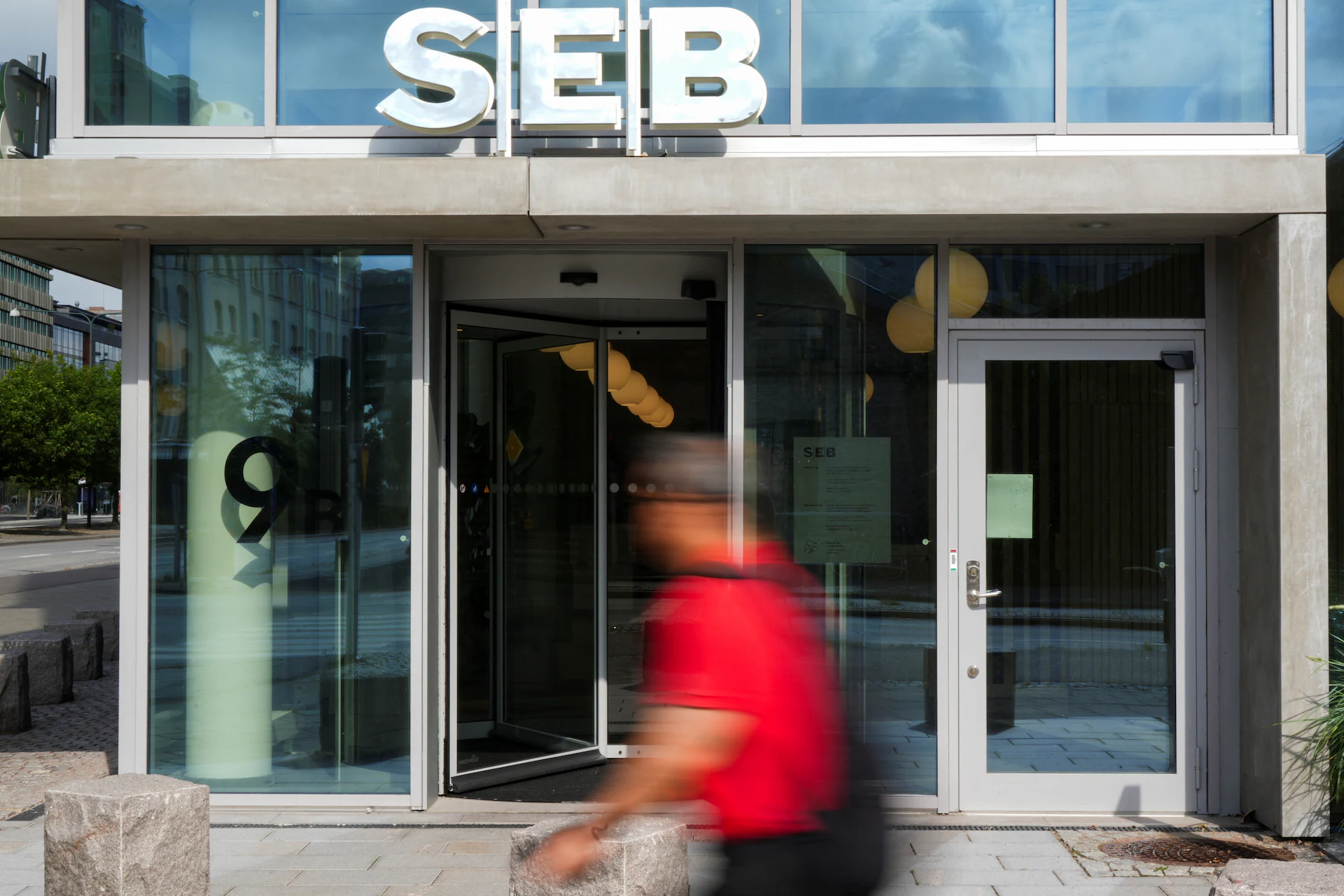
Swedish Banking group SEB reported third-quarter net profit below market expectations on Thursday and announced a pause in share buybacks as it faces continued loan growth and temporarily higher capital requirements. The results reflect pressure on some of the bank’s income streams, particularly trading-related activities, despite an increase in net interest income compared with the previous year.
SEB’s net profit fell to 7.50 billion Swedish crowns ($758.70 million) from 7.68 billion crowns a year earlier, missing the 7.91 billion crowns expected by analysts polled by LSEG. The earnings shortfall came as muted client activity and challenging market-making conditions weighed on net financial income.
The decision to suspend share buybacks also highlights the bank’s need to manage capital carefully following a regulatory measure that will temporarily increase its capital requirements by approximately 10 billion Swedish crowns.
SEB Net Profit Falls Below Analyst Expectations
SEB reported third-quarter net earnings of 7.50 billion Swedish crowns, down from 7.68 billion crowns in the corresponding period a year earlier. The result was also below the 7.91 billion crowns forecast by analysts surveyed by LSEG.
The difference between reported earnings and market expectations indicates that the bank faced challenges in generating the level of profit anticipated by analysts. While net interest income increased year on year, weaker net financial income offset some of that improvement.
Net interest income, which reflects the difference between interest earned on loans and other interest-bearing assets and the interest paid on deposits and funding, totalled 10.88 billion crowns during the quarter. That compared with 10.54 billion crowns a year earlier.
However, the figure remained below the analysts’ average forecast of 10.97 billion crowns. The result shows that although SEB generated more net interest income than in the same period last year, it did not meet market expectations for the quarter.
The bank’s overall earnings performance therefore reflected mixed results across its income sources, with higher net interest income failing to compensate fully for the decline in net financial income.
Trading Conditions Weigh on Net Financial Income
SEB’s net financial income fell to 1.12 billion Swedish crowns from 1.77 billion crowns a year earlier. The category includes trading-related income, which can fluctuate more sharply from quarter to quarter than some other banking revenue streams.
Acting chief executive Jonas Ahlstrom said net financial income had been negatively affected by subdued client activity and a challenging market-making environment in fixed income, foreign exchange and commodities.
Market-making involves financial institutions facilitating transactions by providing prices at which customers can buy or sell financial instruments. Revenue from these activities can be influenced by trading volumes, market conditions and customer demand.
Muted client activity can reduce opportunities for banks to generate trading-related income, while difficult market-making conditions can make it harder to earn revenue from facilitating transactions. SEB’s latest results indicate that these factors contributed to the year-on-year decline in net financial income.
The drop in this category was significant enough to form an important part of the bank’s weaker-than-expected quarterly earnings. Although net interest income increased, the reduction in trading-related income put pressure on overall profitability.
SEB Pauses Share Buybacks as Capital Requirements Increase
SEB said it was pausing share buybacks because of continued loan growth and temporarily higher capital requirements. Share buybacks are a way for companies to return capital to shareholders by repurchasing their own shares in the market.
For banks, decisions about buybacks must take into account regulatory capital requirements and the amount of capital needed to support lending and other activities. A pause can allow a bank to preserve greater financial flexibility while it responds to changes in its capital position.
The announcement follows a decision by Sweden’s financial watchdog earlier this month to impose temporarily higher capital requirements on SEB because of deficiencies in its Internal Ratings-Based (IRB) models.
The new measure increases SEB’s core Tier 1 capital requirement by approximately 10 billion Swedish crowns. Core Tier 1 capital is a key measure of a bank’s financial strength, representing high-quality capital available to absorb losses while supporting its operations.
IRB models are used by banks to estimate credit risk and help determine the capital they must hold against lending exposures. Deficiencies in these models can prompt regulators to require additional capital until the relevant issues are addressed or the requirements are otherwise adjusted.
The higher requirement means SEB must account for an additional capital obligation while continuing to support loan growth. Temporarily suspending share buybacks is one measure the bank has announced in response to these pressures.
Loan Growth Adds to Capital Management Considerations
Continued loan growth was another factor SEB cited when explaining its decision to pause buybacks. Lending is a core banking activity, but expanding a loan portfolio also requires banks to maintain sufficient capital relative to their risk exposures.
When lending increases, banks must ensure that their capital position remains consistent with applicable regulatory requirements. An increase in required capital can therefore influence how much money a bank is able or willing to return to shareholders.
In SEB’s case, loan growth coincides with a temporary increase in its capital requirements of approximately 10 billion crowns. The combination has made capital management a central consideration in the bank’s latest announcement.
The pause in share repurchases does not, by itself, indicate a permanent change in the bank’s shareholder-return policy. The announcement describes a response to current lending and regulatory capital conditions, while the duration of the pause was not specified in the supplied results.
Investors will be watching how SEB manages its capital position as the higher requirements take effect and how its lending and earnings performance develop in subsequent reporting periods.
SEB Expects 2026 Costs to Come in Below Target
Despite the quarterly earnings shortfall, SEB said costs for the full year 2026 are expected to be approximately 500 million to 600 million Swedish crowns below its existing cost target.
The forecast suggests that the bank expects to keep its annual expenses below the level previously targeted. Cost control can help support profitability when some revenue sources are under pressure, although the overall effect on earnings also depends on income trends and other operating factors.
The expected undershoot of the cost target provides a separate element of the bank’s financial outlook from the third-quarter results. While lower-than-expected expenses may offer some support, they do not eliminate the impact of weaker trading-related income or the need to meet higher capital requirements.
The bank’s ability to manage expenses while continuing to serve customers and support lending will remain relevant to its operating performance. However, the available figures do not provide a detailed breakdown of which cost categories are expected to account for the projected undershoot.
What SEB’s Third-Quarter Results Mean
SEB’s latest results present a mixed picture of its financial performance. Net interest income increased compared with a year earlier, but it fell short of analysts’ expectations. Meanwhile, net financial income declined sharply, contributing to a net profit result below market forecasts.
The decision to pause share buybacks adds another important development for shareholders. The bank is prioritising capital management as it deals with continued loan growth and a temporary regulatory increase in its core Tier 1 capital requirement.
At the same time, SEB’s expectation that 2026 costs will come in 500 million to 600 million crowns below target indicates that expenses are expected to remain below the bank’s original plan. The financial benefit will depend on the relationship between costs, income and other factors affecting its results.
Investors and analysts are likely to focus on the bank’s ability to stabilise trading-related income, sustain net interest income and manage capital under the revised regulatory requirements. The timing of any resumption of share buybacks will also be relevant, although SEB did not specify when repurchases might restart.
Overall, the third-quarter report highlights the competing considerations facing SEB: maintaining profitability, supporting lending activity, controlling costs and preserving sufficient capital to meet regulatory expectations.
Currency conversion: $1 was equivalent to 9.8853 Swedish crowns, according to the figures provided in the report.
For breaking news and live news updates, like us on Facebook or follow us on Twitter and Instagram. Read more on Latest Business on thefoxdaily.com.






COMMENTS 0