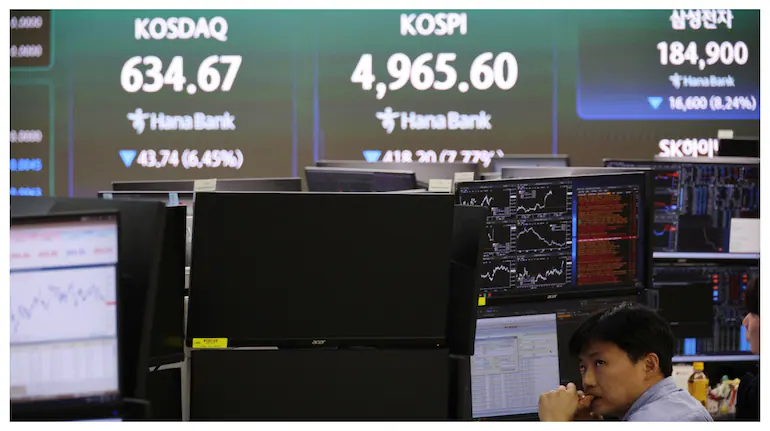
South Korean stocks staged a strong recovery on Tuesday as investors returned to semiconductor shares following a sharp selloff in the Artificial Intelligence (AI) trade. The benchmark Kospi surged more than 5% in early trading, supported by gains in heavyweight chipmakers Samsung Electronics and SK Hynix.
Both companies climbed more than 5% as investors took advantage of lower valuations and renewed interest in AI-related stocks. The rebound followed strong gains among US semiconductor peers on Monday, although Nvidia shares moved in the opposite direction amid controversy surrounding its chief executive, Jensen Huang.
Improving global sentiment, falling oil prices and the introduction of new AI models by Anthropic also supported the recovery. Investors are now assessing whether the recent decline in Korean technology stocks has created an opportunity to buy shares in companies that remain closely linked to global semiconductor demand.
Key Highlights
- South Korea’s benchmark Kospi jumped more than 5% in early trading on Tuesday.
- Samsung Electronics and SK Hynix shares each gained more than 5%.
- Falling oil prices and gains in US semiconductor stocks helped improve investor sentiment.
- The Kospi had fallen more than 40% from its summer peak amid concerns over AI financing and market volatility.
- Investors are watching Anthropic’s planned IPO marketing and Nvidia’s upcoming earnings report for further signals about the AI trade.
Kospi Rallies as Investors Return to AI and Semiconductor Stocks
The Kospi’s early gains reflected renewed buying interest in South Korea’s major technology companies. Samsung Electronics and SK Hynix, two of the country’s most influential semiconductor manufacturers, led the recovery with gains exceeding 5% each.
The rebound came after a difficult period for Korean equities, which had experienced significant selling pressure following a strong rally driven by enthusiasm around artificial intelligence. Concerns about the financing of AI infrastructure, technology valuations and changing global market conditions had encouraged investors to reduce their exposure to the sector.
However, the latest recovery suggests that some investors are returning to semiconductor stocks after the decline. The gains also indicate that market participants are looking again at the underlying demand for AI-related chips rather than focusing exclusively on short-term negative headlines.
According to Jung In Yun, chief executive of Fibonacci Asset Management Global, investors are refocusing on company fundamentals because the controversy surrounding Nvidia’s leadership does little to change underlying AI demand or semiconductor earnings prospects.
Samsung and SK Hynix Lead South Korea’s Stock Market Recovery
Samsung Electronics and SK Hynix played a central role in the Kospi’s rebound. Both companies are major participants in the global Semiconductor Industry and are closely connected to demand for memory chips used in AI infrastructure.
Samsung Electronics has a broad semiconductor business, while SK Hynix is an important supplier of memory products used in advanced computing systems. Their share prices are therefore sensitive to expectations about investment in AI data centres, semiconductor production and demand for high-performance memory.
The latest gains followed a period of heavy selling in Korean technology stocks. The recovery indicates that investors were willing to buy shares after the decline, particularly as valuations became more attractive.
The source data also showed that both Samsung Electronics and SK Hynix were trading at less than three times their estimated forward earnings. Such valuation levels have attracted attention among investors evaluating whether the recent market correction has been excessive.
Why South Korean Stocks Faced Heavy Selling Pressure
South Korea’s Stock Market had been among the major beneficiaries of the global AI investment boom. Strong demand expectations for semiconductors helped fuel a substantial rally in technology shares, but the market later faced a sharp reversal.
The Kospi had fallen more than 40% from its summer peak, reflecting concerns about AI financing, market valuations and broader political developments in the United States.
South Korean equities experienced a deeper decline than some other major Asian markets. Taiwan’s benchmark index was down around 16% from a record high earlier in the month, compared with the much larger fall in the Kospi.
This difference has raised questions about whether Korean stocks were disproportionately affected by the global selloff. Jung In Yun of Fibonacci Asset Management said investors increasingly viewed Korean equities as having experienced a larger decline relative to markets such as Taiwan and Japan.
That perception may have contributed to renewed buying interest as investors looked for opportunities in heavily sold-down semiconductor companies.
Falling Oil Prices and US Chip Gains Support Market Sentiment
Developments outside the semiconductor industry also helped support the Korean market. Oil prices declined after US President Donald Trump said further strikes on Iran would not be necessary.
Lower oil prices can influence investor sentiment by easing concerns about energy costs and inflationary pressures. For financial markets, reduced geopolitical uncertainty can also encourage investors to increase exposure to risk-sensitive assets such as technology stocks.
At the same time, US semiconductor stocks recorded significant gains on Monday, providing additional support for Asian chipmakers. The performance of US technology companies often influences sentiment towards semiconductor manufacturers in South Korea and other major Asian markets.
However, Nvidia shares declined despite gains among several of its US peers. The company’s stock faced pressure amid controversy surrounding Jensen Huang and reports concerning a woman suspected of spying on behalf of China. The allegations and their implications have added uncertainty around the company’s leadership headlines, although investors in Korean chipmakers appeared more focused on broader industry fundamentals.
Anthropic’s New AI Models Add to Technology Sector Optimism
Another development supporting interest in artificial intelligence was the unveiling of new AI models by Anthropic. The company introduced the models ahead of its anticipated Wall Street debut, bringing renewed attention to competition and innovation in the AI industry.
Anthropic’s upcoming IPO is another event investors are watching as they assess the outlook for the wider AI sector. The company’s planned IPO marketing is expected to provide additional attention to investor demand for businesses operating in artificial intelligence.
New AI models can influence expectations about the adoption of artificial intelligence across businesses and industries. For semiconductor companies, sustained growth in AI applications could support demand for the computing infrastructure and memory products required to run advanced systems.
However, the relationship between AI innovation and semiconductor earnings will depend on actual investment, customer demand and the ability of technology companies to generate returns from their AI spending.
Nvidia Earnings Become a Key Event for the AI Trade
Investors are also preparing for Nvidia’s upcoming earnings report next week. As one of the most closely watched companies in the AI industry, Nvidia’s financial results and management commentary can influence sentiment across global semiconductor markets.
Market participants will be looking for information about demand for AI chips, revenue growth and the company’s outlook. Its results could offer further insight into whether spending on AI infrastructure remains strong enough to support semiconductor companies.
The controversy surrounding Jensen Huang has also added another layer of uncertainty. However, investors will need to distinguish leadership-related headlines from the company’s operating performance and the broader demand outlook for AI computing.
What the South Korean Stock Market Rebound Means for Investors
The sharp rise in the Kospi highlights how quickly sentiment can change in technology-heavy markets. After a steep correction, lower share prices and improving global conditions encouraged investors to return to major semiconductor companies.
Samsung Electronics and SK Hynix remain central to the performance of the Korean market because of their importance in the global chip supply chain. Their earnings prospects are closely linked to demand for memory and other semiconductor products used in AI systems.
Nevertheless, a single session of strong gains does not necessarily confirm that the broader market correction has ended. Investors will continue to monitor AI investment trends, semiconductor earnings, oil prices and geopolitical developments.
What to Watch Next in the AI and Semiconductor Market
Several upcoming developments could influence the direction of global technology shares. Anthropic’s planned IPO marketing will offer another indication of investor interest in AI businesses, while Nvidia’s earnings report next week will provide an important update on the semiconductor industry’s performance.
For South Korea, the sustainability of the Kospi’s recovery will depend partly on whether buying interest continues in Samsung Electronics, SK Hynix and other technology companies. Investors will also assess whether the recent valuation declines have created opportunities or reflect concerns about future earnings and AI investment returns.
The latest rebound shows that investors are once again willing to consider heavily sold-down chipmakers. Whether this marks the beginning of a sustained recovery or a temporary bounce will become clearer as corporate earnings and developments across the AI industry unfold.
For breaking news and live news updates, like us on Facebook or follow us on Twitter and Instagram. Read more on Latest Business on thefoxdaily.com.






COMMENTS 0