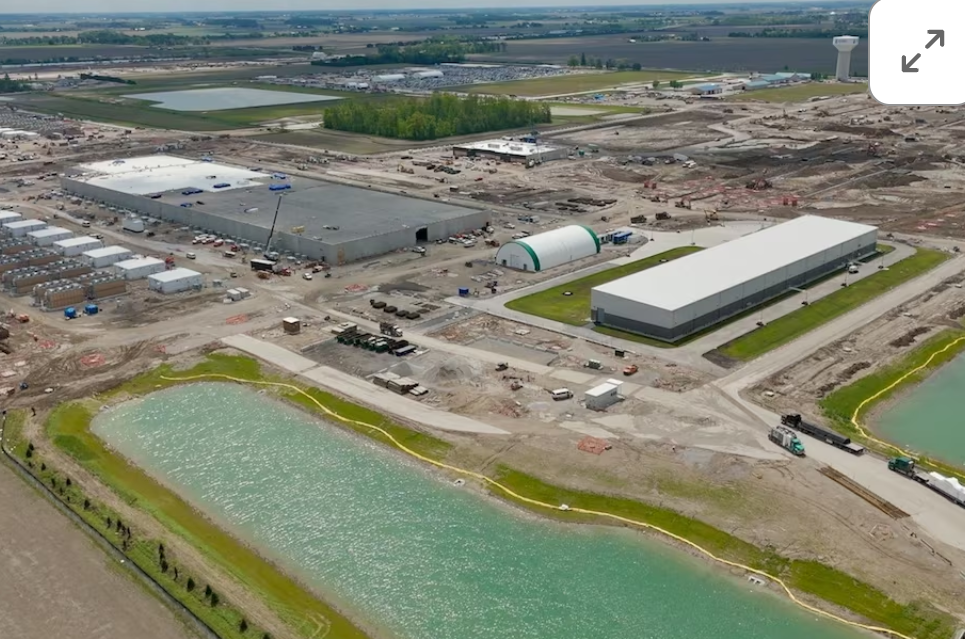
Data center development is emerging as a significant political issue in rural parts of the US Midwest, where residents are raising concerns about electricity costs, water consumption, farmland protection and tax incentives for major technology companies.
In Ohio, the debate is becoming particularly visible ahead of the November 3, 2026, vote. Residents in Defiance, a city surrounded by agricultural land in the state’s northwest, have spent months gathering signatures for a ballot measure that would ban all but the smallest data centers. City officials have also announced a six-month moratorium on new project approvals.
The growing opposition is creating a new challenge for candidates in competitive congressional and statewide races. Democrats are seeking to turn public concerns about data center development into an election issue, while Republicans are disputing accusations that they have put technology companies ahead of local residents.
The controversy has intensified following the disclosure that Ohio gave up more than $2 billion in sales-tax revenue through data center incentives in 2024 and 2025. A poll from Bowling Green State University, cited by Reuters, found that 71% of Ohioans supported a temporary ban on new data center construction.
The dispute is about more than artificial intelligence. It has become a broader debate over who benefits from large-scale technology investment, who pays for the infrastructure it requires and how much control local communities should have over development.
Why Data Centers Are Becoming a Rural Political Issue
Data centers are specialised facilities that house computer servers and related equipment used to store, process and transmit digital information. They support services such as cloud computing, online platforms and artificial intelligence applications.
As demand for digital services and AI computing grows, technology companies are seeking infrastructure capable of handling large volumes of data and processing workloads.
These facilities can bring investment, construction activity, jobs and tax revenue to host communities. But they can also require substantial electricity, water and land, depending on their size, design and cooling systems.
For rural communities, the trade-off can feel especially immediate. A proposed facility may occupy agricultural land, require new power infrastructure or alter the character of an area that residents value for farming and open space.
That is why opposition can develop even before a company formally announces a project. In Defiance, residents became concerned after learning that the county’s economic development group had received inquiries from technology companies.
No company had announced plans to build a data center in the city, according to the Reuters report. Nevertheless, residents began organising around the possibility of future development.
Defiance Residents Push for a Ballot Measure
Defiance, a community of approximately 17,000 people in northwestern Ohio, has become a focal point of the state’s data center debate.
Residents spent months gathering signatures for a November 3 ballot measure that would prohibit all but the smallest data centers. City officials separately announced a six-month moratorium on new project approvals.
The local campaign reflects concerns about the possible consequences of large-scale infrastructure development, including pressure on farmland, electricity demand and water consumption.
Becca Rupp, founder of Citizens for Responsible Development in Defiance, told Reuters that many residents feel vulnerable to large businesses.
The ballot initiative is significant because it attempts to move the debate from public meetings and campaign statements into a direct vote on local development rules.
However, the proposed measure should not be confused with a statewide ban. Its scope is local, and the outcome of the November vote will determine whether the proposed restrictions are adopted in Defiance.
Ohio’s $2 Billion Tax Incentive Disclosure Changes the Debate
One of the most consequential developments in Ohio’s data center controversy was the release of state tax records showing that the state had foregone more than $2 billion in sales-tax revenue through data center incentives in 2024 and 2025.
The Reuters report says the incentives benefited companies including Amazon and Meta.
The disclosure gave campaigners a financial figure around which to organise. Before that, many disputes had focused on individual zoning decisions or specific proposed developments. The reported scale of the tax incentives helped connect those local disagreements to a broader question about public spending and economic policy.
For critics, the issue is whether the economic benefits promised by large technology investments justify the public revenue that governments forgo.
Tax incentives are often intended to attract investment, encourage development and support employment. But their value depends on what a community receives in return, how much revenue it sacrifices and whether the investment would have occurred without the incentive.
Those questions are especially important when public officials are deciding between competing uses of limited public resources.
What the $2 billion figure does—and does not—tell residents
The reported figure refers to sales-tax revenue foregone through incentives in Ohio during 2024 and 2025. It does not, by itself, establish the complete economic impact of data centers in the state.
A full assessment would also consider investment, employment, other tax payments, infrastructure costs, electricity-system effects and the duration of the incentives.
It would also need to distinguish between state-level incentives and agreements made by local governments. Reuters reported that activists are seeking more transparency about how much revenue local authorities have forgone through their own tax arrangements with data center operators.
Without that broader information, residents may have difficulty comparing the public costs and benefits of individual projects.
Polling Shows Strong Support for a Temporary Construction Ban
Public opinion has become an important part of the political debate.
According to an August 31 poll from Bowling Green State University cited by Reuters, 71% of Ohioans supported a temporary ban on new data center construction.
The finding suggests that concerns about data center development extend beyond individual communities where projects are being discussed.
However, support for a temporary ban does not necessarily mean that every respondent opposes all data centers or every form of technology investment. A temporary pause can reflect a desire for additional rules, information or public consultation before new projects proceed.
The poll figure also should not be interpreted as a prediction of how voters will behave in particular congressional or statewide races. Views about data centers are only one part of a wider set of political and economic considerations.
Democrats See an Opening in Rural Ohio
The backlash is creating an opportunity for Democratic candidates in parts of the Midwest where the party has struggled to compete during Donald Trump’s presidency.
Ohio is among the states with competitive races that could help determine control of Congress. Data center development has therefore become part of a wider contest over economic policy, corporate influence and local decision-making.
Democratic candidates are highlighting concerns about tax incentives and electricity costs, seeking to position themselves as advocates for residents who believe that communities are being asked to bear the costs of large technology projects.
Republican candidates and campaigns, meanwhile, are disputing some of those accusations and pointing to proposals intended to make data center operators responsible for additional infrastructure costs.
The political significance of the issue lies in its ability to connect national debates about AI and corporate investment with household concerns about bills, land use and local control.
Marcy Kaptur Uses Data Center Incentives in a Tough Reelection Race
Democratic US Representative Marcy Kaptur is facing one of the toughest reelection contests of her four-decade congressional career, according to Reuters. Her newly redrawn district includes Defiance and other conservative rural areas.
Kaptur has made data center development a prominent part of her campaign messaging. Her television advertisements accuse Republican opponent Derek Merrin of supporting tax incentives that have become unpopular among some Ohio residents.
In a statement cited by Reuters, Kaptur linked data centers to rising utility costs and concerns about corporate influence. She argued that residents should not have to absorb the costs of major electricity and utility demands while companies receive substantial tax breaks.
Merrin did not respond to Reuters’ requests for comment. In a Facebook post, he said Kaptur was blaming him for a data center tax break enacted before he was elected to the Ohio legislature.
The exchange illustrates how the same policy can become a dispute over responsibility: whether current candidates should be judged by their past votes, their present proposals or the broader policies of their parties.
Rising Electricity Bills Add to Local Concerns
Electricity costs are one of the most immediate concerns for residents who live near proposed data center developments.
Reuters reported that residential electricity bills in Defiance rose 10% to 15% in June compared with a year earlier, according to utility FirstEnergy.
The increase has become part of the local debate, but the reported figures alone do not establish that data centers caused the rise. Electricity prices can be affected by several factors, and determining the contribution of a particular facility would require more detailed evidence about the power system and rate-setting process.
Even so, the possibility that large new electricity users could place additional demands on the grid has become a political concern.
Residents want to know whether new infrastructure will be required, who will pay for it and whether household customers could face higher costs as a result.
Those questions are not unique to Ohio. They are relevant wherever large electricity-consuming facilities are proposed.
Ohio’s Senate Race Brings the Issue Into Statewide Politics
The data center controversy has also featured prominently in Ohio’s closely watched US Senate race between Republican incumbent Jon Husted and former Democratic Senator Sherrod Brown, who lost his previous seat in 2024.
Brown has repeatedly criticised Husted over his support for AI infrastructure development and tax incentives, describing him as “data centers’ best friend,” according to Reuters.
Brown’s campaign has argued that Ohio residents, rather than political leaders and wealthy technology investors, should decide whether data centers are built in their communities.
Husted’s campaign rejected the criticism and pointed to legislation he sponsored that would require data center operators to cover the cost of building additional electricity generation and transmission infrastructure.
His campaign spokesperson, Amy Natoce, argued that Brown had spent decades in Congress without taking sufficient action on the issue and was now raising it during an election year.
The competing messages reflect different approaches to the same public concern: whether the main policy response should focus on limiting development and incentives, or on ensuring that companies pay for the infrastructure associated with their facilities.
Republican Candidates Also Respond to the Backlash
The controversy has prompted policy responses from Republican candidates as well as Democrats.
Republican gubernatorial candidate Vivek Ramaswamy, who had previously supported attracting technology investment, released an “Ohioans First” data center proposal.
According to Reuters, his proposal would eliminate local property-tax abatements for data centers, direct revenue towards homeowner rebates and require projects to cover incremental residential electricity costs.
Democratic gubernatorial candidate Amy Acton has proposed restricting tax incentives, requiring developers to pay for their own power infrastructure and mandating union labour standards.
Both candidates have also called for limiting construction on productive farmland.
The proposals show that opposition to some aspects of data center development is not confined to one political party. Candidates are responding to concerns about infrastructure costs, public subsidies and the effects of development on rural land.
However, the proposals differ in their specific mechanisms and should be assessed separately rather than treated as interchangeable policies.
Activists Want More Than Election-Year Promises
For community campaigners, the growing attention from candidates is only one stage in a longer effort to influence data center development.
Lyn Cox, a leader of the local advocacy organisation Conserve Ohio, told Reuters that the disclosure of tax incentives transformed scattered local disputes into a statewide political issue.
She said candidates from both parties had been compelled to engage with activists and develop formal policies on data center construction.
But Cox expressed scepticism about campaign promises, describing them as words that politicians had begun to offer after recognising the issue’s growing significance.
Conserve Ohio is pursuing a state constitutional amendment for 2027 that would ban construction of data centers using more than 25 megawatts of power. The organisation is also supporting similar local ballot initiatives across Ohio.
The proposed amendment would go beyond a temporary pause by seeking a broader restriction based on a facility’s power use. Its eventual status and effect would depend on the amendment process and the final legal language.
Why Transparency Is Becoming a Central Demand
Activists are also pressing state officials to disclose more information about the public costs of data center development.
One concern is that state tax records may not show the full amount of revenue local governments have given up through their own agreements with operators.
Without consistent disclosure, residents may find it difficult to compare proposed projects or understand the full public cost of incentives.
Transparency can help communities evaluate several questions:
- How much tax revenue is being waived, and for how long?
- What investment and employment commitments has a company made?
- Who will pay for new electricity generation and transmission infrastructure?
- What water resources will the facility require?
- How much farmland or other land could be affected?
- What monitoring and reporting obligations will apply after construction?
Publishing this information does not automatically settle disagreements about whether a project should proceed. It does, however, give residents and elected officials a clearer basis for evaluating the trade-offs.
Amazon and Meta Defend Their Economic Contributions
The technology companies involved in Ohio’s data center expansion have defended the economic contributions of their investments.
Amazon says it has invested nearly $40 billion in Ohio since 2015. Meta points to more than $2.3 billion in investments in the state since 2018.
Both companies say their facilities have generated tax revenue, jobs and other economic development.
Those claims form an important part of the debate because data center projects can bring substantial private investment into a region. Construction, equipment purchases and facility operations may support economic activity, although the nature and duration of employment can vary by project.
At the same time, investment totals do not by themselves establish the net public benefit of a particular development. That assessment would require a transparent comparison of tax incentives, infrastructure expenses, employment, other revenue and local impacts.
The disagreement is therefore not simply between investment and no investment. It is about the terms on which investment occurs and how its costs and benefits are distributed.
What the Data Center Debate Means for Rural Communities
The Ohio controversy highlights a wider challenge for rural communities considering large technology projects.
Local officials may see data centers as a way to attract investment and expand the tax base. Residents may instead focus on the land, electricity and water needed to support them, particularly when the benefits are uncertain or unevenly distributed.
Neither perspective can be fully evaluated through headline investment figures alone.
Communities need information about the scale of proposed facilities, the infrastructure they require, the public incentives involved and the commitments companies make in return.
They also need clear processes for public consultation and decisions about zoning, utilities and local development rules.
The Defiance ballot measure and the proposed statewide constitutional amendment represent different ways residents are trying to influence those decisions. Whether such measures become law will depend on the relevant votes and legal processes.
Conclusion: Data Centers Have Become a Test of Local Control and Economic Policy
The backlash against data center development in Ohio has transformed a series of local land-use disputes into a wider political debate about AI infrastructure, tax incentives, electricity costs and rural communities’ ability to shape their future.
The reported $2 billion in foregone sales-tax revenue, the poll showing support for a temporary construction ban and the November 3 ballot measure in Defiance have helped bring the issue into competitive congressional and statewide races.
Democrats are using concerns about corporate subsidies and household utility costs to challenge Republican candidates. Republicans are disputing those attacks and pointing to proposals that would make data center operators responsible for additional infrastructure expenses. Candidates from both parties have also addressed farmland protection and tax incentives.
Meanwhile, technology companies argue that their investments bring jobs, tax revenue and economic development to Ohio.
The central question is how communities should weigh those potential benefits against the public costs and local impacts of large-scale data center construction. Transparent agreements, clear infrastructure responsibilities and reliable information about economic outcomes will be important to that assessment.
As the November election approaches, data centers are becoming more than a technology-sector issue. They are a test of how elected officials respond when national ambitions for AI and cloud computing meet the everyday concerns of rural residents.
For breaking news and live news updates, like us on Facebook or follow us on Twitter and Instagram. Read more on Latest Business on thefoxdaily.com.


COMMENTS 0