Ethereum co-founder Vitalik Buterin has criticised Layer 2 (L2) blockchain networks that simply imitate Ethereum’s technology and focus on scaling, calling such projects “boring” and urging developers to build more innovative solutions. He believes L2 networks should offer capabilities that Ethereum’s main blockchain does not provide rather than replicate its existing features.
In an exclusive interview with Moneycontrol, Buterin highlighted high-performance decentralised finance (DeFi) and privacy-focused applications as two important areas where L2 developers are creating differentiated products. He also said enterprises could use blockchain technology to manage business records, including supply chain, healthcare and manufacturing data.
Key Highlights
- Vitalik Buterin described L2 blockchains that simply copy Ethereum and scale its network as boring.
- He urged developers to create distinctive features that Ethereum’s main network does not offer.
- High-performance DeFi and privacy applications were highlighted as important areas for L2 innovation.
- Buterin cited projects such as Lighter, Aztec and Inax as examples of specialised blockchain development.
- He said enterprises could use blockchain technology for supply chain, healthcare and manufacturing records.
Vitalik Buterin Wants Layer 2 Networks to Move Beyond Copying Ethereum
Buterin believes the purpose of Layer 2 blockchains should extend beyond increasing Ethereum’s transaction capacity. According to him, developers should focus on building products that introduce new capabilities to the broader blockchain ecosystem.
He explained that Ethereum is following a relatively conservative approach to blockchain technology and cryptography. Its development philosophy encourages L2 projects to experiment with different features instead of simply reproducing Ethereum’s existing infrastructure.
Buterin said that an L2 network that only copies Ethereum and focuses on scaling is not particularly interesting. Instead, developers should identify specific problems and create solutions that cannot be delivered in the same way by Ethereum’s main network.
This approach could help establish a more diverse ecosystem in which different blockchain networks serve specialised purposes while remaining connected to the broader Ethereum environment.
What Are Layer 2 Blockchains?
Ethereum is primarily a Layer 1 blockchain, meaning its main network handles core functions such as transaction processing, network security and settlement. Layer 2 networks are built on top of Layer 1 blockchains to improve scalability and support additional applications.
These networks generally aim to process transactions more efficiently while relying on Ethereum for some aspects of security and settlement. They help address limitations associated with network congestion and transaction costs.
However, Buterin’s comments suggest that improving scalability alone should not be the long-term objective for every L2 project. He wants developers to create specialised networks that bring additional functionality to users and businesses.
High-Performance DeFi and Privacy Are Key Areas of Innovation
Buterin identified high-performance decentralised finance and privacy-focused applications as two major areas where Layer 2 networks are developing differentiated capabilities.
High-Performance Decentralised Finance
Decentralised finance allows users to access financial services through blockchain-based applications and smart contracts without relying entirely on traditional intermediaries. These applications include trading, lending and other financial activities.
Buterin pointed to Lighter as an example of a project focused on high-performance DeFi. Such platforms aim to improve transaction speed and execution capabilities, which can be important for applications that require frequent trading and rapid processing.
Privacy-Focused Blockchain Applications
Privacy is another area where L2 developers can offer features beyond basic transaction scaling. Blockchain transactions are often publicly visible, creating challenges for users and organisations that do not want sensitive information exposed.
Buterin cited privacy-focused projects such as Aztec and Inax as examples of innovation in this area. Privacy technologies can help users and businesses interact with blockchain applications while limiting the exposure of sensitive information.
These developments could make blockchain technology more suitable for applications that require stronger confidentiality and data protection.
Enterprises Could Use Blockchain for Business Records
Buterin also discussed the potential use of blockchain technology by enterprises. He suggested that businesses could build applications using existing blockchain logic while maintaining their own servers and infrastructure.
Potential applications include managing supply chain information, healthcare records and manufacturing data. These systems could help organisations maintain records and coordinate information across different business operations.
Enterprise adoption does not necessarily require every business process to operate entirely on a public blockchain. Companies can explore different technical approaches depending on their requirements for privacy, security, performance and data management.
This creates another opportunity for blockchain developers to build specialised solutions rather than concentrating only on transaction scaling.
Buterin Says Developers Can Choose Their Own Security Approach
Addressing concerns about security, artificial intelligence and quantum computing, Buterin said developers could use the same technologies and methodologies adopted by Ethereum if they wanted to take a conservative approach.
He emphasised that Ethereum’s technology is open source, allowing other projects to reuse its tools and security methods. At the same time, developers have the freedom to experiment with different approaches if their applications require them.
This reflects his broader argument that Layer 2 networks should have the flexibility to innovate while making informed decisions about security and technical design.
Vitalik Buterin Raises Concerns About AI and Blockchain Privacy
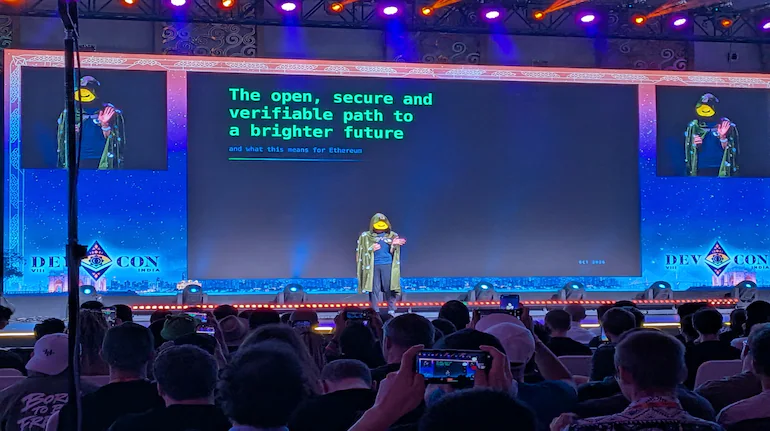
Buterin’s comments on L2 innovation follow his warning about data privacy during his keynote address at Devcon 8 in Mumbai on November 3, 2026.
He highlighted the privacy risks associated with advances in artificial intelligence and the growing collection, storage and use of personal information by large corporations.
He also raised concerns about privacy breaches and hacking incidents caused by vulnerabilities in software and hardware systems. Such weaknesses could expose sensitive user information and create new challenges for individuals and organisations.
As AI systems become more capable and data collection expands, privacy-focused blockchain technologies could become increasingly relevant. However, blockchain alone cannot eliminate every security risk, making strong data protection practices and secure system design essential.
What Buterin’s Vision Means for the Ethereum Ecosystem
Buterin’s remarks point towards a broader shift in how Ethereum’s Layer 2 ecosystem could develop. Instead of competing primarily on transaction costs and scaling capacity, L2 projects may increasingly differentiate themselves through specialised applications and technical capabilities.
High-performance financial platforms, privacy solutions and enterprise-focused systems could help expand blockchain adoption into different sectors. Such developments may also encourage greater experimentation among developers.
For Ethereum, the objective is not necessarily to make every L2 network identical to its main blockchain. A more specialised ecosystem could allow different networks to address distinct user requirements while contributing to the wider blockchain environment.
Conclusion
Vitalik Buterin has urged Layer 2 blockchain developers to move beyond copying Ethereum and focus on building genuinely differentiated products. By highlighting high-performance DeFi, privacy technologies and enterprise applications, he outlined several areas where L2 networks could create additional value.
His message is that scalability alone should not define the future of Layer 2 development. As blockchain technology evolves alongside AI and growing data privacy concerns, innovation, security and specialised use cases could play an increasingly important role in the Ethereum ecosystem.
For breaking news and live news updates, like us on Facebook or follow us on Twitter and Instagram. Read more on Latest Business on thefoxdaily.com.






COMMENTS 0