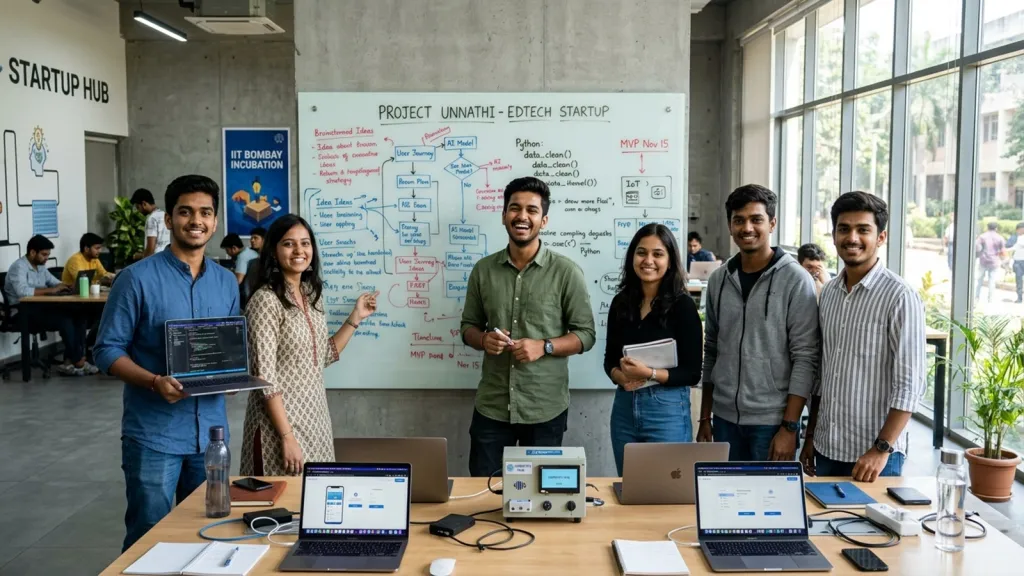
More than one in five Indian college students has already started a business, highlighting the growing role of entrepreneurship in India’s higher education landscape. According to the GUESSS India 2025 National Survey Report, released by the Indian Institute of Technology (IIT) Mandi in partnership with REVA University, Bengaluru, 22% of surveyed students had launched a business, close to the global average of 23%.
The report, titled How Do We Make Student Entrepreneurs?, found that 43% of Indian students aspired to start a business, matching the global average. Based on responses from 25,783 students across more than 1,200 higher education institutions in 34 states and Union Territories, the findings highlight strong entrepreneurial ambitions among young Indians, alongside gaps in mentorship, business networks and early-stage commercial support.
Although many students are interested in becoming entrepreneurs, turning that ambition into a functioning business remains a challenge. The report found that only 51 out of every 100 students who wanted to become entrepreneurs had actually started a venture. It also identified differences between male and female students in translating entrepreneurial intentions into action.
The findings suggest that universities, incubators and policymakers have an opportunity to strengthen entrepreneurship education by helping students find mentors, access industry connections, develop practical business skills and secure their first customers.
GUESSS India 2025: Key Findings on Student Entrepreneurship
The GUESSS India 2025 survey offers a broad picture of entrepreneurial intentions and activities among students in Indian higher education institutions. Its findings show that business creation is already a reality for a substantial proportion of students, while many others are considering entrepreneurship as a possible career path.
- Students who have started a business: 22% in India, compared with 23% globally.
- Students aspiring to become entrepreneurs: 43%, matching the global average.
- Student businesses reporting regular sales: 35.5%, compared with 33% globally.
- Students wanting to run their own business immediately after graduation: 16.2% in 2025, up from 14% in 2023.
- Students wanting a government job immediately after graduation: 10.1% in 2025, down from 12.7% in 2023.
- Students wanting a job in a large company after graduation: 27.4% in 2025, down from 31.3% in 2023.
- Female aspiring entrepreneurs who had started a venture: 45%, compared with 53% of male aspiring entrepreneurs.
- Student businesses with regular sales founded in 2025: 31%, compared with 18% globally.
These figures indicate that entrepreneurial activity is becoming an important part of students’ career aspirations. However, they also highlight the need to distinguish between wanting to start a business, launching a venture and building a business that generates consistent revenue.
43% of Indian Students Want to Become Entrepreneurs
The survey found that 43% of Indian students aspired to start a business, matching the global average recorded by GUESSS. The result suggests that Indian students are as interested in entrepreneurship as their international counterparts, at least in terms of stated intentions.
Entrepreneurship can appeal to students for several reasons, including the opportunity to develop their own products, solve problems, work independently and build organisations around ideas they believe have commercial potential. For some, starting a business may also offer an alternative to conventional employment.
However, entrepreneurial ambition does not automatically translate into business creation. Students may have promising ideas but lack the capital, experience, customer access or professional networks needed to turn them into viable ventures.
The GUESSS report therefore places emphasis on helping students move beyond expressing an interest in entrepreneurship. Its findings suggest that educational institutions should focus not only on how many students say they want to start businesses, but also on how many take concrete steps towards establishing them.
This distinction matters because entrepreneurship involves practical decisions and risks that cannot always be addressed through classroom instruction alone. Students need opportunities to test ideas, understand customer needs, develop prototypes and learn how to manage the financial and operational realities of running a business.
22% of Students Have Already Started a Business
One of the report’s central findings is that 22% of Indian students surveyed had already started a business. This figure is close to the global average of 23%, indicating that student entrepreneurship in India is not limited to theoretical interest or future career plans.
Starting a business can mean different things depending on the venture’s stage of development. Some student founders may be experimenting with an idea or developing an early product, while others may have registered a business, attracted customers or established regular sales.
The report’s findings on commercial activity provide additional insight into this distinction. Among students who had launched businesses, 35.5% reported generating regular sales, compared with 33% globally.
This indicates that a proportion of student-led ventures have progressed beyond the initial idea stage and begun selling products or services. Regular sales can be an important milestone because they provide evidence that customers are willing to pay for what a business offers.
Nevertheless, sales alone do not establish whether a business is profitable, financially sustainable or capable of growing. A venture may generate revenue while continuing to face challenges involving costs, customer retention, cash flow and competition.
The findings therefore point to two connected priorities for universities: encouraging students to take their first entrepreneurial steps and supporting those who have already started businesses as they work towards sustained commercial activity.
More Students Want to Start Businesses Immediately After Graduation
The survey found a measurable increase in the share of students who want to run their own businesses immediately after completing their studies. The proportion rose from 14% in the 2023 survey to 16.2% in 2025.
At the same time, the proportion of students who wanted a government job immediately after graduation declined from 12.7% to 10.1%. The share seeking employment in a large company also fell, from 31.3% in 2023 to 27.4% in 2025.
These changes suggest that the immediate post-graduation career preferences reported by students are shifting towards entrepreneurship, even as conventional employment remains an important option.
However, the figures should be interpreted carefully. They describe stated career intentions at the time of the surveys and do not establish how many students ultimately founded businesses, secured jobs or changed their plans after graduation.
Entrepreneurship can also follow different timelines. Some students may start a venture while studying, while others may first gain professional experience, develop industry contacts or save money before launching a business.
For higher education institutions, the increase in immediate entrepreneurial ambitions creates an opportunity to introduce practical business support earlier in students’ academic journeys. This could include startup mentoring, customer discovery exercises, prototype development and guidance on the administrative requirements of establishing a venture.
Indian Student Founders Are Launching Businesses and Trying Again
The GUESSS India 2025 report highlights a pattern of early action and repeated attempts among student entrepreneurs. Around 31% of student businesses with regular sales were founded in 2025 alone, compared with 18% globally.
The finding indicates that a considerable proportion of commercially active student ventures in the Indian sample were relatively new. It also points to the importance of understanding the conditions that help young businesses move from launch to regular sales.
The report also found that 41% of student founders had closed an earlier business and started again, compared with 33% globally. In addition, 42% of Indian student founders ran two or more businesses, compared with 25% worldwide.
These findings suggest that entrepreneurship among the surveyed Indian students often involves multiple ventures and repeated attempts rather than a single business launched once. Founders may pursue different ideas, experiment with business models or start new ventures after earlier projects close.
Closing a business does not necessarily mean that a founder has gained nothing from the experience. An unsuccessful venture may provide lessons about customers, pricing, product development, teamwork or financial management. Those lessons can inform future decisions.
At the same time, repeated business attempts can involve financial and personal costs. Students need support that helps them assess risks, understand their obligations and make informed decisions about when to continue, change direction or close a venture.
The findings strengthen the case for entrepreneurship education that addresses the full business journey, including market testing, financial planning, sales, operations and learning from setbacks.
IT, AI and Digital Businesses Attract Student Interest
Information technology, artificial intelligence and digital services emerged as the most common planned areas of activity among student founders, according to the report. The interest reflects the prominence of technology-driven opportunities in the wider business environment.
Students may be drawn to software, AI applications and digital products because these fields offer opportunities to develop solutions for specific problems and reach customers through online channels. Technology-related ideas can also be explored through prototypes and early testing before a business commits to a larger operation.
However, the report identifies a gap between the sectors students plan to enter and the businesses they currently operate. Only about one in 10 running student businesses was digital, despite the strong interest in IT, AI and digital ventures.
The difference suggests that aspirations and actual business activity do not always align. Students may express interest in digital industries without having the technical skills, teams, funding or customer access needed to launch ventures in those areas.
Some students may also start businesses in more familiar or immediately accessible sectors before pursuing technology-based ideas. The supplied findings do not establish the specific reasons for the gap, so it should not be interpreted as evidence that students are abandoning digital entrepreneurship.
Universities could help bridge this divide by connecting students with technical mentors, experienced founders and potential customers. Access to product-development support, prototype facilities and practical feedback could help students evaluate whether their ideas address genuine market needs.
Entrepreneurship programmes should also encourage students to consider the commercial side of technology. A technically sophisticated product is not automatically a successful business; founders must identify users, demonstrate value, establish a workable pricing model and determine how the venture can sustain itself.
Having an Entrepreneur in Your Network Makes a Difference
One of the report’s notable findings concerns the influence of personal networks. Students who had entrepreneurs in their circle, including relatives, friends, classmates or teachers, were three times more likely to start a venture, according to the survey.
Exposure to entrepreneurs can give students a clearer understanding of what starting a business involves. Conversations with founders may reveal practical details about finding customers, raising funds, managing expenses, recruiting team members and responding to setbacks.
Personal connections can also provide encouragement and help students identify opportunities that they might otherwise overlook. A friend who has launched a business, a teacher with industry experience or a relative who operates a company can make entrepreneurship seem more accessible.
The findings highlight the importance of entrepreneurial role models in higher education. Universities cannot assume that every student has access to a family member or personal contact who can explain how to establish a business.
Instead, institutions can create opportunities for students to meet founders through mentoring programmes, alumni networks, startup events, practical workshops and classroom discussions led by entrepreneurs.
These connections can be particularly valuable when students are moving from an initial idea to their first commercial steps. A founder who has already navigated the process may be able to identify practical obstacles and suggest ways to test an idea without taking unnecessary risks.
Half of Indian Students Do Not Know an Entrepreneur Beyond Their Parents
The survey found that half of Indian students did not know any entrepreneur beyond their parents. Globally, the corresponding proportion was approximately one in three students.
This gap points to a potential limitation in students’ access to entrepreneurial networks. Students who have never interacted with a founder outside their immediate family may have fewer opportunities to learn informally about the challenges and practical requirements of starting a business.
Entrepreneurship often depends on more than an idea. Founders may need introductions to potential customers, advice from experienced business owners, access to professional services and guidance on financing or product development.
When these connections are difficult to access, students may find it harder to determine which steps to take first or how to respond when a business encounters a problem.
Universities can help address the gap by bringing entrepreneurs into students’ everyday academic environment. Regular interaction with founders can make entrepreneurial work more visible and help students build relationships before they need specialised advice.
Alumni who have launched businesses may be especially useful in this effort because they can connect their experiences to the challenges students face during and after university. Student entrepreneurs can also share their experiences with peers, creating opportunities for practical learning within campus communities.
The report’s findings suggest that access to entrepreneurial networks should be treated as an important part of startup support rather than an optional extra.
Only 10% of Students Developing Ventures Had Made Their First Sale
The report identifies another important challenge among students who were still developing their ventures. Only 10% had made their first sale, compared with 23% globally.
The first sale is a meaningful milestone because it indicates that at least one customer has paid for a product or service. It can provide early evidence of demand and give founders feedback on pricing, product quality, delivery and customer expectations.
Students who have developed an idea but have not yet secured a paying customer may still be working through essential stages of business development. They may need to refine their product, identify a suitable market, understand customer problems or determine how to reach prospective buyers.
The gap between Indian and global figures suggests that moving from venture development to an initial commercial transaction may be a particular challenge for students in the Indian sample.
However, the supplied report findings do not identify a single cause for the difference. Access to mentors, customer networks, funding, industry partnerships and practical training are among the areas institutions may examine when designing support programmes.
The report encourages universities to prioritise tangible milestones rather than focusing exclusively on business-plan competitions. Students can learn a great deal by testing a product with potential users, building a prototype, registering a business where appropriate or securing an initial sale.
Such milestones provide evidence of progress and help founders discover whether their assumptions match real customer behaviour. They can also make entrepreneurship education more practical by connecting classroom concepts with actual business decisions.
Women Show Similar Entrepreneurial Interest but Face a Conversion Gap
The GUESSS India 2025 report found that women expressed an interest in starting businesses at nearly the same rate as men. However, the transition from entrepreneurial intention to action remained uneven.
Among women who wanted to become entrepreneurs, 45% had started a venture. The corresponding proportion among men was 53%.
The difference highlights a gap between wanting to become an entrepreneur and taking the step of launching a business. It also suggests that measuring interest alone may not provide a complete picture of how accessible entrepreneurship is to different groups of students.
The figures do not, by themselves, establish why the gap exists. The supplied findings do not identify a single explanation or quantify the contribution of factors such as access to funding, professional networks, mentorship, time constraints or other barriers.
Nevertheless, the results provide a reason for universities and incubators to examine whether their programmes are equally accessible and useful to aspiring founders of different backgrounds.
Practical support could include access to experienced mentors, opportunities to develop and test business ideas, introductions to potential customers and transparent information about available funding and incubation programmes.
Institutions should also evaluate outcomes rather than relying only on participation numbers. Tracking how many students launch businesses, make first sales and continue operating their ventures can help identify where aspiring founders encounter obstacles.
The report’s wider message is that entrepreneurial potential needs practical support if it is to translate into action. Ensuring that students can access relevant networks and resources is an important part of that process.
IIT Mandi and REVA University Call for More Practical Startup Support
The report was led by Dr Puran Singh, Associate Professor at the School of Management at IIT Mandi and Country Delegate for GUESSS India. It was authored by Dr Puran Singh and Prerak Sharma and launched on October 9, 2026.
Dr Singh said the findings showed that Indian students were highly ambitious and that those who started businesses were already building ventures that employed people.
He highlighted the role of courses, dedicated programmes and campus incubators in supporting student entrepreneurship. He also called for more direct exposure to founders and greater emphasis on helping students take their first practical steps towards launching a business.
According to Singh, universities should measure how many students move from entrepreneurial ambition to actual business creation, rather than concentrating only on the number who express an interest in startups.
Dr P Shyama Raju, Chancellor of REVA University and the national partner for GUESSS India 2025, said universities had a role beyond preparing students for employment. He argued that institutions should also help students develop the capacity to establish enterprises and create jobs.
Prof Anjan Swain, Chair of the School of Management at IIT Mandi, said student entrepreneurship was central to the school’s approach to management education. He stated that the institution wanted students to build ventures and organisations, rather than only learn to manage existing ones.
Swain also indicated that the school would use the study’s findings to shape its programmes. The comments reflect the report’s emphasis on practical entrepreneurship, direct exposure to founders and measurable progress towards business creation.
What Is the GUESSS India 2025 Report?
GUESSS stands for the Global University Entrepreneurial Spirit Students’ Survey, an international research initiative focused on student entrepreneurship. Its Indian chapter examines entrepreneurial intentions and activities among students enrolled in higher education institutions.
The GUESSS India 2025 National Survey Report, titled How Do We Make Student Entrepreneurs?, was released by IIT Mandi in partnership with REVA University, Bengaluru.
The study was based on a survey conducted between September and December 2025. It covered 25,783 students from more than 1,200 higher education institutions across 34 states and Union Territories.
The scale of the survey provides a broad view of student entrepreneurship in India. Its findings compare Indian responses with global figures and examine several aspects of entrepreneurial activity, including students’ intentions, existing businesses, commercial progress, personal networks and differences between male and female aspiring founders.
As with any survey, the findings describe the responses collected under the study’s methodology. They should be interpreted in the context of the survey’s coverage and measures rather than treated as a complete account of every student or business in the country.
What the Report Recommends for Universities and Policymakers
The report calls on universities, incubators and governments to focus more directly on converting entrepreneurial intentions into practical action. Its recommendations centre on measurable outcomes, stronger founder networks and early commercial progress.
1. Measure business creation, not just entrepreneurial interest
The report recommends tracking how many students who express an intention to start a business actually launch a venture. According to its findings, 51 out of every 100 aspiring student entrepreneurs have started a business.
Tracking this conversion rate can help institutions identify whether their programmes are helping students progress beyond the idea stage. It can also reveal whether particular groups of students need more guidance or access to resources.
2. Bring entrepreneurs into students’ everyday lives
The report encourages institutions to introduce students to alumni founders, entrepreneur-faculty members and student business owners. These interactions can help aspiring entrepreneurs learn from people who have dealt with real commercial challenges.
Founder engagement need not be limited to occasional events. Universities can integrate entrepreneurial experiences into classes, mentoring arrangements, campus activities and informal discussions.
The aim is to make practical knowledge and professional networks more accessible, particularly for students who do not already know business owners personally.
3. Prioritise the first customer over the perfect business plan
The report recommends rewarding practical milestones such as first sales, business registrations and working prototypes instead of placing excessive emphasis on business-plan competitions.
A detailed plan can help founders organise their thinking, but real-world testing can reveal whether customers are willing to use or pay for a product. Early sales and customer feedback may also expose weaknesses that are not obvious during classroom exercises.
Encouraging students to test ideas and learn from the results can make entrepreneurship education more closely aligned with the decisions founders face when building a business.
4. Strengthen mentorship, funding and industry connections
The findings also point to the value of connecting student founders with mentors, potential investors, industry professionals and prospective customers. Such relationships can help students understand market requirements and identify the resources needed to develop their ventures.
Incubators and entrepreneurship centres can play a role by providing structured guidance and helping students navigate early-stage challenges. The most useful support will depend on the venture’s needs, its stage of development and the experience of the founders.
5. Track outcomes across different student groups
The difference between women and men in the transition from entrepreneurial intention to business creation suggests that institutions should evaluate whether their support systems are working equally well for different groups.
Tracking participation alongside venture launches, first sales and business continuation can provide a more detailed picture of how students progress. Such data can help institutions adjust their programmes based on evidence rather than assumptions about why aspiring founders succeed or struggle.
Frequently Asked Questions
What does the GUESSS India 2025 report say about student entrepreneurs?
The report found that 22% of surveyed Indian college students had already started a business, compared with a global average of 23%. It also found that 43% of Indian students aspired to become entrepreneurs.
How many students participated in the GUESSS India 2025 survey?
The survey covered 25,783 students from more than 1,200 higher education institutions across 34 states and Union Territories. It was conducted between September and December 2025.
Who released the GUESSS India 2025 report?
IIT Mandi released the report in partnership with REVA University, Bengaluru. Titled How Do We Make Student Entrepreneurs?, it was authored by Dr Puran Singh and Prerak Sharma and launched on October 9, 2026.
What percentage of Indian students want to start a business?
According to the survey, 43% of Indian students aspire to start a business, matching the global average reported by GUESSS.
How many student businesses generate regular sales?
Among students who had launched businesses, 35.5% reported regular sales, compared with 33% globally.
Which sectors are popular among aspiring student entrepreneurs?
Information technology, artificial intelligence and digital services are the most common planned areas of activity among student founders. However, only about one in 10 operating student businesses was digital, according to the report.
Are women as interested in entrepreneurship as men?
The report found that women expressed an interest in starting businesses at nearly the same rate as men. However, 45% of women who wanted to become entrepreneurs had started a venture, compared with 53% of men.
What is the biggest challenge identified by the report?
A key challenge is converting entrepreneurial ambition into action. The report found that 51 out of every 100 students who wanted to start a business had launched a venture. It also identified gaps in entrepreneurial networks and early commercial progress.
What does the report recommend to universities?
The report recommends measuring the conversion of entrepreneurial intentions into business creation, connecting students with experienced founders and prioritising practical milestones such as first sales, registrations and prototypes.
Conclusion: Turning Student Entrepreneurial Ambition into Real Businesses
The GUESSS India 2025 report presents a picture of strong entrepreneurial ambition among Indian college students, with 22% already having started a business and 43% expressing an interest in becoming entrepreneurs. The findings place India close to global averages on both measures while highlighting areas where aspiring founders need additional support.
Student entrepreneurs in the survey showed signs of commercial activity and a willingness to launch new ventures after earlier attempts. At the same time, the limited access to entrepreneurial networks, the gap between planned and existing digital businesses, and the lower conversion rate among women who aspire to entrepreneurship point to challenges that universities and incubators can examine.
The report’s central message is that encouraging students to think about entrepreneurship is only the beginning. Helping them meet experienced founders, test ideas with customers, develop prototypes and make their first sales can create more opportunities for ambition to become action.
For India’s higher education institutions, the challenge is to prepare students not only for jobs but also for the possibility of creating businesses and employment. Measuring practical progress, strengthening mentorship and expanding access to entrepreneurial networks could help more students take that first step towards building sustainable ventures.
For breaking news and live news updates, like us on Facebook or follow us on Twitter and Instagram. Read more on Latest Education on thefoxdaily.com.

COMMENTS 0