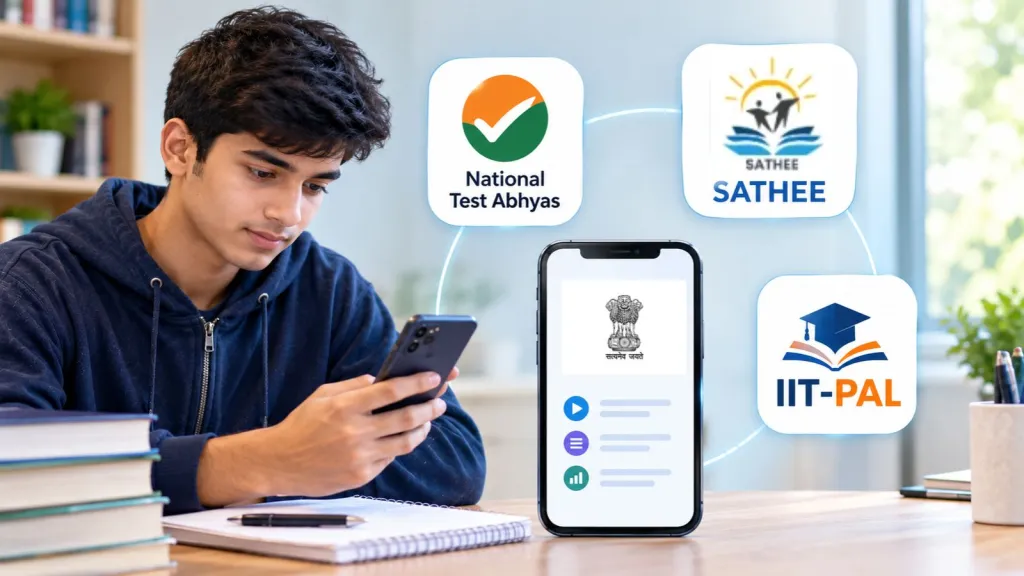
With JEE Main 2027 Session 1 approaching, engineering aspirants can strengthen their preparation using free online learning platforms, mock tests and video lectures. Resources such as National Test Abhyas, SATHEE and IIT-Professor Assisted Learning (IIT-PAL) provide ways to practise questions, revise concepts and prepare for the computer-based examination without paying for expensive coaching programmes.
The National Testing Agency (NTA) has started the application process for JEE Main 2027 Session 1. According to the supplied examination schedule, the test is tentatively scheduled for January 20, 21, 22, 23, 24 and 28, 2027, in computer-based test (CBT) mode at examination centres in India and abroad.
JEE Main is one of India’s major engineering entrance examinations, with more than a million candidates appearing in a typical examination cycle. As the examination approaches, students need a focused preparation strategy that combines concept revision, regular practice, mock tests and analysis of mistakes.
Free Online Platforms for JEE Main 2027 Preparation
Candidates preparing for JEE Main 2027 can explore the following platforms to supplement their regular studies. Each offers a different type of support, from examination-style practice to subject lectures and doubt-clearing sessions.
1. National Test Abhyas
National Test Abhyas is an initiative developed by the National Testing Agency to help candidates practise for competitive examinations, including JEE Main. The app provides mock tests through a computer-based testing interface designed to familiarise students with the digital examination format.
Practising through a CBT-style interface can help candidates become more comfortable with navigating questions, managing time and maintaining concentration during a timed test. Regular mock tests can also reveal which topics need more revision and where students are losing marks because of calculation errors or poor time management.
One useful feature described for National Test Abhyas is the ability to download mock tests and attempt them offline. This can help students who have inconsistent internet access continue practising without depending on a stable connection throughout the test.
Students can visit the official NTA website at nta.ac.in to look for access to the National Test Abhyas resources. Candidates should check the current availability and instructions for the platform before getting started.
To make the most of the app, aspirants should attempt mock tests under timed conditions and review their performance afterwards. Simply completing a large number of tests is less useful than identifying recurring mistakes and revisiting the concepts behind incorrect answers.
2. SATHEE
SATHEE stands for Self Assessment, Test and Help for Entrance Exams. The platform was launched by the Ministry of Education in association with the Indian Institute of Technology Kanpur to provide free preparation support for competitive examinations, including JEE Main and JEE Advanced.
SATHEE offers online learning resources such as video lectures, mock tests and doubt-clearing sessions. These resources can help students study from home and supplement classroom teaching or independent preparation without paying the high fees associated with some coaching programmes.
The platform is accessible through smartphones and computers, allowing students to use its resources according to their schedules. Video lectures can support concept revision, while mock tests provide opportunities to apply those concepts in examination-style questions.
SATHEE has also offered free online crash courses for JEE Main preparation. Students should check the official portal for announcements about any course available for the 2027 examination cycle, including enrolment requirements, schedules and live sessions.
Aspirants can visit sathee.iitk.ac.in to explore the platform and check the resources currently available.
For effective preparation, students can use SATHEE lectures to address weak topics, solve related questions independently and then test their understanding through practice tests. This sequence helps turn passive video watching into active learning.
3. IIT-Professor Assisted Learning (IIT-PAL)
IIT-Professor Assisted Learning, commonly known as IIT-PAL, provides educational video lectures from IIT professors and subject experts to help students understand concepts relevant to senior secondary education and competitive examinations.
The initiative is associated with the Ministry of Education and IIT Delhi. Its learning resources cover subjects including Physics, Chemistry, Mathematics and Biology, with content linked to the NCERT syllabus for Classes 11 and 12. These subjects are particularly relevant to students building the conceptual foundation needed for entrance examinations.
For JEE Main aspirants, the Physics, Chemistry and Mathematics lectures can be useful when revisiting difficult concepts or strengthening understanding of topics studied in school. Topic-wise learning resources also allow students to focus on specific areas instead of revising an entire subject at once.
The supplied information also describes opportunities for problem-solving and live interaction. Students should check the official portal to confirm which sessions and interaction facilities are currently available.
IIT-PAL lectures have also been broadcast through Swayam Prabha educational channels, including Doordarshan DTH Channel 22, according to the provided information. This can offer an additional way to access educational content beyond online streaming.
Students can visit iitpal.iitd.ac.in to explore the available lectures and learning resources.
How to Choose the Right Free JEE Preparation Platform
Students do not need to use every available resource every day. Choosing a platform according to the task at hand can make preparation more organised and prevent time from being lost switching between multiple sources.
| Platform | Main use | How students can use it |
|---|---|---|
| National Test Abhyas | Mock tests and CBT practice | Practise timed tests and identify recurring mistakes. |
| SATHEE | Video lectures, tests and doubt-clearing resources | Revise concepts, practise questions and address weak topics. |
| IIT-PAL | Subject lectures and conceptual learning | Strengthen understanding of Physics, Chemistry and Mathematics. |
A student who understands the syllabus but struggles to finish papers on time may benefit from prioritising mock tests. Someone who repeatedly gets questions wrong because of weak conceptual understanding may need to spend more time on lectures and topic-wise practice before attempting another full-length test.
The most effective approach is to use learning resources to solve a specific preparation problem. Students should also check that the content they use matches the relevant JEE Main syllabus and examination requirements.
How to Use AI Tools for JEE Main 2027 Preparation
Artificial intelligence tools can supplement JEE Main preparation by helping students organise their study schedules, review concepts and generate additional practice questions. Used carefully, these tools can offer support when a student needs help understanding a topic or planning revision outside regular classroom hours.
However, AI tools should be treated as supplementary resources rather than replacements for official study material, textbooks, teachers or verified answer keys. AI-generated explanations can contain errors, and a confident-sounding answer is not necessarily correct. Students should independently verify important formulas, calculations and solutions.
1. Create a Structured Study Plan
Students can use AI tools to draft a revision timetable based on the time remaining before the examination, the topics they have completed and the areas where they need more practice. A useful plan should include time for Physics, Chemistry and Mathematics, along with mock tests, revision and analysis of mistakes.
The plan should be realistic. Students who spend too much time following an ambitious timetable may struggle to complete it consistently. A manageable schedule that includes regular revision and rest is more practical than one that leaves no room for unexpected delays.
2. Generate Mnemonics and Revision Notes
AI tools can help create mnemonics, summaries and flashcard-style revision prompts for facts, reactions, definitions and other material that requires memorisation. Students can ask for a difficult concept to be explained in simpler language or request a step-by-step explanation of a problem.
These outputs should be checked against trusted textbooks and study materials. Mnemonics can make information easier to remember, but they cannot replace an understanding of the underlying concept or the ability to apply it to unfamiliar questions.
3. Practise Questions and Analyse Mistakes
Aspirants can ask AI tools to generate additional practice questions on a particular topic or explain why a particular solution works. They can also use the tools to organise mistakes from mock tests into categories, such as conceptual gaps, calculation errors and incorrect question selection.
Generated questions and answers should be verified before students rely on them. AI tools may produce questions that are too easy, too difficult or inconsistent with the examination syllabus. Official sample papers, previous-year questions and reliable mock tests should remain central to practice.
4. Avoid Depending Entirely on AI
AI tools can provide quick explanations, but students should not assume that every answer is accurate. A wrong formula, flawed calculation or incomplete explanation can reinforce a misunderstanding if it is accepted without checking.
Students should attempt problems independently before consulting an AI tool, compare its explanation with reliable sources and make sure they can reproduce the solution without assistance. The goal is to build problem-solving ability, not merely to obtain an answer quickly.
JEE Main 2027: Preparation Tips for the Final Months
With Session 1 scheduled for January 2027, candidates should focus on consistent practice and targeted revision. The exact preparation strategy will depend on each student’s current level, completed syllabus and performance in mock tests, but several principles apply broadly.
- Review the syllabus: Check the applicable JEE Main syllabus and identify topics that need revision.
- Practise regularly: Solve topic-wise questions before moving to full-length mock tests.
- Analyse every mock test: Review incorrect answers, unanswered questions and time-consuming problems.
- Strengthen weak areas: Use lectures and textbooks to address conceptual gaps rather than repeatedly attempting questions without understanding the mistakes.
- Revise consistently: Schedule time to revisit formulas, key concepts and previously difficult questions.
- Use reliable resources: Prioritise official information and trusted educational material over unverified claims or answer keys.
- Protect study time: Limit unnecessary switching between apps and platforms so that practice and revision remain the main focus.
Students should also keep track of official NTA announcements relating to registration, examination dates, admit cards and other requirements. The latest official notification should be used to confirm examination details.
What Is JEE Main and Why Is It Important?
JEE Main is a national-level entrance examination conducted by the National Testing Agency on behalf of the Ministry of Education. It is used for admission to undergraduate engineering programmes at institutions including National Institutes of Technology (NITs), Indian Institutes of Information Technology (IIITs), Government Funded Technical Institutions (GFTIs) and other participating colleges that accept JEE Main scores.
For candidates seeking engineering admission, preparation involves more than memorising formulas. Students need to understand concepts, apply them to unfamiliar problems, manage time and maintain accuracy under examination conditions.
Free online resources can help make preparation more accessible, particularly for students who cannot afford expensive coaching programmes. National Test Abhyas, SATHEE and IIT-PAL serve different learning needs, while carefully checked AI tools can provide additional support for planning and practice.
Conclusion
JEE Main 2027 aspirants can strengthen their preparation by combining free online learning platforms with a disciplined study routine. National Test Abhyas can support mock-test practice, SATHEE offers learning and assessment resources, and IIT-PAL provides subject lectures to help students build conceptual understanding.
AI tools may also assist with study planning, revision and additional practice, but their answers should always be checked against reliable sources. Ultimately, consistent problem-solving, regular mock-test analysis and a clear understanding of the syllabus are more valuable than using a large number of resources without a focused plan.
As Session 1 approaches, candidates should prioritise the topics they need to improve, practise under timed conditions and monitor official NTA announcements for the latest examination information.
For breaking news and live news updates, like us on Facebook or follow us on Twitter and Instagram. Read more on Latest Education on thefoxdaily.com.




COMMENTS 0