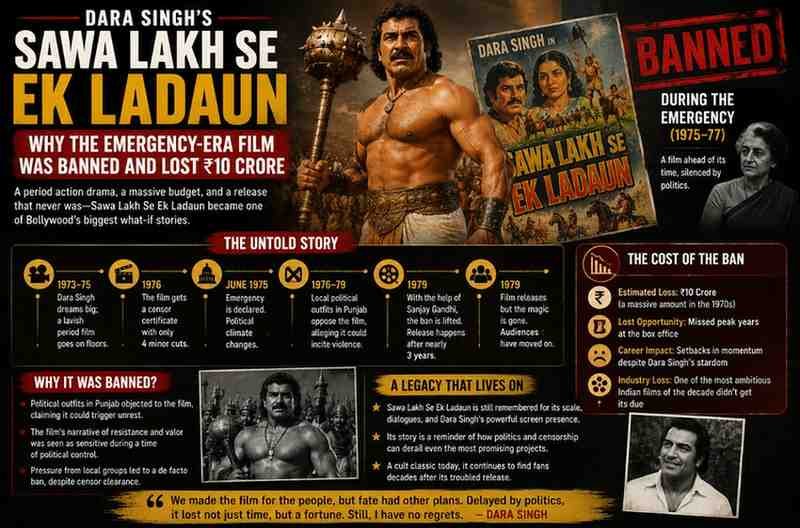
Indian cinema has witnessed its share of controversies, but few stories illustrate the complex relationship between politics and filmmaking quite like Dara Singh’s historical film Sawa Lakh Se Ek Ladaun. Produced during one of the most politically sensitive periods in India’s history the Emergency the film became embroiled in controversy despite obtaining official certification for release.
Instead of reaching audiences immediately, the film reportedly remained stalled for almost three years after protests by local political groups in Punjab. By the time it finally arrived in cinemas, changing audience preferences and the prolonged delay had significantly affected its commercial prospects, with reports suggesting losses of nearly ₹10 crore a substantial amount for its era.
The episode remains an important chapter in the history of Indian cinema, demonstrating how political developments, public sentiment and distribution challenges can shape the fate of even highly anticipated films.
What Was Sawa Lakh Se Ek Ladaun About?
Sawa Lakh Se Ek Ladaun was a historical drama inspired by Sikh history and themes of courage, sacrifice and resilience. Known for portraying physically powerful and morally upright characters throughout his career, Dara Singh was a natural choice for a film rooted in heroism and historical pride.
The project reflected his ambition to bring culturally significant stories to mainstream audiences while expanding beyond the wrestling-inspired roles that first made him a household name.
Why the Film Became Controversial
According to reports, the film received its censor certificate in 1976, indicating that it had cleared the official certification process required for theatrical release.
However, despite this approval, opposition from certain local political outfits in Punjab reportedly prevented its smooth release. The controversy emerged during the Emergency (1975–1977), a period marked by heightened political tensions, censorship concerns and restrictions affecting multiple forms of public expression.
The situation demonstrated that obtaining certification did not always guarantee an uninterrupted theatrical release.
Understanding the Emergency’s Impact on Indian Cinema
The Emergency remains one of the most debated periods in independent India’s political history. During these years, restrictions on civil liberties, media and public expression influenced several sectors, including the film industry.
Filmmakers often navigated heightened scrutiny, while politically sensitive subjects attracted additional attention. Although not every film faced censorship or disruption, the period created an environment in which creative works could become entangled with broader political developments.
The experience of Sawa Lakh Se Ek Ladaun illustrates how external circumstances sometimes affected films even after regulatory approvals had been granted.
How Delayed Releases Can Damage a Film
Timing is one of the most valuable assets in filmmaking. A delayed release can reduce audience excitement, increase financial costs and disrupt marketing strategies.
Extended postponements may also result in:
- Higher interest and production expenses.
- Loss of distribution opportunities.
- Changing audience preferences.
- Competition from newer releases.
- Reduced commercial momentum.
Even strong films can struggle financially if they miss their intended release window.
The Reported Role of Sanjay Gandhi
Accounts surrounding the film state that assistance associated with Sanjay Gandhi eventually helped clear the path for the film’s theatrical release after years of uncertainty.
The episode has since become part of the film’s historical narrative, highlighting the close intersection between politics and cinema during that period.
Regardless of the circumstances that ultimately enabled its release, the prolonged delay had already taken a heavy financial toll.
| Key Milestone | Significance |
|---|---|
| Film Completed | Historical project starring Dara Singh |
| Censor Certification | Official approval for theatrical release |
| Political Opposition | Release reportedly stalled for nearly three years |
| Theatrical Release | Arrived after prolonged delay |
| Commercial Outcome | Reported financial losses of around ₹10 crore |
Dara Singh: More Than a Wrestling Icon
Although celebrated worldwide as a legendary wrestler, Dara Singh also built an influential career in Indian cinema. His screen image was closely associated with strength, integrity and cultural pride, making him a popular leading man across multiple languages.
He frequently portrayed characters inspired by mythology, history and traditional values, earning admiration from audiences across generations.
Sawa Lakh Se Ek Ladaun reflected his desire to tell stories deeply connected to India’s historical and cultural heritage.
When Politics and Cinema Intersect
Films often become part of larger public conversations because they engage with identity, history, religion and social issues. While this ability makes cinema culturally significant, it can also expose filmmakers to political controversy.
Throughout India’s cinematic history, numerous films have encountered debates surrounding historical interpretation, artistic freedom and public sentiment.
The experience of Sawa Lakh Se Ek Ladaun demonstrates how these dynamics are not unique to the modern era.
Why Certification Does Not Always End Controversy
Receiving certification from the appropriate authority indicates that a film has met regulatory requirements for public exhibition. However, certification alone cannot always prevent protests, legal disputes or demands for further review.
Public opinion, regional sensitivities and political developments may continue influencing a film’s release even after formal approval.
This distinction remains relevant in discussions about cinema today.
The Financial Cost of Delayed Distribution
The reported ₹10 crore loss associated with the film illustrates how commercial success depends on far more than production quality.
Successful theatrical releases require careful coordination among distributors, exhibitors, marketers and audiences. When that process is interrupted for extended periods, recovering investment becomes increasingly difficult.
For producers, delays can prove just as damaging as poor box-office performance.
| Immediate Release | Delayed Release |
|---|---|
| Maintains audience excitement | Interest may decline |
| Marketing remains effective | Promotional campaigns lose momentum |
| Competitive advantage | Faces changing market conditions |
| Predictable distribution | Higher financial uncertainty |
| Better revenue potential | Greater commercial risk |
Why the Story Still Resonates Today
The journey of Sawa Lakh Se Ek Ladaun continues to interest film historians because it represents more than a delayed release. It reflects the challenges filmmakers can face when creative work intersects with political developments, public debate and historical circumstances.
It also serves as a reminder that some films are remembered not only for what appears on screen but also for the extraordinary paths they take before reaching audiences.
Conclusion
The story of Dara Singh’s Sawa Lakh Se Ek Ladaun remains one of the most remarkable episodes in Indian cinema’s history. Although the film reportedly secured its censor certificate in 1976, political opposition during the Emergency delayed its release for nearly three years. By the time it finally reached theatres, the prolonged uncertainty had reportedly resulted in financial losses of around ₹10 crore.
Beyond its commercial outcome, the film’s journey highlights the complex relationship between cinema, politics and public discourse. It demonstrates that a movie’s success depends not only on its creative vision but also on the historical moment in which it seeks to find its audience.
Decades later, Sawa Lakh Se Ek Ladaun remains an enduring reminder that some of Indian cinema’s most compelling stories unfold long before the opening scene appears on screen.
For breaking news and live news updates, like us on Facebook or follow us on Twitter and Instagram. Read more on Latest Entertainment on thefoxdaily.com.

COMMENTS 0