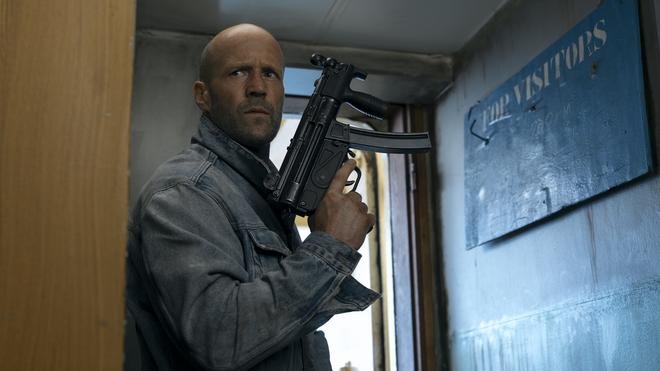
‘Mutiny’ arrives with the most reliable ingredient in contemporary action cinema: Jason Statham. The actor has spent decades perfecting the role of the laconic professional who can absorb impossible punishment, dismantle heavily armed opponents and communicate entire paragraphs with a raised eyebrow.
Unfortunately, even Statham’s familiar physical charisma cannot rescue a thriller that seems unsure what kind of film it wants to be. Directed by Jean-François Richet, Mutiny reportedly began life as a sequel to the 2023 Gerard Butler action film Plane. The proposed follow-up was apparently titled Ship, suggesting a franchise built around increasingly improbable modes of transport. When Butler opted not to return, the project was reworked into the story that has become Mutiny.
The result feels less like a carefully developed standalone action thriller and more like a screenplay that has been repeatedly dismantled and reconstructed. There are ingredients for an entertaining Statham vehicle here — secret identities, international criminals, betrayals, guns, conspiracies and a protagonist with a very particular set of survival skills — but the film rarely combines them into anything genuinely gripping.
‘Mutiny’ is not short on movement, but it is surprisingly short on momentum.
A Statham Hero We Have Seen Before
Statham plays Cole Reed, a former Marine and former Metropolitan Police officer with a troubled past. He now works as the bodyguard of Thai shipping magnate Tibu Campalo, played by Ramon Tikaram.
Reed’s backstory is designed to establish him as the kind of man who can walk into a crisis and remain standing after everyone else has been knocked down.
Five years earlier, he saved Campalo’s life. That act apparently created the professional relationship that forms the foundation of the film’s story.
On paper, this is exactly the sort of character Statham has played successfully many times before. The actor’s physicality is ideally suited to characters whose personalities are communicated through action rather than lengthy speeches.
The difficulty is that a familiar character archetype needs a strong surrounding story to remain interesting.
Mutiny does not provide one.
When a Simple Action Formula Becomes Complicated
The best Statham films often understand a basic principle: keep the story simple enough for the audience to focus on the action.
That does not mean an action movie needs to be intellectually simple. It means its motivations should be clear.
Who is the protagonist protecting? Who is hunting him? What does he need to accomplish? What happens if he fails?
Mutiny repeatedly complicates those questions without generating enough intrigue to justify the complications.
The screenplay introduces conspiracy elements and layers of betrayal, but instead of creating suspense, they frequently make the narrative feel unnecessarily tangled.
The audience is asked to follow twists before becoming sufficiently invested in the characters affected by them.
The ‘Plane’ Connection Explains More Than It Excuses
The film’s origins as a proposed sequel to Plane are revealing.
Plane worked because its premise was immediately understandable. A pilot crashes in a dangerous location and must protect his passengers. The situation creates a straightforward survival objective that can generate escalating action.
Mutiny appears to have inherited some of the DNA of that concept without retaining its simplicity.
The proposed Plane sequel reportedly evolved from an aircraft-based story into Ship, and eventually into a different project after Gerard Butler departed. That unusual development history may help explain why Mutiny sometimes feels structurally unsettled.
It has the machinery of a franchise action movie but not the confidence of a story that was built from the ground up around its protagonist.
Jason Statham Cannot Fight the Screenplay
Statham’s biggest advantage is also the reason the film’s weaknesses become so obvious.
Audiences know what they expect from him. They expect physical commitment, dry humour, efficient violence and the sense that his character is always two steps ahead of the people trying to kill him.
When the screenplay gives him an obstacle, Statham can make it entertaining.
But there is no amount of controlled glare or expertly executed punch that can repair a weak motivation.
Statham can fight villains. He can survive car crashes. He can handle armed men in confined spaces. What he cannot do is manufacture emotional stakes that the screenplay has failed to establish.
That is the central problem with Mutiny: the actor is doing the work of an action hero, but the script does not consistently give the audience a reason to care about the man behind the fists.
The Action Lacks Imagination
Action cinema has changed dramatically over the past decade.
Audiences have become accustomed to increasingly inventive choreography, elaborate practical stunts and carefully designed sequences in which geography matters. Movies influenced by the John Wick model have demonstrated that action can be both spectacular and visually precise.
Against that background, Mutiny‘s action feels surprisingly conventional.
There are fights, pursuits and confrontations, but too few sequences have the kind of distinctive identity that makes an action scene memorable after the credits roll.
A good action sequence should tell us something about the character. It should exploit a particular environment, reveal a new tactical problem or force the hero to improvise.
Too often, Mutiny treats action as an obligation rather than an opportunity.
The Biggest Problem Is the Pace
For a movie built around Jason Statham, ‘Mutiny’ is strangely slow.
There is nothing inherently wrong with a deliberate pace. Some of the best thrillers take their time because atmosphere, character development and suspense require patience.
But slow pacing only works when tension is accumulating.
Here, stretches of the film feel as though they are waiting for the next plot development rather than building toward it. The result is a strange contradiction: the movie is ostensibly an action thriller, yet it can feel inert.
The problem is not simply that there are too few explosions. It is that the story does not create enough anticipation between major set pieces.
A Thriller Needs More Than a Conspiracy
Conspiracy plots are attractive because they promise hidden information.
The audience knows that something is being concealed and keeps watching to discover the truth.
But suspense depends on more than withholding information. The audience must care about the consequences of discovering it.
In Mutiny, the conspiracy machinery often feels more important than the people caught inside it.
That makes the twists less satisfying than they should be. A revelation can only land if it changes our understanding of a character, a relationship or the stakes.
When a twist merely provides another piece of information, it becomes narrative paperwork.
The Supporting Characters Struggle to Leave an Impression
Ramon Tikaram’s Tibu Campalo provides the central connection to Reed, but the supporting cast is not given enough material to create a strong emotional counterweight to Statham’s deliberately restrained performance.
This matters because Statham’s action heroes often work best when surrounded by characters who challenge them, humanise them or provide a contrasting personality.
Without that contrast, the protagonist risks becoming a machine who moves from one threat to another.
Mutiny rarely gives its supporting characters enough depth to change that equation.
Why the Premise Could Have Worked
There is actually a strong action movie hidden somewhere inside this concept.
A former Marine and police officer working as a powerful businessman’s bodyguard is already a useful starting point. Add a violent conspiracy, an international setting and a betrayal that forces the protagonist to question everyone around him, and the basic ingredients are there.
The film could have leaned into Reed’s professional background and made his investigative abilities as important as his combat skills.
It could have built tension around the difference between protecting a powerful client and discovering whether that client is trustworthy.
It could even have explored the psychological consequences of a man whose entire career has revolved around identifying threats and surviving them.
Instead, the screenplay often chooses the easiest route from one plot point to another.
Statham’s Screen Persona Has Become a Genre of Its Own
There is an interesting phenomenon at work in Statham’s recent action films: the actor himself has become a genre shorthand.
Put Statham in a poster, give him a weapon or a suit, and audiences immediately understand the promise.
He is the professional. He is competent. He is dangerous. He is probably going to win.
That formula can be extremely effective when the surrounding filmmaking is energetic.
But it can also become limiting.
Because viewers already know what Statham can do, filmmakers need to provide something unexpected around him. Otherwise, familiarity turns into predictability.
Mutiny does not sufficiently reinvent the formula.
What Works in ‘Mutiny’
- Jason Statham: His physical presence remains naturally suited to the action genre.
- Premise: The combination of a former Marine, bodyguard duties and an international conspiracy offers the foundations for a compelling thriller.
- Professional scale: The film has the appearance of a major studio action production.
- Genre familiarity: Viewers who enjoy straightforward Statham thrillers will recognise the formula immediately.
Where ‘Mutiny’ Goes Wrong
- Weak plotting: The story becomes more complicated without becoming more interesting.
- Slow pacing: The thriller takes too long to generate genuine urgency.
- Generic action: Several sequences lack a memorable visual or tactical identity.
- Thin characterisation: Reed’s personal stakes are not developed strongly enough.
- Unconvincing twists: Plot revelations do not consistently create the intended dramatic impact.
‘Mutiny’ Compared With the Better Statham Thrillers
| Element | What a Strong Statham Thriller Needs | What ‘Mutiny’ Delivers |
|---|---|---|
| Hero | A familiar archetype with a compelling personal motivation | A familiar Statham persona with limited emotional depth |
| Plot | Simple objectives with escalating complications | A convoluted storyline that often obscures its core stakes |
| Action | Distinctive choreography and creative environments | Functional but largely conventional action |
| Pacing | Continuous escalation and tension | Long stretches of sluggish storytelling |
| Supporting cast | Characters who deepen or challenge the protagonist | Supporting roles that struggle to make a lasting impression |
| Payoff | A satisfying combination of character and spectacle | Spectacle that rarely compensates for the weak narrative foundation |
The Bigger Lesson for Action Cinema
Mutiny illustrates an increasingly important problem for star-driven action movies.
Having a recognisable actor is no longer enough. Streaming has given audiences access to action cinema from around the world, while franchises have pushed stunt choreography and visual effects to extraordinary levels.
That means the basic promise of “Jason Statham fights bad guys” has become less distinctive than it once was.
The genre now needs specificity.
The best modern action films give their heroes unusual environments, emotional complications, distinctive enemies or innovative choreography. They make the action inseparable from the story.
Mutiny often treats those elements as separate components.
Final Verdict
‘Mutiny’ is a Jason Statham action thriller that never manages to become as exciting as its leading man.
The film’s convoluted origins as a proposed Plane sequel may explain some of its structural awkwardness, but they do not excuse the finished product. The plot is unnecessarily tangled, the pacing is painfully sluggish and the action lacks the imagination expected from a modern theatrical thriller.
Statham remains watchable because Statham is almost always watchable. His physical confidence and understated screen persona are still perfectly suited to the genre.
But a star can only elevate a film so far.
Mutiny needed a sharper script, stronger character stakes and action sequences worthy of its leading man’s reputation. Instead, it leaves Statham fighting not just villains, but the movie itself.
For breaking news and live news updates, like us on Facebook or follow us on Twitter and Instagram. Read more on Latest Entertainment on thefoxdaily.com.

COMMENTS 0