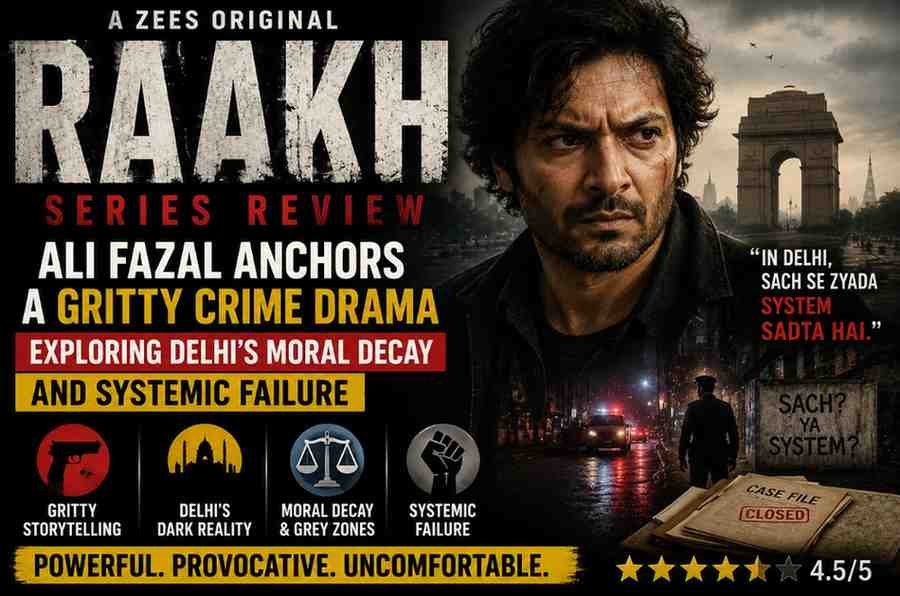
With ‘Raakh’, the creators deliver a layered investigative crime series that leans heavily on mood, character depth, and procedural realism. Led by Ali Fazal in a controlled yet compelling performance, the series stands out as a slow-burning exploration of guilt, justice, and the psychological cost of violence.
Rather than relying on high-octane twists or sensational storytelling, ‘Raakh’ builds its tension gradually, allowing the investigation to unfold like peeling layers of ash—revealing hidden truths buried under social and institutional neglect.
A Crime Drama Rooted in Atmosphere and Absence
At its core, ‘Raakh’ is less about solving a crime quickly and more about understanding what the crime reveals about society.
The series paints Delhi not just as a backdrop, but as a living, breathing organism shaped by inequality, ambition, and moral compromise. Every alley, police station, and courtroom feels charged with unspoken tension.
The narrative structure deliberately avoids clean resolutions, instead favoring ambiguity that reflects the complexity of real-world justice systems.
Ali Fazal: Controlled Intensity Over Performative Drama
Ali Fazal delivers a restrained performance that anchors the series. Instead of overt emotional displays, he opts for internalized tension—portraying a character shaped by fatigue, moral uncertainty, and professional pressure.
This subtle approach allows the character to function as both investigator and emotional witness to the unfolding decay around him.
His performance ensures that even when the plot slows down, the emotional stakes remain consistently high.
Delhi as a Character: The City of Forgotten Innocence
One of the most striking aspects of ‘Raakh’ is its portrayal of Delhi—not as a glamorous metropolitan hub, but as a city grappling with its contradictions.
The series highlights:
- Socio-economic divides that influence justice outcomes.
- Institutional fatigue within law enforcement systems.
- Everyday violence normalized by urban anonymity.
- Lost idealism among young professionals and officers.
In doing so, Delhi becomes symbolic of broader urban decay and moral exhaustion.
Comparison: Conventional Crime Thrillers vs ‘Raakh’
| Conventional Crime Thrillers | ‘Raakh’ Approach |
|---|---|
| Fast-paced investigations | Slow-burning procedural unfolding |
| Clear hero vs villain structure | Moral ambiguity across characters |
| High action dependency | Psychological tension-driven storytelling |
| Resolution-focused narrative | Reflection-focused narrative |
| Crime as spectacle | Crime as social commentary |
Investigative Depth Over Sensationalism
‘Raakh’ distinguishes itself by resisting the temptation of over-dramatization. Instead, it focuses on procedural authenticity—police work, interrogation dynamics, and bureaucratic limitations are depicted with a grounded tone.
The investigation unfolds through interviews, fragmented evidence, and conflicting testimonies, mirroring the often imperfect nature of real-life criminal cases.
This commitment to realism enhances the show’s credibility and emotional impact.
An Insight Competitors Often Miss: Crime Stories as Social Autopsies
Beyond its narrative surface, ‘Raakh’ functions as a social autopsy examining not just how crimes occur, but why societies produce them.
The series subtly connects individual acts of violence to larger systemic conditions such as inequality, neglect, and psychological alienation.
This elevates the show from a standard investigative thriller to a commentary on modern urban life and its hidden fractures.
Ensemble Cast: Strength in Collective Performance
While Ali Fazal leads the narrative, the ensemble cast plays a crucial role in shaping the world of ‘Raakh’.
Each supporting character contributes to the layered storytelling, representing different facets of law enforcement, media influence, and civilian response.
This ensemble approach ensures that no single perspective dominates the narrative, reinforcing the idea that truth is fragmented and subjective.
Tone and Cinematic Language
The series adopts a muted visual palette that reflects its thematic concerns. Shadows, narrow frames, and subdued lighting are used to reinforce the feeling of moral uncertainty.
Silences are used as effectively as dialogue, allowing tension to build naturally without excessive exposition.
This restrained cinematic language supports the series’ slow-burn storytelling approach.
The Psychology of Crime and Punishment
At a deeper level, ‘Raakh’ explores how crime affects not just victims and perpetrators, but also those tasked with investigating it.
Characters are often shown grappling with emotional fatigue, ethical dilemmas, and the psychological burden of repeated exposure to violence.
This focus on mental strain adds emotional depth to the procedural format.
Prediction: Rise of Introspective Crime Dramas in Streaming Era
The success of shows like ‘Raakh’ suggests a growing appetite for crime dramas that prioritize psychological and social depth over spectacle.
Future trends in the genre may include:
- More morally ambiguous protagonists.
- Focus on systemic rather than individual crime narratives.
- Slower, character-driven storytelling structures.
- Greater emphasis on realism and procedural authenticity.
This shift reflects evolving audience preferences for layered, thoughtful storytelling.
Conclusion
‘Raakh’ stands as a compelling addition to the evolving landscape of Indian crime dramas. Anchored by Ali Fazal’s measured performance and supported by a strong ensemble, the series moves beyond the boundaries of conventional thrillers to explore deeper questions of morality, justice, and urban decay.
Its strength lies not in solving crime quickly, but in understanding what crime reveals about society itself.
Ultimately, ‘Raakh’ is less about catching the guilty—and more about confronting the ashes left behind in the process.
For breaking news and live news updates, like us on Facebook or follow us on Twitter and Instagram. Read more on Latest Entertainment on thefoxdaily.com.



COMMENTS 0