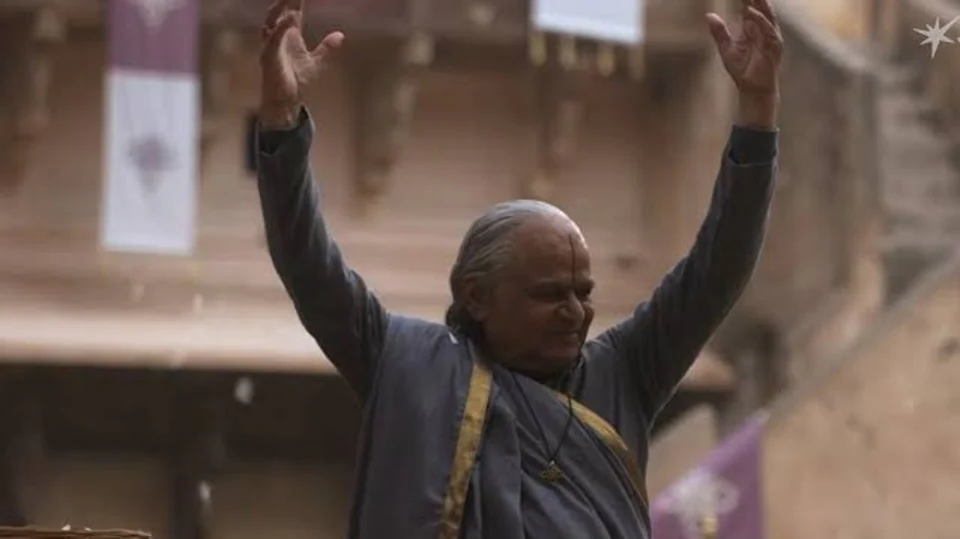
Raghubir Yadav Reveals Heart Attack Before Hunkkaar: The Roar Courtroom Scene
Raghubir Yadav Reveals He Suffered a Heart Attack the Night Before Filming Hunkkaar: The Roar’s Intense Courtroom Scene
The veteran actor opened up about the emotionally demanding courtroom sequence with director Karan Kapadia, explaining how personal emotions, Baapji’s confession and Meenu Rawat’s testimony shaped one of the drama’s most powerful moments.
Veteran actor Raghubir Yadav has revealed that he suffered a heart attack the night before filming a pivotal courtroom scene in Hunkkaar: The Roar. In a conversation with director Karan Kapadia, the actor reflected on the challenging sequence, which centres on a shocking confession by his character, Sunil Chakosi, popularly known as Baapji. Their discussion offered a closer look at the emotional preparation, performance choices and filmmaking techniques that brought the courtroom drama to life.
The sequence is among the most emotionally charged moments in the six-episode Hindi courtroom drama. It brings together Baapji’s response to his actions and the painful testimony of Meenu Rawat, a 17-year-old girl fighting for justice. Rather than relying on dramatic gestures or exaggerated performances, the scene allows the characters’ words, expressions and silences to communicate the weight of the proceedings.
During the scene breakdown, Yadav explained that he did not consciously manufacture the voice or emotional intensity required for Baapji’s confession. Instead, he allowed the character’s circumstances and grief to shape his performance. Kapadia, meanwhile, discussed how the camera was used to capture not only the confession itself but also its impact on everyone present in the courtroom.
Raghubir Yadav Recalls Suffering a Heart Attack Before the Shoot
Kapadia recalled that Yadav had suffered a heart attack on the night before they were scheduled to film Baapji’s courtroom testimony. The revelation added another layer to the discussion about the physical and emotional circumstances surrounding the scene.
Yadav spoke about the incident with a touch of humour while reflecting on the emotions that emerged during the performance. As Baapji confesses to his crime, the character expresses a disturbing sense of satisfaction. Recalling the emotional state associated with the moment, the actor said, “And during that heart attack, I was actually feeling a strange sense of satisfaction.”
The remark came during a discussion about the character’s confession and the complicated emotions driving it. Baapji is not simply a man responding to an accusation; he is a powerful spiritual leader confronting the consequences of his actions in a courtroom where his authority and public image are being challenged.
When Kapadia asked how he had found the right voice for the scene, Yadav explained that he had not deliberately created a particular vocal quality or emotional effect. He said the performance emerged naturally from within, guided by the character’s circumstances rather than by a conscious attempt to sound a certain way.
“I didn’t create it at all. It came out from within on its own. There was no need to create it,” Yadav said.
The conversation then turned to the grief underlying Baapji’s emotional state. Asked whether the character’s pain had influenced his delivery, Yadav connected the performance to a particularly painful development in the story: the death of his character’s son.
“Yes, because I had just come back after cremating my son’s body,” the actor explained.
This detail helps establish the emotional context of the confession. Baapji’s response is shaped by more than the immediate pressure of the courtroom. His grief complicates the scene, creating a moment in which personal loss, guilt and the consequences of his actions intersect.
Was Baapji’s Confession Genuine or a Calculated Move?
One of the central questions in Kapadia and Yadav’s discussion was whether Baapji’s confession reflected genuine remorse or was another attempt to manipulate the people around him. Given the character’s influence as a spiritual leader, the distinction is important to understanding the scene and the larger conflict in Hunkkaar: The Roar.
Kapadia asked Yadav whether he had considered the possibility that Baapji was using the moment strategically rather than expressing authentic pain.
“At that moment, did you not feel that this was a calculated move on his part? Did you genuinely feel that you were in pain because of what he had done?” the director asked.
Yadav explained that he would have recognised deliberate manipulation in the character’s words if that had been his interpretation of the scene.
“If it had been a calculated move, I would have been able to tell from his words that he was trying to manipulate the situation,” he said.
The exchange highlights the ambiguity that can make a courtroom drama compelling. A confession may appear to reveal the truth, but the motivations behind it can remain difficult to establish. In Baapji’s case, the audience must consider the relationship between his public identity, his personal circumstances and the allegations against him.
Yadav’s approach also reflects his emphasis on responding to the character’s emotional reality rather than imposing a predetermined interpretation. By allowing the scene to unfold through the character’s words and feelings, the performance leaves room for viewers to assess whether Baapji’s response is an expression of remorse, grief or something more complicated.
Karan Kapadia Explains How He Filmed the Courtroom Scene
For Kapadia, the challenge was to show how Meenu Rawat’s testimony affected everyone in the courtroom, with particular attention to Baapji’s reaction. The director explained that the camera movement was designed to begin with the character’s individual emotions before gradually revealing the wider impact of the testimony.
“I always went in close to him for his emotion. I let him finish his emotion and then started pulling out further and wider, so that that emotion was extending on to everybody who is in the courtroom, from the lawyers to the police officer to the judge,” Kapadia said.
The gradual widening of the frame serves an important storytelling purpose. A close-up allows viewers to focus on a character’s expression and emotional response, while a wider shot places that response within the larger courtroom. The shift helps connect an individual’s reaction to the collective atmosphere surrounding the testimony.
Kapadia revealed that he divided the sequence into two parts. The first follows Meenu as she delivers her testimony for the eleventh time, beginning with the words, “My name is Meenu Rawat.” Although Baapji’s reaction was central to the scene, the director wanted to capture the details of his behaviour and the responses of those around him.
“I wanted to capture everything about the father,” he said.
For Kapadia, the scene required him to use every element of the filmmaking process to communicate the emotional weight of the moment. He described how the camera could move towards Meenu, draw attention to the people listening and gradually allow the atmosphere to change as the testimony progressed.
“Use the camera, use every trick in the craft. What can be done?” the director said while explaining his approach.
He added that the camera was used to bring viewers closer to Meenu and the emotions of the characters surrounding her. At the beginning, the scene focuses on the process of testimony, but its rhythm changes as the words begin to resonate with those listening.
“When she gives her testimony, it is more about the process, but then everything stops. The silence takes over,” Kapadia explained.
The contrast between movement and stillness is crucial to the scene’s impact. As the testimony unfolds, the camera does not need to continually signal the importance of what is happening. Instead, the characters’ expressions and the silence around them become central to the storytelling.
Why Meenu Rawat’s Testimony Was Filmed Without Camera Movement
Meenu’s testimony is one of the most difficult parts of the courtroom sequence. As she recounts what happened to her when she was 17, the scene shifts away from the reactions of other characters and focuses directly on her face and words.
“I was 17 years old. This should not have happened to me when I was 17. But it happened to me,” Meenu says in the scene.
Kapadia explained that he deliberately avoided unnecessary camera movement during this part of the testimony. Rather than using elaborate visual techniques to intensify the moment, he wanted the audience to remain focused on Meenu as she spoke about her experience.
“I was very mindful that I just wanted to shoot it classically, without any movement, right up in her face, and feel that emotion,” he said.
The decision to keep the camera still gives the testimony room to breathe. It also places the responsibility for conveying the scene’s intensity on the performance itself. Meenu’s words are not interrupted by frequent cuts or visual distractions, allowing viewers to remain with her account and the emotional consequences it carries.
The sequence also draws attention to the burden of repeatedly recounting a traumatic experience during a legal process. Meenu’s testimony is not presented as an isolated statement; the fact that she is delivering it for the eleventh time underlines the persistence required to continue seeking justice.
By combining a restrained visual approach with a deeply personal account, the scene places Meenu’s experience at the centre of the narrative. The courtroom becomes more than a setting for legal proceedings: it becomes a space where the consequences of abuse, the pursuit of accountability and the emotional cost of seeking justice are brought into focus.
The Courtroom Scene Left Raghubir Yadav and Karan Kapadia Shaken
The emotional intensity of the courtroom sequence extended beyond the characters to the people making the series. Both Yadav and Kapadia admitted that the scene remained difficult to experience, even after repeated exposure during filming and editing.
Reflecting on the demands of performing the sequence, Yadav said, “At the very least, I have died 50 times while doing this, honestly.”
The statement conveyed the emotional exhaustion associated with repeatedly engaging with such a painful moment. The actor’s description also reflected how deeply the character’s confession and Meenu’s testimony affected him while he worked through the scene.
Kapadia revealed that watching the sequence during the editing process had not made it any easier to sit through. Despite viewing it between 100 and 200 times, he said its emotional effect remained unchanged.
“Sir, I have watched it at least 100 to 200 times during the editing process and throughout my life. Every time, it gets to me. Every single time,” the director said.
He described the confession and testimony as particularly painful elements of the sequence, explaining that the moment continued to overwhelm him whenever he returned to it.
“It feels like a man like that should simply die. I am telling you, I have died so many times while watching this entire scene,” Kapadia said.
The director further described the helplessness he felt while watching Meenu recount her experience. Her words, he suggested, create a moment in which the emotional weight of what has happened becomes almost impossible to bear.
“Yes, and the kind of words she says… At that very moment, you feel as though the earth should split open so you can disappear into it and die. What else can you do?” he said.
Kapadia added that the experience was not limited to him as a filmmaker. He felt connected to the character’s emotional journey while watching the scene unfold, making the process of revisiting it especially difficult.
“And it is not as though I was living through it alone. That character was living through it too, and I was living through it alongside him,” he explained.
The comments offer insight into the emotional demands of creating a sequence that deals with abuse, grief and the pursuit of justice. They also underline the importance of performance and restraint in a scene where the subject matter carries much of the dramatic weight.
Hunkkaar: The Roar Explores Faith, Power and the Fight for Justice
Hunkkaar: The Roar is a six-episode Hindi courtroom drama and socio-thriller centred on 17-year-old Meenu Rawat, played by Aneet Padda. The story follows Meenu as she accuses a powerful spiritual leader, Sunil Chakosi, popularly known as Baapji, of sexual assault and attempts to secure justice in the face of his influence.
The series examines the challenges faced by a young complainant confronting a figure whose authority extends beyond the courtroom. Baapji’s standing among his followers adds another dimension to the conflict, placing questions of faith, power and public perception alongside the pursuit of legal accountability.
Meenu’s testimony forms a crucial part of this narrative. Her determination to speak about what happened to her brings the personal consequences of the case into focus, while the courtroom setting exposes the competing pressures surrounding the search for truth.
Raghubir Yadav plays Baapji, while the cast also includes Fatima Sana Shaikh as ACP Jasleen Singh Soin, Mohammed Zeeshan Ayyub, Arjun Mathur, Ram Kapoor, Zoya Hussain and Rajesh Sharma.
The series was created by Karan D. Kapadia and Nitya Mehra. Kapadia, Mehra and Heeraz Marfatia directed the show, with Priyanka Chopra Jonas serving as executive producer. Hunkkaar: The Roar premiered on JioHotstar on September 25, 2026.
Why the Courtroom Sequence Stands Out
The discussion between Yadav and Kapadia reveals how the scene’s impact comes from the combination of emotionally grounded performances and deliberate filmmaking choices. Yadav’s emphasis on allowing the character’s feelings to emerge naturally contrasts with Kapadia’s carefully controlled use of framing, camera movement and silence.
Baapji’s confession is complicated by questions about guilt, grief and possible manipulation. Meenu’s testimony, meanwhile, remains firmly focused on the experience she is trying to communicate and the effort required to seek justice. Bringing these perspectives together gives the courtroom sequence its tension.
For Kapadia, the aim was not simply to record the dialogue but to show how the testimony changes the atmosphere of the room. The camera moves closer when individual emotions need to be felt, widens to capture the reactions of others and becomes still when Meenu’s words must speak for themselves.
Yadav’s account of the night before filming adds a striking personal detail to the story behind the performance. His comments also reinforce the distinction between consciously constructing an emotion and responding to a character’s circumstances in the moment. Together, the actor and director’s reflections provide a glimpse into the creative decisions behind one of Hunkkaar: The Roar‘s most emotionally demanding scenes.
Clarify the heart attack context Reduce repetitive courtroom analysis Add a sensitive content warning
For breaking news and live news updates, like us on Facebook or follow us on Twitter and Instagram. Read more on Latest Entertainment on thefoxdaily.com.


COMMENTS 0