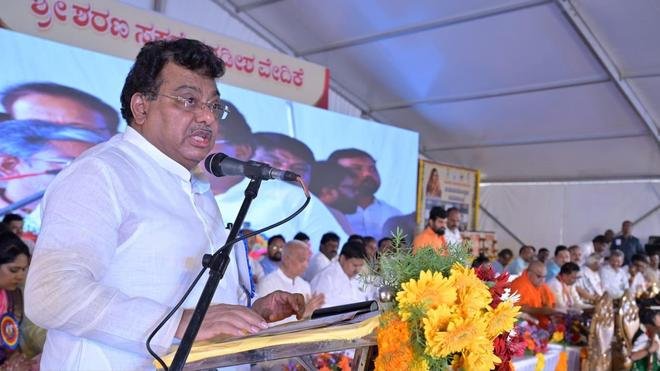
Union government following anti-farmer policies is the charge levelled by Karnataka Minister M. B. Patil as he highlighted the financial difficulties facing farmers amid severe drought conditions in the state. Patil said farmers have been forced to sow crops multiple times, losing money on seeds and other inputs when earlier attempts failed.
His remarks place the spotlight on a problem that extends beyond the politics of agricultural policy: when rainfall fails or crops are damaged, farmers can face losses before a crop even reaches the market. The cost of repeated sowing, land preparation, fertilisers, labour and other inputs can quickly turn a difficult agricultural season into a serious financial crisis.
Patil also pointed to the role of cooperative societies in supporting farmers during such circumstances. His comments underline the importance of accessible institutional credit and local agricultural support when farm households need to recover from crop failures.
What did M. B. Patil say about the farmers’ crisis?
M. B. Patil said farmers are facing a serious crisis and described the state’s drought situation as severe. According to his remarks, some farmers have had to sow their fields two or three times, effectively bearing the cost of agricultural inputs repeatedly.
“Farmers have sown two or three times, but lost money and inputs,” Patil said, adding that cooperative societies are supporting farmers in the difficult situation.
His statement connects three issues that are often discussed separately: drought, rising cultivation risk and access to institutional support.
When a crop fails after sowing, the farmer does not simply lose the expected harvest. The money already spent on seeds, fertilisers, pesticides, labour, machinery and land preparation may also be lost. A second or third sowing can therefore increase financial exposure at precisely the time when the household has fewer resources available.
Why repeated sowing can deepen a farm crisis
A failed crop creates a different economic problem from an ordinary poor harvest.
In a poor harvest, the farmer may still recover part of the investment through the produce that reaches the market. Repeated sowing following crop failure can mean that the same land generates additional costs before it generates meaningful income.
Consider a simplified agricultural cycle. A farmer prepares the field, purchases seed and inputs, pays for labour and sows the crop. If inadequate rainfall prevents germination or damages the crop, those expenses have already been incurred. Sowing again requires another round of expenditure.
By the third attempt, the farmer may be operating with borrowed money or reduced household savings.
This is why drought should not be understood solely as a water problem. It is also a financial-risk problem for farming households.
Drought changes the economics of farming
Agriculture is inherently exposed to weather risk, but drought can affect several stages of production simultaneously.
Insufficient rainfall can influence sowing decisions, germination, crop growth, irrigation requirements and ultimately yields. Where groundwater or irrigation facilities are limited, farmers may have few options when rainfall patterns become unfavourable.
The financial consequences can continue even after the immediate weather event. A lower harvest can reduce farm income, making it harder to repay loans or finance the following agricultural season.
This creates a cycle:
- Unfavourable weather damages the crop.
- The farmer loses part or all of the initial investment.
- Re-sowing requires additional money.
- Borrowing or reduced savings may finance the next attempt.
- A further failure can increase household debt and financial stress.
- Reduced income can affect the farmer’s ability to invest in the next season.
The severity of this cycle varies considerably depending on crop, irrigation access, household finances, insurance coverage, credit availability and local weather conditions.
Why cooperative societies matter during an agricultural crisis
Patil’s reference to cooperative societies is significant because agricultural recovery often depends on whether farmers can access affordable and timely financial support.
Cooperative institutions have historically played an important role in rural credit and agricultural financing in India. Their local presence can make them particularly relevant when farmers require working capital for seeds and other inputs.
The advantage of institutional support is not limited to providing money. A functioning agricultural support system can also connect farmers with local institutions, government programmes and other forms of assistance.
However, credit alone cannot solve a drought crisis.
If farmers borrow repeatedly to compensate for crop failures without corresponding income recovery, additional credit can simply postpone the financial problem. Effective drought response therefore needs to combine credit support with water management, crop planning, insurance, input assistance and market support.
Anti-farmer policies: what does the political allegation mean?
Patil’s description of Union government policies as “anti-farmer” is a political assessment rather than an independently established fact. Such claims need to be understood in the context of India’s wider debate over agricultural policy.
Farmers’ organisations, political parties and governments frequently disagree over issues including minimum support prices, procurement, agricultural markets, input costs, subsidies, crop insurance, rural credit and central-state responsibilities.
For readers, the important question is not simply whether a policy is labelled pro-farmer or anti-farmer. The more useful test is what measurable effect a policy has on farm incomes, production costs and risk.
For example, a policy intended to reduce input costs may be beneficial if farmers actually experience lower cultivation expenses. Similarly, a crop-insurance programme is meaningful only if eligible farmers can obtain timely compensation when covered losses occur.
The bigger issue: farm income is not the same as crop output
One of the most important distinctions in agricultural economics is the difference between producing more and earning more.
A farmer can achieve a high yield but still struggle financially if input costs rise faster than the value of the crop. Conversely, a smaller harvest can sometimes remain economically viable if production costs are controlled and market prices are favourable.
This is why assessing the health of agriculture requires more than looking at production figures.
Policymakers need to consider the relationship between:
- Cost of seeds and other inputs
- Labour expenses
- Availability and cost of irrigation
- Yield per acre
- Farm-gate prices
- Storage and transportation costs
- Access to institutional credit
- Insurance coverage and claim settlement
- Household debt obligations
For farmers facing repeated crop failures, even a relatively small increase in input costs can become significant because the expenditure may have to be incurred more than once.
Climate risk is making farm planning more complicated
Extreme weather and unpredictable rainfall patterns have made agricultural planning increasingly challenging in many parts of the world.
For farmers, timing is critical. Planting too early or too late can affect crop performance. A rainfall deficit at one stage of cultivation can have very different consequences from the same deficit at another stage.
This makes access to reliable weather information increasingly important.
Modern agricultural support can potentially combine weather forecasts, soil information, irrigation planning and crop advisories to help farmers make better decisions. But technology is useful only when the information reaches farmers in a form they can understand and act upon.
Why repeated crop failure needs a policy response beyond compensation
Emergency relief is important during a severe agricultural crisis, but long-term resilience requires reducing the probability and cost of future failures.
That can involve better irrigation infrastructure, watershed development, rainwater harvesting, drought-resistant crop varieties, crop diversification and improved extension services.
Crop diversification can be particularly relevant in drought-prone regions. Depending on local conditions, farmers may be able to reduce exposure to a single crop or water-intensive production system.
But diversification also has to make economic sense. Farmers cannot simply be told to grow a different crop without considering whether there is a reliable market, appropriate processing infrastructure and reasonable price.
The role of crop insurance in protecting farmers
Crop insurance is designed to help protect farmers against specified agricultural risks. In principle, this can be particularly important when a farmer loses the investment made in a crop because of an insured event.
But insurance works only when coverage is understandable, enrolment is effective, assessments are credible and claims reach farmers in a timely manner.
For a farmer who has already lost money after one failed sowing, waiting too long for compensation can make it difficult to finance another planting cycle.
This is why the quality of implementation can matter as much as the existence of a scheme on paper.
Credit support can prevent distress—but only if it is sustainable
Access to institutional credit can provide an important alternative to informal borrowing, particularly when farmers face urgent input expenses.
However, agricultural credit must be viewed alongside the farmer’s ability to generate income.
If repeated drought-related losses make repayment difficult, simply increasing borrowing can increase financial pressure. A more resilient system may therefore require a combination of affordable credit, insurance, timely relief and investment in drought mitigation.
Cooperative societies can have an important role within that ecosystem, particularly where they have strong local networks and can respond to farmers’ financing needs.
What the drought crisis means for rural households
The consequences of crop failure rarely stop at the farm field.
A farm household may reduce spending on education, healthcare, household purchases or farm equipment when agricultural income falls. Seasonal workers can also be affected when agricultural activity declines.
Local businesses may feel the impact because rural consumption is closely linked to farm income. Lower agricultural earnings can therefore have a multiplier effect across rural economies.
This is why agricultural distress is not simply a farming-sector issue. It can influence rural employment, consumption, credit demand and local economic activity.
What should policymakers focus on?
Patil’s remarks highlight the immediate need for support, but the broader policy response can be divided into short-term and long-term priorities.
| Challenge | Immediate priority | Long-term approach |
|---|---|---|
| Repeated crop failure | Timely relief and input support | Drought-resilient farming systems |
| Credit pressure | Affordable institutional finance | Stronger farm-income resilience |
| Water shortage | Emergency water management | Irrigation and watershed investment |
| Crop risk | Effective insurance support | Diversification and climate-smart agriculture |
| Low farm returns | Market intervention where appropriate | Better value chains, storage and processing |
The political debate should ultimately return to farmer outcomes
Political accusations over agricultural policy are likely to continue, particularly when farmers are experiencing severe financial pressure.
But the most useful measure of any government’s agricultural strategy is what happens on the ground.
Are farmers able to access affordable credit? Can they obtain compensation after covered crop losses? Are irrigation systems reliable? Are cultivation costs manageable? Can farmers sell their produce at remunerative prices? Are rural households becoming more financially resilient?
These questions provide a more meaningful framework for judging agricultural policy than political labels alone.
A new approach may be needed as weather risk increases
The recurring nature of drought and other weather-related agricultural shocks suggests that policy cannot remain focused only on crisis management.
A stronger approach would treat climate and weather risk as a permanent component of agricultural planning.
That means investing in water efficiency, strengthening local institutions, improving agricultural information systems and ensuring that financial safety nets work when farmers need them most.
It also means recognising that Indian agriculture is not one uniform sector. A drought affecting a rain-fed farming region creates different challenges from a water-stressed area with irrigation or a region dominated by commercial crops.
Policies therefore need enough flexibility to respond to local conditions rather than relying exclusively on a one-size-fits-all model.
Conclusion: Farmers need resilience, not just relief
M. B. Patil’s remarks have brought attention to the financial pressure created when farmers are forced to sow crops repeatedly during a severe drought. His emphasis on cooperative societies also highlights the importance of accessible rural institutions when agricultural households face sudden losses.
The political allegation that the Union government is following “anti-farmer” policies remains Patil’s stated position and should be assessed against the evidence surrounding individual agricultural policies. The larger and less partisan issue, however, is clear: repeated crop failure can rapidly turn a weather crisis into a credit and income crisis.
Long-term agricultural resilience will require more than emergency assistance. Farmers need dependable water resources, affordable institutional finance, effective insurance, appropriate crop choices, reliable markets and timely access to agricultural information.
If those systems work together, cooperative institutions can become part of a broader safety net rather than merely a temporary source of financial support. As climate and rainfall uncertainty continue to challenge agriculture, the central policy question will increasingly be how to make farming financially resilient before the next crop failure occurs—not simply how to respond after the damage has already been done.
Frequently Asked Questions
What did M. B. Patil say about the Union government?
M. B. Patil accused the Union government of following anti-farmer policies while discussing the difficulties faced by farmers amid severe drought conditions.
Why are farmers facing losses during the drought?
According to Patil, some farmers have had to sow crops two or three times after earlier attempts failed, resulting in repeated expenditure on seeds and other agricultural inputs.
How does repeated sowing affect farmers financially?
Repeated sowing can increase cultivation costs because farmers may have to purchase seeds and inputs and pay labour or machinery expenses multiple times without receiving income from the failed crop.
What role do cooperative societies play for farmers?
Cooperative societies can provide access to institutional financial support and other rural services. Patil said such societies are supporting farmers during the current difficult situation.
Why is drought an economic problem for farmers?
Drought can reduce yields, increase irrigation requirements, cause crop failure and force farmers to spend additional money on re-sowing, potentially increasing debt and financial pressure.
Can crop insurance protect farmers from drought losses?
Crop insurance can provide financial protection against covered agricultural risks, but its effectiveness depends on eligibility, coverage, implementation, assessment and timely settlement of claims.
What can reduce farmers’ vulnerability to drought?
Long-term measures can include better irrigation, watershed management, water-efficient farming, suitable crop diversification, improved weather information, effective insurance and access to affordable institutional credit.
Is the “anti-farmer” claim an established fact?
The description of Union government policies as “anti-farmer” is the political position expressed by M. B. Patil. Individual agricultural policies and their effects need to be evaluated separately using evidence and measurable outcomes.
Primary keyword: Union government anti-farmer policies
LSI keywords: M B Patil farmers crisis, Karnataka drought, farmers crop loss, cooperative societies farmers, agricultural distress India, farm input costs, farmer credit support, drought relief, crop insurance, rural economy
SEO title: Union Government Following Anti-Farmer Policies, Says M. B. Patil Amid Drought Crisis
SEO URL: union-government-anti-farmer-policies-m-b-patil-drought-farmers
Important keywords: Union government anti-farmer policies, M B Patil, Karnataka drought, farmers crisis, cooperative societies
Tags: Farmers Crisis, Karnataka Politics
Key points:
- M. B. Patil said farmers are facing a serious crisis amid severe drought conditions.
- He said some farmers have sown crops two or three times, losing money spent on agricultural inputs.
- Patil highlighted the role of cooperative societies in supporting farmers during the difficult period.
- The wider crisis shows why drought response needs to combine credit, insurance, water management and long-term farm resilience.
For breaking news and live news updates, like us on Facebook or follow us on Twitter and Instagram. Read more on Latest Entertainment on thefoxdaily.com.

COMMENTS 0