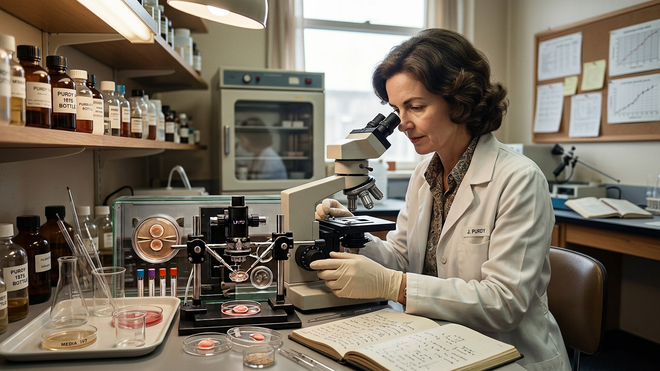
Jean Purdy played a crucial role in the early development of in vitro fertilisation, including recognising and documenting the formation of the early human blastocyst in laboratory culture.
Introduction
In vitro fertilisation is often told as the story of a few famous names: the doctor who pioneered the treatment, the scientist who developed the laboratory techniques and the birth of the first baby conceived through IVF. But behind that landmark achievement was a wider team whose contributions were essential—and one of the most overlooked figures was Jean Purdy.
Purdy was a laboratory scientist and embryologist who worked with Robert Edwards and Patrick Steptoe during the formative years of IVF. Her contribution was particularly important because she observed and documented a critical stage of early human development: the formation of the blastocyst, a structure that develops several days after fertilisation and eventually gives rise to the embryo and supporting tissues involved in implantation.
Why does that observation matter today? Because modern IVF depends on the ability to fertilise eggs outside the body, culture embryos under carefully controlled conditions, assess their development and transfer an appropriate embryo into the uterus. The laboratory culture system that makes this possible was built through painstaking experimentation rather than a single breakthrough.
Jean Purdy’s story therefore offers a different way to understand IVF—not as the invention of one person, but as a collaborative scientific achievement in which laboratory observation, clinical medicine and embryology had to converge.
What Is a Blastocyst and Why Is It Important in IVF?
A blastocyst is an early stage of embryo development that occurs several days after fertilisation.
After a sperm fertilises an egg, the resulting embryo undergoes repeated cell divisions. It progresses through several developmental stages before forming a fluid-filled structure known as a blastocyst.
The blastocyst contains distinct groups of cells with different developmental roles. The inner cell mass gives rise to the embryo itself, while the outer layer, known as the trophectoderm, contributes to structures that support implantation and pregnancy, including the placenta.
For IVF, reaching the blastocyst stage in laboratory culture is significant because it demonstrates that an embryo has continued developing outside the human body for several days under controlled conditions.
Modern IVF laboratories routinely culture many embryos to the blastocyst stage when clinically appropriate. Embryologists then evaluate their development before an embryo is selected for transfer or, in some circumstances, freezing.
Jean Purdy’s Crucial Laboratory Contribution
Jean Purdy’s role was far more than that of an assistant working behind the scenes.
During the early IVF experiments, she was involved in the laboratory work required to culture human embryos and observe their development. Her observations helped demonstrate that fertilised human eggs could continue developing outside the body under laboratory conditions.
Purdy was the first member of the Edwards and Steptoe team to recognise and describe the development of the early human blastocyst in culture, an observation that represented an important milestone in understanding whether human embryos could progress through pre-implantation development outside the uterus.
This achievement may sound routine to a modern embryologist because blastocyst culture is now a familiar part of assisted reproductive technology. Historically, however, maintaining human embryos in culture long enough to observe advanced early development was an enormous technical challenge.
Why Early IVF Was So Difficult
Today’s IVF laboratory is built around precise environmental control. Temperature, gas concentrations, culture media, pH, sterility and embryo handling are carefully monitored.
Early researchers did not have the sophisticated equipment and standardised culture systems available to contemporary fertility clinics.
They had to answer basic questions that are now fundamental to reproductive medicine:
- How can human eggs be collected safely?
- How can sperm and eggs be brought together outside the body?
- How can fertilisation be identified?
- What conditions allow a fertilised egg to continue dividing?
- How long can an embryo remain viable in laboratory culture?
- What developmental stage is suitable for transfer?
Each question represented a separate technical problem.
Purdy’s contribution came at precisely this intersection between biology and laboratory technique. Observing embryo development was not simply a matter of looking through a microscope. It required a culture environment capable of supporting that development in the first place.
The IVF Team Was Larger Than the Famous Names Suggest
The historical narrative of IVF has often focused heavily on Robert Edwards and Patrick Steptoe. Edwards was a reproductive scientist whose research helped establish the biological and laboratory foundations of IVF, while Steptoe was a gynaecologist who developed techniques for retrieving eggs from the ovaries.
Purdy occupied an essential position between experimental science and day-to-day embryology.
Her laboratory work involved observing, recording and helping maintain the developing embryos. This kind of work is easy to overlook because successful laboratory science can make extraordinary procedures appear deceptively ordinary.
But in pioneering research, the laboratory scientist is often the person who discovers whether an idea actually works under real experimental conditions.
From Fertilisation to Blastocyst: A Remarkable Biological Journey
The significance of Purdy’s observations becomes clearer when the early stages of embryonic development are considered.
Fertilisation
Fertilisation occurs when a sperm successfully fuses with an egg, producing a new cell called a zygote.
Cleavage
The zygote begins dividing into progressively smaller cells. These divisions increase cell number without a corresponding increase in the overall size of the embryo.
Morula
After several rounds of division, the developing embryo becomes a compact ball of cells called a morula.
Blastocyst
The cells then reorganise into a more complex structure containing a fluid-filled cavity and distinct cell populations. This is the blastocyst stage, typically reached around five to six days after fertilisation, although developmental timing varies.
Implantation
In natural conception, the developing embryo reaches the uterus and eventually begins the process of implantation into the uterine lining.
In IVF, much of this early journey can occur in laboratory culture. That is one of the fundamental transformations created by assisted reproductive technology.
Why Reaching the Blastocyst Stage Changed IVF
Early IVF did not begin with today’s routine practice of culturing embryos for several days and selecting blastocysts for transfer.
The field evolved gradually as researchers learned more about embryo development and improved culture conditions.
Being able to observe a human embryo developing to the blastocyst stage outside the body provided important evidence that laboratory culture could support development beyond the earliest cell divisions.
That mattered for two reasons.
First, it expanded scientific understanding of early human embryology. Second, it helped establish the laboratory techniques that would eventually support longer embryo culture and more sophisticated IVF strategies.
Modern blastocyst culture is associated with several potential advantages, including allowing embryologists to assess which embryos continue developing in vitro before transfer. However, reaching the blastocyst stage does not guarantee implantation or a successful pregnancy.
Jean Purdy’s Role Helps Correct a Common Problem in Scientific History
Scientific breakthroughs are frequently remembered through a handful of celebrated names.
This can create an incomplete picture.
Major discoveries usually depend on teams: researchers who design experiments, clinicians who treat patients, laboratory scientists who perform technically demanding procedures, technicians who maintain equipment and countless people who document results.
Purdy’s story illustrates how laboratory expertise can become invisible in historical narratives even when it is essential to the final achievement.
Recognising her contribution does not diminish the roles of Edwards or Steptoe. Instead, it provides a more accurate account of how IVF emerged.
Why Her Contribution Still Matters in Modern Fertility Medicine
Modern IVF is dramatically more advanced than the procedures available during Purdy’s career. Embryologists now work with sophisticated incubators, specialised culture media, micromanipulation technologies and imaging systems.
Procedures such as intracytoplasmic sperm injection (ICSI), embryo cryopreservation and preimplantation genetic testing have expanded the capabilities of assisted reproductive medicine.
Yet one fundamental principle remains unchanged: embryos must be maintained under carefully controlled laboratory conditions if they are to develop outside the body.
The basic question that early IVF researchers faced—can early human development be supported outside the body?—still sits at the heart of every IVF laboratory.
Blastocyst Culture Is Now a Major Part of IVF
Today, many fertility clinics culture embryos for several days before deciding whether and when to transfer them.
Extended culture can provide embryologists with additional information about developmental progression. Some embryos that appear similar at an earlier stage may develop differently over the following days.
However, embryo selection is not an exact prediction of which embryo will result in a healthy baby.
A blastocyst that looks favourable under laboratory assessment may fail to implant, while embryo morphology alone cannot reveal every genetic or biological characteristic that influences reproductive success.
This is an important distinction for patients. Modern embryology has become highly sophisticated, but IVF remains a biological process with uncertainty.
Jean Purdy and the Human Side of Scientific Recognition
There is another reason Purdy’s story deserves attention.
She represents the many women whose scientific contributions were historically less visible than those of male colleagues. Her work occurred during a period when women were significantly underrepresented in senior scientific and medical positions.
Recognition of Purdy is therefore not simply a historical footnote. It encourages a broader examination of how scientific credit is assigned and how laboratory contributions are remembered.
The history of IVF is particularly well suited to this discussion because its success depended on collaboration across disciplines. No single laboratory observation, clinical procedure or scientific theory could have produced IVF alone.
What the First IVF Era Teaches Today’s Researchers
The early IVF story offers a lesson that remains relevant to modern biomedical research: technical problems often become the decisive problems.
A scientific theory can be correct, but if researchers cannot reproduce the necessary conditions in the laboratory, the theory cannot become a clinical treatment.
Purdy’s laboratory work demonstrates the importance of careful observation. Recognising an unexpected developmental milestone can lead to new questions, new experiments and eventually new clinical possibilities.
This is one reason embryology requires both technical precision and biological judgment.
A Timeline of the IVF Breakthrough
| Period | Development | Why it mattered |
|---|---|---|
| Early 20th century | Researchers investigate mammalian reproduction and fertilisation | Established foundational knowledge for later IVF research |
| 1950s–1960s | Advances in reproductive biology and embryo culture | Made laboratory fertilisation increasingly plausible |
| 1960s–1970s | Edwards, Steptoe, Purdy and colleagues develop human IVF techniques | Combined reproductive science, clinical medicine and embryology |
| 1970s | Early human IVF success culminates in the birth of Louise Brown | Demonstrated that IVF could result in a live birth |
| Later decades | Blastocyst culture, embryo freezing, ICSI and genetic testing develop | Expanded the scope and effectiveness of assisted reproduction |
| Today | Embryology laboratories use highly controlled culture and assessment systems | Builds on the foundational laboratory work of early IVF researchers |
The Broader Legacy of IVF
IVF has changed reproductive medicine far beyond the treatment of infertility.
It has created new options for people facing blocked fallopian tubes, severe male-factor infertility, ovulation disorders and other reproductive challenges. IVF has also become part of fertility preservation, donor conception and other areas of reproductive care.
At the same time, the technology has raised complex ethical questions about embryo storage, genetic testing, embryo disposition, reproductive choice and access to treatment.
Those debates are easier to understand when IVF is viewed not simply as a procedure but as a technology that transformed the boundary between biology occurring inside the body and biological development that can be observed and supported in a laboratory.
The Overlooked Insight: IVF Was Also a Revolution in Observation
The most important lesson from Jean Purdy’s work may be overlooked when IVF is described solely as a fertility treatment.
IVF changed what scientists could see.
Before laboratory fertilisation became possible, many stages of early human development were inaccessible to direct observation. IVF created an environment in which embryologists could study embryos during the earliest stages of development outside the body.
That shift had scientific consequences extending beyond infertility treatment. It allowed researchers to investigate early embryo development, improve culture techniques and develop new approaches to embryo assessment.
In that sense, Purdy’s observation of blastocyst formation was not merely a technical milestone. It was part of a much larger transformation in human reproductive biology.
Conclusion
Jean Purdy’s contribution to IVF deserves to be remembered alongside the better-known names associated with the birth of the technology.
Her recognition and description of early human blastocyst formation in laboratory culture demonstrated an important stage of pre-implantation development and reflected the painstaking laboratory work required to make IVF possible.
Modern fertility medicine now operates with technologies that the pioneers of IVF could scarcely have imagined. Embryos can be cultured, assessed and frozen; sperm can be injected directly into eggs; and genetic information can sometimes be analysed before embryo transfer.
Yet the foundation remains remarkably familiar: successful IVF depends on understanding and carefully supporting the earliest stages of human development.
Purdy’s story is therefore more than an argument for correcting the historical record. It is a reminder that medical revolutions are often built in laboratories by people whose most important contributions are hidden behind the headline.
As reproductive medicine continues to evolve, her legacy offers a valuable lesson: breakthroughs do not always arrive as dramatic moments. Sometimes they begin with a scientist looking through a microscope, recognising something no one had clearly documented before, and understanding why that observation matters.
Primary search intent: Informational — readers want to understand who Jean Purdy was, what she contributed to IVF, why blastocyst development was an important milestone, and how her laboratory work influenced modern reproductive medicine.
Primary keyword: Jean Purdy IVF
Related semantic keywords: Jean Purdy contribution to IVF, IVF history, blastocyst development, human embryo culture, Robert Edwards IVF, Patrick Steptoe IVF, Louise Brown, embryology, in vitro fertilisation history, pre-implantation development
SEO title: Jean Purdy IVF: The Overlooked Scientist Who Helped Transform Fertility Treatment
SEO URL: jean-purdy-ivf-blastocyst-history
Important keywords: Jean Purdy IVF, blastocyst, IVF history, human embryo culture, embryology
Tags: IVF, reproductive medicine
4 important points:
- Jean Purdy was a key laboratory scientist in the pioneering IVF team led by Robert Edwards and Patrick Steptoe.
- She was the first member of the team to recognise and describe the formation of an early human blastocyst in laboratory culture.
- Blastocyst development became an important milestone in demonstrating that early human embryos could continue developing outside the body.
- Purdy’s story highlights how modern medical breakthroughs depend on collaborative laboratory work that can remain hidden behind better-known names.
For breaking news and live news updates, like us on Facebook or follow us on Twitter and Instagram. Read more on Latest Health on thefoxdaily.com.


COMMENTS 0