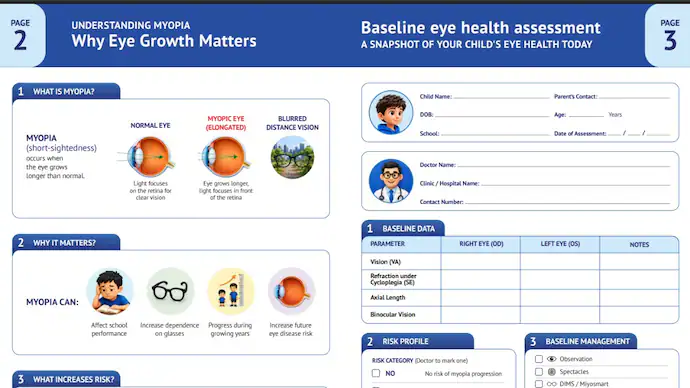
India’s Vision Growth Card aims to help parents and ophthalmologists monitor children’s eye health, track myopia progression and improve timely treatment through standardised assessments and regular follow-ups.
India has introduced a new tool to improve how childhood myopia is monitored, as concerns grow about increasing rates of short-sightedness among children. Developed by the All India Ophthalmological Society (AIOS) with support from Mankind Pharma, the Vision Growth Card is designed to help doctors and families track changes in a child’s eyesight over time.
The booklet works on a principle familiar to many parents: just as a growth chart records a child’s height, weight and development, a vision growth card documents eye health, treatment and changes in vision during childhood.
The initiative comes amid concerns about children spending more time on screens and less time outdoors. By providing a consistent record of eye assessments and treatment, the card aims to support earlier intervention and more structured management of myopia.
Why India Needs a Vision Growth Card
Myopia, commonly known as short-sightedness, is a vision condition in which distant objects appear blurred. It develops when the eye grows too long from front to back or when its optical system focuses light in front of the retina rather than directly on it.
The condition often begins during childhood and can progress as the eyes continue to grow. Without appropriate monitoring, changes in a child’s prescription may go unnoticed until vision problems affect everyday activities, including reading classroom boards, participating in sports or carrying out other tasks that require clear distance vision.
Figures cited in the source material indicate that myopia prevalence among urban Indian children increased from 4.44% in 1999 to 21.15% in 2019. Projections suggest that the condition could affect up to 48.14% of urban children by 2050. These figures refer to urban children and should not be interpreted as prevalence rates for all Indian children.
Although myopia can often be corrected with glasses or contact lenses, its progression during childhood requires attention. Higher levels of myopia are associated with an increased risk of certain eye conditions later in life, making appropriate monitoring and management important.
The Vision Growth Card is intended to make that process more systematic. Instead of relying only on separate prescriptions or parents’ recollections of previous appointments, families and doctors can use a single record to follow changes in vision and eye growth.
How the Vision Growth Card Works
The card brings together baseline eye assessments, risk categorisation, treatment records, progression tracking and follow-up reminders. Each section is intended to help ophthalmologists document a child’s condition consistently and give parents a clearer picture of how it changes over time.
1. Baseline Assessment of Eye Health
The first section establishes a starting point for monitoring. It records key measurements and examination findings for each eye, including visual acuity, refraction under cycloplegia, axial length and binocular vision.
Cycloplegic refraction involves using eye drops to temporarily relax the focusing muscles before measuring refractive error. This can help ophthalmologists obtain a more reliable assessment, particularly in children.
Axial length measures the distance from the front to the back of the eye. Because myopia progression is often associated with excessive elongation of the eyeball, tracking this measurement can provide useful information beyond changes in a glasses prescription.
The doctor also assigns a risk category: none, low, moderate or high. The card records the selected management approach, which may include observation, spectacles, specialised lenses, atropine therapy, orthokeratology, lifestyle changes or nutritional support, depending on the child’s clinical needs.
It also records whether an annual fundus examination is required. This helps document plans for examining the back of the eye when clinically indicated.
2. Tracking Myopia Progression Over Time
The progression tracker is designed to record measurements at successive appointments. Doctors can document the child’s age, vision, refractive error, axial length and treatment at each visit.
Progression is categorised as stable, slow, moderate or rapid. Graphs displaying visual acuity, refractive progression and axial length allow doctors and parents to identify patterns more easily than they might from individual test results alone.
For example, a child’s glasses prescription may change between visits, but the wider record can help the ophthalmologist assess whether the overall pattern suggests stable vision or continuing progression. Changes in axial length can provide additional information when that measurement is available and clinically appropriate.
These records can support discussions about whether the existing management plan remains suitable. Treatment decisions, however, must be based on the child’s examination findings and the ophthalmologist’s clinical judgement rather than on a graph alone.
3. Treatment and Compliance Monitoring
Managing childhood myopia may involve more than prescribing corrective lenses. Depending on the child’s condition and the treatment selected, families may need to follow specific instructions consistently and attend scheduled reviews.
The card includes a treatment and compliance tracker that records the current management plan and rates how closely the family follows it, from excellent to poor. It also documents the next follow-up appointment.
The suggested follow-up intervals are three, six or 12 months, with the appropriate interval determined by the child’s clinical circumstances and the doctor’s recommendation.
This section is intended to make missed appointments and inconsistent treatment easier to identify. A documented follow-up plan can also help families understand when the next assessment is due instead of waiting for a noticeable change in eyesight.
4. Red-Flag Symptoms That Need Attention
The Vision Growth Card includes a page identifying warning signs that may warrant an earlier medical review. These include:
- A rapid increase in the child’s glasses prescription.
- Frequent headaches.
- Reduced vision.
- Increasing squinting.
- Excessive eye rubbing.
- Difficulty seeing the classroom board.
These symptoms do not necessarily indicate myopia progression, as several can have other causes. However, they can signal that a child needs an eye assessment rather than waiting until the next routine appointment.
The red-flag list gives parents practical indicators to watch for at home and helps connect everyday observations with decisions about seeking professional care.
Five Golden Rules for Healthier Eyes
The card also includes a child-friendly educational summary outlining habits intended to support eye health and improve adherence to treatment.
- Spend time outdoors: Aim for at least two hours of outdoor activity daily, as recommended by the card.
- Follow the 20-20-20 rule: During prolonged near work or screen use, look at something about 20 feet away for 20 seconds every 20 minutes.
- Maintain a comfortable viewing distance: Keep books and screens approximately 30 to 40 centimetres from the eyes.
- Wear prescribed glasses: Follow the ophthalmologist’s advice on corrective lenses and any additional treatment.
- Attend follow-up appointments: Regular reviews help doctors monitor changes and assess whether the management plan needs adjustment.
Outdoor activity is particularly relevant to childhood myopia prevention. Research has linked greater time outdoors with a lower risk of developing myopia, although outdoor time does not guarantee that a child will avoid the condition. Screen use and close-up work are also important considerations, especially when they displace outdoor activity or involve prolonged periods without breaks.
The 20-20-20 rule is a practical reminder to take breaks from sustained near work. It can help reduce visual discomfort associated with prolonged screen use, but it should not be presented as a stand-alone treatment for myopia or as a guarantee against its progression.
Similarly, maintaining a reasonable reading distance, wearing prescribed glasses and attending appointments are useful parts of an eye-care routine. Families should follow their ophthalmologist’s specific advice, particularly when a child has been prescribed treatment intended to slow myopia progression.
What the New Card Means for Parents
For parents, one of the main benefits of the Vision Growth Card is that it turns an ongoing health concern into something easier to follow. Rather than viewing each eye examination as an isolated event, families can see how measurements and treatment decisions change over time.
A record of refractive error and axial length can help parents understand why doctors may recommend continued monitoring even when a child can see clearly with glasses. Correcting blurred vision and managing the progression of myopia are related but distinct goals.
The red-flag section also provides a practical reference between appointments. If a child begins struggling to see the board, squints more frequently or experiences a noticeable change in vision, parents have clearer guidance on when to seek advice rather than simply waiting for the next scheduled review.
The educational section offers families specific habits to reinforce at home. Consistent routines around outdoor activity, screen breaks, prescribed glasses and follow-up visits can make it easier to participate in a child’s care.
How Ophthalmologists Could Use the Standardised Format
For eye specialists, the card provides a structured format for documenting assessments and management decisions. A consistent record can make it easier to compare findings between appointments, identify changes and explain treatment choices to families.
Early risk categorisation may also help doctors organise monitoring and determine which children require closer attention. Recording the treatment selected, the family’s adherence and the next appointment can support continuity of care, particularly when a child returns for multiple assessments over several years.
The card is intended to encourage ophthalmologists to track childhood myopia more consistently rather than relying on disconnected records. Its practical impact will depend on how widely doctors adopt it, how accurately measurements are recorded and whether families attend the recommended follow-ups.
AIOS President Dr Jeewan Singh Titiyal emphasised the importance of monitoring children’s eye health. He said, “When the eye issue in kids is properly tracked then only can it be treated.” He also called on ophthalmologists across the country to adopt and use the chart for the children they examine.
What the Vision Growth Card Cannot Replace
Although the card is designed to support consistent monitoring, it is not a substitute for a comprehensive eye examination or an individual treatment plan. Its measurements and records are useful only when interpreted by qualified eye-care professionals in the context of each child’s condition.
Not every child with myopia will need the same approach. Some may require corrective spectacles and routine monitoring, while others may be considered for interventions intended to slow progression. Options such as specialised spectacle lenses, atropine therapy and orthokeratology have different indications and requirements, so treatment should be selected by an ophthalmologist.
Parents should also avoid assuming that a child’s symptoms alone can establish whether myopia is worsening. Headaches, eye rubbing and difficulty seeing clearly may have several explanations, which is why professional assessment remains important.
The card’s value lies in helping families and doctors keep a clearer, more consistent record of eye health, treatment and follow-up. It can support clinical decisions, but it does not make those decisions independently.
A Structured Approach to Childhood Eye Health
India’s Vision Growth Card introduces a standardised way to monitor children’s eye health as concern about childhood myopia grows. By combining baseline assessments, progression graphs, treatment records, warning signs and practical eye-care guidance, it aims to make long-term monitoring easier for both families and ophthalmologists.
The tool’s effectiveness will ultimately depend on regular use, accurate clinical assessments and timely follow-up. For parents, the central message is straightforward: changes in a child’s eyesight should not be ignored, and routine eye examinations can help identify problems and guide appropriate care.
As more children grow up using digital devices for education and entertainment, a structured approach to eye health could help families recognise changes earlier and take a more active role in managing their children’s vision.
For breaking news and live news updates, like us on Facebook or follow us on Twitter and Instagram. Read more on Latest Health on thefoxdaily.com.

COMMENTS 0