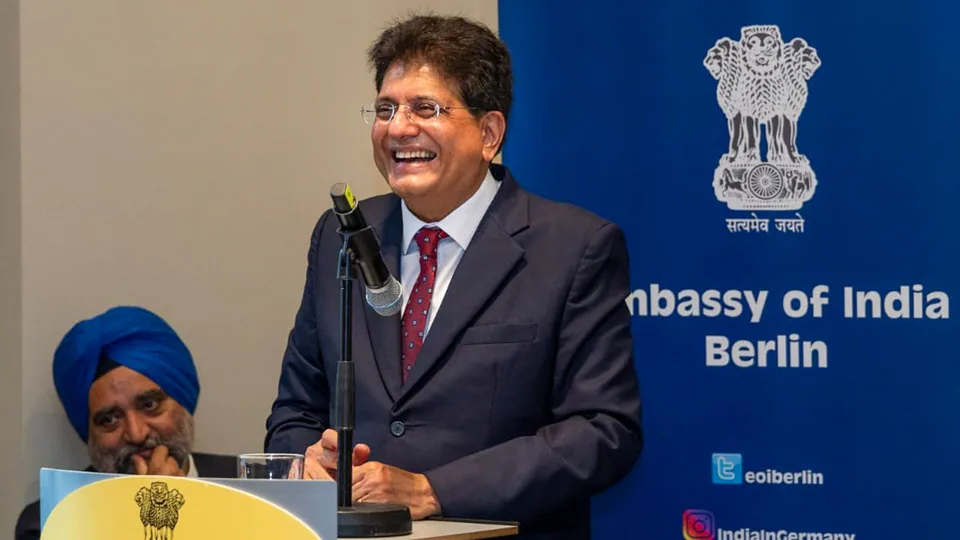
Union Commerce and Industry Minister Piyush Goyal has identified handicrafts, handlooms, culinary arts and tourism as key sectors in which India’s traditional skills, human creativity and cultural strengths could offer an advantage as Artificial Intelligence reshapes the job market.
Speaking in Berlin, Germany, on Friday, October 23, 2026, Goyal said the Commerce Ministry had begun identifying professions and industries that are less susceptible to replacement by AI. The initiative aims to help India prepare for technological change while creating opportunities for its large and predominantly young workforce.
Goyal said the objective was to identify areas where artificial intelligence could improve efficiency and productivity without necessarily replacing human workers. He stressed that India needed to harness the skills and talent of its youth to strengthen these sectors and support the long-term economic prospects of the country’s 1.4 billion people.
“I got my ministry to start working on what are the AI-proof professions,” Goyal said, highlighting the need to anticipate how technological advances could affect Employment across the country.
Which Sectors Does Piyush Goyal Consider ‘AI-Proof’?
Goyal identified four areas that he believes could benefit from India’s traditional expertise and human-led services: handicrafts, handlooms, culinary arts and tourism. These sectors rely on practical skills, creativity, cultural knowledge and personal experiences that can be difficult to replicate entirely through automated systems.
“Our handicraft, handloom… no amount of AI can replace that,” the minister said, underlining the value of human craftsmanship in producing distinctive goods.
India has a wide range of traditional crafts and textile practices, alongside diverse regional cuisines and tourism experiences. These industries can draw on specialised knowledge passed between generations, individual artistic expression and direct interaction between people.
In handicrafts and handlooms, for example, the identity of a product may depend on the maker’s technique, the choice of materials and the cultural traditions behind its creation. AI tools could potentially assist with design development, marketing, inventory management and other business activities, but the minister’s remarks emphasised the continuing importance of human skill.
Culinary arts similarly involve more than preparing food according to a fixed process. Regional knowledge, creativity, taste, presentation and the ability to adapt to customers all contribute to the experience. In tourism, human interaction, local knowledge and personalised hospitality can also shape a visitor’s experience.
Goyal’s comments point to a broader approach to employment in the AI era: strengthening industries where technology can support workers while preserving the human contribution that makes their products and services distinctive.
Commerce Ministry Identifying Jobs AI May Not Replace
The minister said the Commerce Ministry was examining professions and sectors that could be comparatively resilient to advances in artificial intelligence. Rather than focusing only on jobs that technology might eliminate, the initiative seeks to identify opportunities in which AI can support workers and improve productivity.
“What are the sectors where AI can at max add to efficiency, not necessarily replace [the] human workforce,” Goyal said.
The distinction is important because the impact of AI is not necessarily the same across all occupations. In some jobs, automated systems can take over specific repetitive tasks. In others, technology may assist with planning, analysis or administration while people continue to perform the central work.
Goyal’s approach suggests that identifying suitable sectors is part of preparing India’s workforce for a changing economy. Industries that combine technological tools with human creativity, specialised skills and personal services could offer opportunities to improve productivity without eliminating the need for workers.
However, describing a sector as “AI-proof” does not mean every job within it is protected from automation. Technology can still change how businesses operate, how products are designed and how services are delivered. The minister’s remarks focused on sectors where human capabilities could remain central even as AI becomes more widely used.
Will the Government Introduce Incentives for These Sectors?
Asked whether the government would provide incentives to support the sectors identified as less vulnerable to AI, Goyal said assistance would be considered where necessary. He also made clear that government schemes alone would not be sufficient to drive development.
“It’ll be a mix of several initiatives, some privately led, some government led, some people led, some opportunity led,” he said.
The minister’s response indicates that support could involve contributions from different parts of society, including businesses, public institutions and individuals. However, he did not announce a specific incentive package or provide details of a new scheme in the remarks cited.
Such a collaborative approach would place responsibility for developing these industries beyond the government alone. Private businesses could identify market opportunities and invest in growth, while public initiatives could provide support where required. Workers, entrepreneurs and local communities would also play a role in building skills and expanding economic activity.
For traditional industries, the challenge is to preserve distinctive human expertise while adapting to changing markets. Better access to customers, more efficient business operations and the careful use of digital tools could help businesses grow without removing the craftsmanship and personal service that underpin their appeal.
Why Handicrafts, Handlooms and Tourism Matter in the AI Era
Goyal’s emphasis on traditional industries reflects the potential value of skills that are closely connected to people, places and cultural knowledge. These sectors can offer a different path to technological adaptation from occupations dominated by repetitive digital tasks.
Handicrafts and handlooms
Handicrafts and handlooms depend on specialised techniques, manual work and creative decisions. AI may assist artisans and businesses with product concepts, customer outreach or operational planning, but the value of many handcrafted products lies in the techniques and human effort involved in making them.
Culinary arts
Food-related businesses combine technical knowledge with creativity, regional traditions and individual preferences. Technology may help with restaurant operations, planning and customer service, while chefs and other culinary professionals continue to contribute through preparation, flavour development and presentation.
Tourism and hospitality
Tourism involves experiences shaped by local culture, human interaction and knowledge of destinations. Digital tools can help travellers discover places and organise trips, but personal service and local expertise can remain important parts of the visitor experience.
These examples illustrate the distinction at the centre of Goyal’s comments: the question is not simply whether a sector uses AI, but whether technology can replace the human contribution that gives its products and services value.
Piyush Goyal’s Berlin Visit and India’s Technology Partnerships
Goyal made the remarks in Berlin while interacting with members of the Indian diaspora and speaking to the media after meeting Indian researchers.
He visited Germany from October 22 to October 24, 2026, as part of an official trip intended to strengthen India’s trade, investment, industrial and technological partnerships with Europe. He was accompanied by a delegation of approximately 100 Indian businesses and startups.
The visit also placed his comments on AI and employment within the broader context of India’s economic and technological ambitions. As businesses adopt new tools, policymakers face the challenge of encouraging innovation while preparing workers and industries for changes in the nature of employment.
Goyal is scheduled to travel to the Netherlands from October 24 to October 27, 2026, following his Germany visit.
What Goyal’s AI Jobs Initiative Could Mean for Indian Workers
The Commerce Ministry’s effort to identify professions that may be less vulnerable to AI could help frame discussions about future employment opportunities. Its practical significance, however, will depend on how the initiative develops and whether it leads to concrete measures supporting workers and businesses.
Goyal’s comments highlight the importance of India’s existing strengths, particularly traditional craftsmanship, textiles, food-related expertise and tourism. These industries could benefit from technology that improves efficiency while allowing workers to retain their central roles.
At the same time, workers in these fields may still need to adapt as AI changes marketing, design, customer engagement and other business functions. The long-term opportunity lies in combining human expertise with useful technology rather than assuming that traditional industries will remain unaffected by automation.
The minister did not announce a definitive list of protected occupations or specify a timeline for the ministry’s work. His remarks instead outlined an effort to identify areas where AI could add value without necessarily displacing the workforce.
Conclusion
Piyush Goyal’s identification of handicrafts, handlooms, culinary arts and tourism as India’s potential “AI-proof” sectors highlights the continuing importance of human creativity, specialised skills and personal experiences in an increasingly automated economy.
The Commerce Ministry is examining professions where AI could improve productivity without necessarily replacing workers, with the broader objective of preparing India for technological change. Goyal said support would depend on a combination of government-led, privately led and community-driven initiatives, rather than government schemes alone.
While no sector can be considered completely immune to technological disruption, the minister’s remarks underline the potential for India to build on its traditional strengths as AI becomes more widespread. The next step will be to translate this approach into practical opportunities for businesses, artisans, service providers and workers.
For breaking news and live news updates, like us on Facebook or follow us on Twitter and Instagram. Read more on Latest India on thefoxdaily.com.






COMMENTS 0