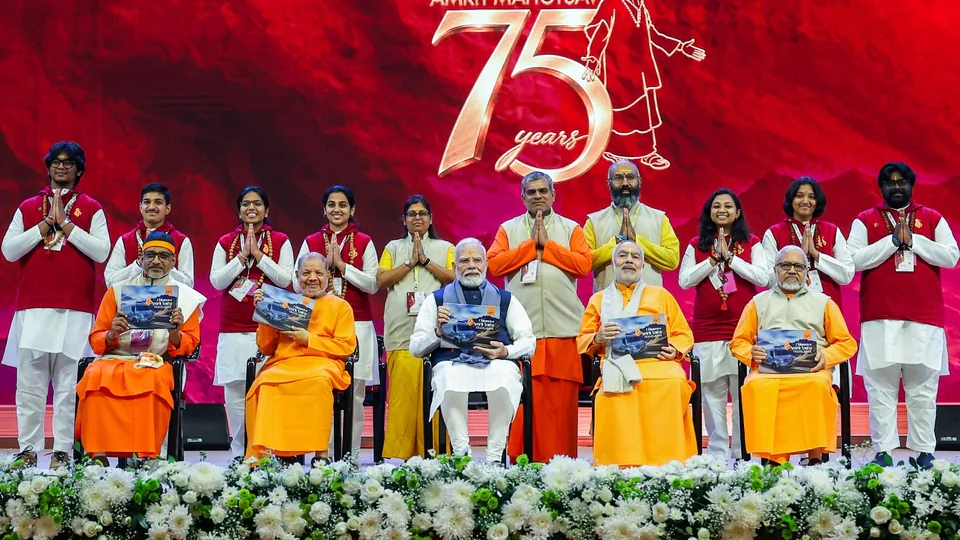
Prime Minister Narendra Modi has called for collective efforts to address emerging societal challenges and unite people against divisive forces, linking the work of spiritual and cultural organisations to India’s ambition of becoming a developed nation by 2047. Speaking at the inauguration of the Chinmaya Amrit Mahotsav Global Sammelan at Bharat Mandapam in New Delhi, he urged institutions to help citizens embrace self-reliance, strengthen social unity and contribute to national development.
The three-day gathering marks 75 years of the Chinmaya Mission and has brought together more than 9,000 participants from India and abroad. Modi connected the mission’s anniversary with India’s 2047 development goal, noting that both milestones fall in the same year.
His address highlighted the role of spiritual institutions in public life, particularly their potential to preserve India’s philosophical traditions, guide younger generations and complement formal education. He also recalled his association with the mission’s founder, Swami Chinmayananda, whose teachings he said contributed to India’s cultural and spiritual renaissance.
PM Modi urges collective action against societal challenges
Addressing the gathering, Modi said changing circumstances had brought new challenges and societal problems that required a shared response. He argued that responsibility for addressing these issues rested with society as a whole rather than any single institution or organisation.
“We must unite society against divisive forces. We must inspire citizens towards self-reliance, and we must connect every individual to the vision of a developed India by 2047,” the prime minister said.
He also called on spiritual and cultural organisations to become more proactive in advancing these objectives. His message placed social cohesion, individual responsibility and national development within a broader discussion about the contribution of civil society institutions.
Although the speech emphasised unity against divisive forces, the supplied account did not identify specific organisations, individuals or activities as the target of that appeal. The statement is therefore best understood as a general call for collective action against social divisions rather than an announcement of a particular policy or enforcement measure.
Chinmaya Mission’s 75-year journey and its role in Indian society
Founded by Swami Chinmayananda in 1951, the Chinmaya Mission was established to make the teachings of Vedanta and the Bhagavad Gita accessible to a wider audience. Over the decades, its activities have extended beyond spiritual discourses to include education, cultural preservation, youth development and community service.
Vedanta is a philosophical tradition rooted in the teachings of the Upanishads, while the Bhagavad Gita explores questions of duty, ethical conduct, knowledge and spiritual understanding. By bringing these teachings to wider audiences, the mission has sought to connect traditional Indian philosophy with the concerns of everyday life.
During his address, Modi described the Chinmaya Mission as more than an institution, presenting it as an enduring body of thought. He credited Swami Chinmayananda with helping renew interest in India’s spiritual heritage by communicating philosophical ideas to the public.
The distinction between an institution and a broader intellectual movement is central to the mission’s legacy. Institutions can preserve teachings through organised activities, but their longer-term influence depends on whether people understand, practise and pass those ideas on to others.
For the Chinmaya Mission, the 75th-anniversary celebrations provide an opportunity to highlight this process across generations. The global gathering also brings together people connected to its educational, spiritual and cultural activities, reinforcing the relationship between individual development and community participation.
Why 2047 is significant for India and the Chinmaya Mission
The year 2047 occupies a prominent place in the government’s development agenda because it will mark 100 years of India’s Independence. The national objective of building a developed India, commonly described as Viksit Bharat 2047, is intended to provide a long-term direction for economic, social and institutional progress.
The Chinmaya Mission’s centenary will also fall in 2047, creating a parallel milestone for the organisation. Modi used this coincidence to connect the mission’s continuing work with the country’s broader development ambitions.
His appeal was directed towards spiritual and cultural organisations as contributors to national development. The underlying argument was that progress involves more than economic activity or government programmes; it also depends on the values, capabilities and participation of citizens.
This approach places particular emphasis on the relationship between individual responsibility and collective progress. Education, self-reliance, social cooperation and the transmission of cultural knowledge can all influence how people participate in their communities and respond to changing circumstances.
However, the shared 2047 milestone does not mean that the Chinmaya Mission’s objectives and the government’s development agenda are identical in every respect. The mission’s principal focus includes spiritual education and cultural activities, while the national development goal encompasses a much broader range of economic and public policy priorities.
The connection highlighted by Modi is therefore one of potential contribution: cultural and educational organisations can support aspects of national development through their work with individuals and communities.
Modi recalls his meeting with Swami Chinmayananda in 1993
A personal recollection formed another important part of the prime minister’s address. Modi spoke about meeting Swami Chinmayananda in Chicago in February and March 1993, when he invited the spiritual leader to participate in the centenary celebrations of the Parliament of the World’s Religions.
Chinmayananda accepted the invitation and travelled to the United States to encourage people to attend the gathering. He died in San Diego on August 3, 1993, before the event began in Chicago on September 11.
Modi recalled the absence of the spiritual leader during the celebrations, saying that those involved deeply missed him. The memory connected the prime minister’s personal experience with the mission’s broader history of sharing Indian philosophical traditions beyond the country’s borders.
The Parliament of the World’s Religions has served as a forum for encounters between religious and spiritual traditions. Chinmayananda’s involvement in encouraging participation reflected the international dimension of his work, which sought to make Indian spiritual teachings accessible to audiences outside India.
For Modi, the recollection also reinforced the theme of youth empowerment. He said that his conversation with Chinmayananda had focused on building the capabilities of young people and developing a strong India through their participation.
Holobot technology brings Swami Chinmayananda’s presence to the event
The gathering also featured a technological tribute that added a contemporary dimension to the commemoration. Modi interacted with a holobot, described in the source account as a realistic, three-dimensional holographic digital representation of Swami Chinmayananda.
The prime minister said the experience made him feel as though he had travelled back 33 years to his earlier meeting with the spiritual leader. He described the encounter as emotional and linked the experience to his memories of their association.
The use of digital representation at a spiritual commemoration illustrates one way technology can be used to revisit historical figures and preserve aspects of their public legacy. Unlike a conventional photograph or recorded speech, an interactive representation can create a different experience for visitors by presenting a person in a lifelike visual form.
Such technology can support exhibitions, educational programmes and heritage presentations, particularly when organisers want younger audiences to engage with historical personalities. Its value, however, depends on the accuracy of the material presented and the clarity with which a digital representation is distinguished from the historical person.
In this instance, the holobot served as part of the event’s tribute to Chinmayananda. The emotional response described by Modi also demonstrated how digital tools can complement traditional forms of remembrance without replacing the underlying historical record.
Youth empowerment remains central to the mission’s work
Modi highlighted youth development as a shared priority in the legacy of Swami Chinmayananda and the country’s future. He praised young people associated with the mission who undertook a long-distance outreach initiative to communicate its message to communities across India.
According to the figures cited in the supplied account, the participants travelled nearly 40,000 kilometres over approximately 300 days and reached more than 100,000 people. Modi congratulated the team for its efforts.
The scale of the initiative illustrates how organised outreach can extend the reach of an educational or cultural organisation beyond its established centres. Travelling to different communities also provides opportunities to engage with people who may not otherwise participate in its regular activities.
The initiative reflects a broader approach to youth empowerment: young people are not simply recipients of education or cultural instruction but can also become active participants in communicating ideas, organising activities and serving their communities.
Modi said that the Chinmaya Mission had nurtured large numbers of young people who were acting as cultural ambassadors of India. He credited them with helping transmit Indian values to younger generations.
For such efforts to have a lasting impact, outreach needs to be supported by continued learning and participation. A journey or public event can introduce people to a subject, but sustained engagement through educational programmes, community activities and discussion is what allows knowledge to be developed over time.
The mission’s youth-focused activities therefore connect its anniversary celebrations with a longer-term question: how can traditional knowledge remain relevant to people growing up amid rapid technological, social and economic change?
National Education Policy and the integration of Indian knowledge traditions
Education was another major theme in Modi’s speech. He referred to the National Education Policy (NEP) as an effort to prepare India’s education system for the needs of a changing country while giving greater attention to Indian Knowledge Systems, mother-tongue instruction, modern science and emerging technologies.
The prime minister said the policy placed importance on connecting Indian knowledge traditions with contemporary scientific and technological learning. His remarks presented cultural understanding and modern education as areas that can be pursued together rather than as competing priorities.
This approach raises a practical question for schools and educational institutions: how can students learn about philosophical, historical and cultural traditions while developing the scientific understanding and technical skills needed in modern workplaces?
One possible approach is to teach traditional material in its historical and intellectual context while using evidence-based methods to develop scientific literacy. Students can examine philosophical ideas, understand their influence on Indian society and learn how different forms of knowledge address different questions.
At the same time, integrating cultural content into education requires careful attention to academic standards. Students benefit when material is presented accurately, competing interpretations are explained where relevant and scientific claims are evaluated using appropriate evidence.
Modi also praised the Chinmaya Mission’s educational institutions and cultural activities for introducing Indian values to younger generations. He said that more than 100 institutions run by the mission combine modern education with Indian values.
The mission’s educational work provides an example of how a cultural or spiritual organisation can contribute to learning through institutions and programmes. The broader significance of such work depends on the quality of education provided, the opportunities available to students and the ability of institutions to prepare them for changing social and professional demands.
India’s cultural heritage and the development of religious sites
Modi also referred to Swami Chinmayananda’s support for the Vivekananda Rock Memorial in Kanyakumari. According to the prime minister, Chinmayananda made the first financial contribution to the project, which honours Swami Vivekananda and his legacy.
The reference connected Chinmayananda’s personal contributions to a wider tradition of supporting cultural and religious institutions. Such projects can preserve historical associations, provide places for reflection and help introduce visitors to figures who have influenced India’s intellectual and spiritual history.
The prime minister also highlighted the development of prominent religious and cultural sites, including Kashi Vishwanath Dham, the Ram temple in Ayodhya and centres at Kedarnath and Badrinath.
These sites hold religious significance for many people and feature prominently in India’s cultural landscape. Their development can also affect the experience of pilgrims and visitors, including access to facilities and the organisation of public spaces around important religious destinations.
However, heritage preservation and site development involve distinct considerations. Maintaining a site’s religious or historical significance is one objective, while managing visitor access, protecting surrounding environments and preserving the character of the location are additional responsibilities where relevant.
By referring to these projects alongside Chinmayananda’s legacy, Modi placed cultural preservation within his wider argument that India’s traditions can contribute to national confidence and development.
What Modi’s message means for spiritual and cultural organisations
The address at Bharat Mandapam offered spiritual and cultural organisations a broad role in the country’s future. Rather than limiting their contribution to religious observances or the preservation of historical teachings, Modi encouraged them to engage more actively with social challenges, self-reliance and the development of young people.
For organisations working in this area, that appeal can translate into several practical priorities:
- Expand educational outreach: Make philosophical, cultural and historical knowledge accessible through structured learning programmes and community engagement.
- Support young people: Give young participants opportunities to develop leadership, communication and organisational skills through meaningful activities.
- Encourage community participation: Create opportunities for people to work together on shared educational, cultural and social objectives.
- Use technology thoughtfully: Explore digital tools that make learning and heritage more accessible while maintaining historical accuracy.
- Connect values with practical service: Translate educational and ethical principles into activities that respond to the needs of local communities.
These are possible ways of interpreting the prime minister’s appeal, rather than a formal list of new government directives. The speech, as described in the supplied material, called for greater initiative but did not announce a specific programme requiring every spiritual or cultural organisation to adopt these measures.
The distinction matters because the work of such organisations varies considerably. Some focus primarily on spiritual instruction, while others operate educational institutions or undertake community service. Their contributions to national development will depend on their individual capabilities, objectives and activities.
What comes next for the Chinmaya Mission’s 2047 vision?
The Chinmaya Amrit Mahotsav Global Sammelan is being held from October 23 to 25, 2026, marking the culmination of year-long celebrations of the mission’s 75-year journey. The gathering provides an opportunity for participants to reflect on its past work and consider how its educational, spiritual and cultural activities can continue reaching new audiences.
The longer-term significance of the celebrations will depend on what follows the anniversary. Public gatherings can renew interest in an organisation’s mission, but sustained programmes, active participation and the continuity of its educational work determine how that interest translates into lasting engagement.
The same distinction applies to the broader goal of a developed India by 2047. Connecting citizens with a national vision is one step; translating that vision into progress requires continued efforts across education, institutions, communities and other areas of public life.
For the Chinmaya Mission, the coincidence of its centenary with the 100th anniversary of India’s Independence creates a long-term milestone around which its future activities can be organised. Modi’s appeal was that spiritual and cultural organisations should contribute proactively to this journey while helping address the challenges facing society.
His central message at the gathering was that national development and social cohesion require participation beyond government alone. By linking Swami Chinmayananda’s legacy, youth empowerment, education and cultural preservation with the 2047 ambition, the prime minister called on organisations to turn their established work into a continuing contribution to India’s future.
For breaking news and live news updates, like us on Facebook or follow us on Twitter and Instagram. Read more on Latest India on thefoxdaily.com.





COMMENTS 0