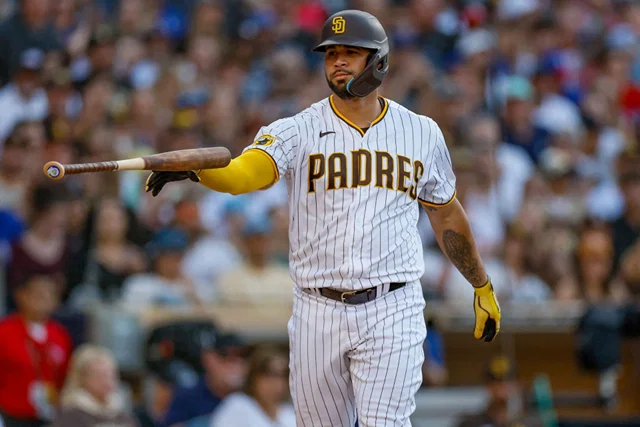
The rivalry between the New York Yankees and Boston Red Sox has produced generations of memorable players, dramatic games and historic performances. Both franchises have featured some of Major League Baseball’s biggest stars, but a player’s success can also depend on opportunity, team structure, ballpark dimensions and the environment surrounding him.
Several players who spent time with the Yankees showed considerable ability but faced injuries, limited playing opportunities, difficult expectations or challenging roles. A different situation in Boston might have allowed some of them to develop further, receive more regular at-bats or take on greater responsibilities.
From Greg Bird and Clint Frazier to former Yankees legends such as Dave Winfield and Joe DiMaggio, here are 12 players whose careers could have followed a different path if they had played for the Red Sox instead.
12. Greg Bird
Greg Bird spent his entire Major League Baseball career with the New York Yankees. He showed considerable promise during his breakthrough season in 2015, hitting 11 home runs and recording an impressive .871 OPS across 46 games. His early performances suggested that he could become an important offensive contributor for the franchise.
However, injuries repeatedly interrupted his progress and prevented him from establishing himself as a consistent presence in the Yankees lineup. The potential displayed during his first season never translated into the sustained MLB production that many had expected.
Boston could have offered Bird a different opportunity during the late 2010s. The Red Sox used a first-base platoon featuring Mitch Moreland and Steve Pearce, creating a situation in which Bird might have competed for regular playing time against right-handed pitchers.
A defined role in a platoon system could have helped him find a more consistent rhythm at the plate. Although a move to Boston would not necessarily have prevented his injury problems, the opportunity to compete for at-bats could have given him another route to establish himself.
11. Shane Spencer
Shane Spencer played five seasons with the Yankees between 1998 and 2002. He made an immediate impression during his 1998 breakout, hitting 10 home runs in just 27 games, including eight during September. His power production helped him become one of the memorable contributors from that period.
By the end of his Yankees tenure, Spencer had recorded 43 home runs and 167 RBIs. Those numbers demonstrated his ability to provide offensive production, but finding a regular starting role in New York was difficult.
Bernie Williams, Paul O’Neill and Chili Davis were among the established players limiting Spencer’s opportunities for everyday playing time. The competition for places in the Yankees lineup made it difficult for him to secure a permanent role.
Boston could have presented a different situation in 1999. The Red Sox were giving rookie Trot Nixon regular opportunities in right field, meaning Spencer might have had a chance to compete for a starting position.
More consistent playing time could have allowed Spencer to build on the power he demonstrated during his breakout period. Instead of remaining in a crowded Yankees outfield picture, he might have enjoyed a clearer opportunity to establish himself in Boston.
10. Clint Frazier
Clint Frazier spent five seasons with the Yankees from 2017 to 2021. During that period, he hit 29 home runs and recorded a .761 OPS across 228 games. His strongest offensive performance came during the pandemic-shortened 2020 season, when he posted a .905 OPS.
Frazier’s offensive ability was never in serious doubt during his best stretches. His bat speed and capacity to make hard contact suggested that he could become a productive MLB hitter. However, his development in New York was affected by injuries and competition for playing time in a crowded outfield.
The Yankees had several options competing for outfield positions, making it difficult for Frazier to secure a consistent role. The combination of limited opportunities and injury setbacks interrupted the momentum he needed to establish himself.
Fenway Park could have offered an interesting alternative. Its dimensions, particularly the Green Monster in left field, might have suited Frazier’s ability to hit the ball hard toward left field. Some of his well-struck balls could potentially have turned into extra-base hits in Boston.
A more regular role and a ballpark that suited his hitting profile might have helped Frazier produce more consistently. His time with the Yankees showed promise, but the circumstances never allowed him to fully establish himself as an everyday star.
9. Jose Rijo
Jose Rijo made his MLB debut with the Yankees in 1984 at just 18 years old. His first experience in the major leagues was difficult, as he finished with a 2-8 record and a 4.76 ERA across 24 appearances.
The Yankees eventually traded Rijo to the Oakland Athletics before he had developed into an established major league starter. His early introduction to the highest level of baseball and subsequent move meant that New York did not get to see the full extent of his potential.
A different development path in Boston during the late 1980s could have offered Rijo an opportunity to learn from experienced pitchers. The Red Sox had Roger Clemens, whose experience and success could have provided a valuable example for a young pitcher trying to establish himself.
Andy Pettitte, who later pitched for the Yankees, viewed Clemens as a mentor. Rijo might similarly have benefited from sharing a clubhouse with an established pitcher who could offer guidance on handling the demands of MLB competition.
There is no guarantee that such a relationship would have changed Rijo’s career, but the opportunity to develop alongside an experienced pitcher could have been valuable during his early years.
8. Dave Winfield
Dave Winfield was a perennial All-Star during his time with the Yankees and remained one of the most recognisable players of his era. Between 1980 and 1988, he averaged nearly 25 home runs per season, providing consistent power and offensive production.
Despite his performances, Winfield’s time in New York was affected by a public feud with Yankees owner George Steinbrenner. The disagreement became a major distraction and added pressure to an already demanding environment.
A move to Boston could have allowed Winfield to focus more heavily on his performance without the same personal conflict surrounding his relationship with Steinbrenner. A different organisational atmosphere might have reduced some of the distractions that accompanied his Yankees tenure.
The Red Sox also had an accomplished offensive group during the 1980s. Wade Boggs, Jim Rice and Dwight Evans were among the established players who could have shared the offensive responsibility with Winfield.
Playing alongside those hitters might have created a strong lineup in which Winfield did not have to carry as much of the offensive burden. His established power and experience could have made him an important part of Boston’s attack.
7. Javier Vazquez
Javier Vazquez had two separate single-season stints with the Yankees, pitching for the franchise in 2004 and 2010. Across those periods, he recorded a 24-20 record with a 5.09 ERA over 355.1 innings.
His numbers in New York were disappointing compared with the level of performance he demonstrated elsewhere. In 2009, while pitching for the Atlanta Braves, Vazquez produced a 2.87 ERA and delivered performances that placed him among the league’s most effective starting pitchers that season.
The contrast between his Atlanta success and his struggles in the Bronx raises an interesting question about whether a different team environment could have helped him perform more consistently.
Had Vazquez joined the Red Sox in 2004, he could have entered a rotation featuring Pedro Martinez and Curt Schilling. Pitching behind two established stars might have reduced the pressure on him to serve as the leading figure in the starting rotation.
Instead of carrying expectations associated with being a major rotation addition in New York, Vazquez could have worked within a pitching staff that already had experienced leaders. A different role might have helped him settle into a more comfortable routine.
6. Dellin Betances
Dellin Betances spent eight seasons with the Yankees between 2011 and 2019. He developed into one of the team’s most effective relief pitchers, earning four All-Star selections and recording five consecutive seasons with at least 100 strikeouts from 2014 through 2018.
His strikeout ability made him a major part of the Yankees bullpen. However, the team generally relied on Betances as a setup man, while Andrew Miller and Aroldis Chapman served as closers at different points during his tenure.
Despite his excellent relief performances, Betances never secured a permanent full-time closer role in New York. That limited his opportunities to collect saves, which often play an important part in a relief pitcher’s statistical profile and awards recognition.
Boston could have offered him a different responsibility. The Red Sox faced questions about ninth-inning stability after Craig Kimbrel departed following the 2018 season. A healthy Betances could potentially have become a candidate for the closer position.
Taking on that role might have increased his save totals and strengthened his awards profile. His established ability to strike out hitters would have made him an interesting option for the Red Sox during a period when they needed greater stability at the back of the bullpen.
Health would still have been a major factor, but a permanent ninth-inning assignment in Boston could have given Betances a different opportunity to build his reputation.
5. Miguel Andujar
Miguel Andujar played parts of six seasons with the Yankees between 2017 and 2022. His most impressive campaign came in 2018, when he hit .297 with 47 doubles, 27 home runs and 92 RBIs.
That performance established him as an important offensive contributor and demonstrated his potential to become a long-term part of the Yankees lineup. However, injuries and defensive struggles affected his position within the team’s plans after 2019.
As New York adjusted its roster, Andujar gradually lost ground on the depth chart. His offensive production had shown that he could contribute at the major league level, but finding a regular defensive position became a challenge.
Boston might have provided another opportunity in 2021. The Red Sox traded Andrew Benintendi that year, potentially opening up playing time in the outfield. Andujar could have competed for that opportunity and attempted to establish himself as an outfielder.
Regular at-bats in a different organisation might have helped him regain offensive momentum. Rather than facing limited opportunities in New York, he could have had a clearer route to earning a consistent place in Boston’s lineup.
4. Bobby Murcer
Bobby Murcer faced enormous expectations during his time with the Yankees because many fans viewed him as the successor to Mickey Mantle. Being compared with one of the most iconic players in franchise history created a difficult standard for Murcer to meet.
Although he had the opportunity to build his own reputation, the constant comparisons with Mantle could have made it harder for him to establish an identity separate from the legendary Yankees star.
A career with the Red Sox might have created a different environment. Murcer could have shared the clubhouse with Carl Yastrzemski and, from 1972, Carlton Fisk. Playing alongside established stars would have given him an opportunity to contribute without carrying the expectation of replacing Mantle.
Instead of being viewed primarily through the comparison with his predecessor, Murcer might have been able to develop his own identity as a leading player. The Boston environment could have allowed him to be judged more directly on his individual performances.
The hypothetical move would not necessarily have made him a more productive player, but it could have changed how his career was perceived and reduced some of the pressure attached to his role in New York.
3. Tommy Henrich
Tommy Henrich spent his entire MLB career with the Yankees, playing from 1937 to 1942 and again from 1946 to 1950. His ability to deliver important hits earned him the nickname “Old Reliable,” reflecting the trust placed in him during significant moments.
However, Henrich spent much of his Yankees career alongside Joe DiMaggio, whose performances and popularity often attracted greater media attention. Henrich was an accomplished hitter in his own right, but he frequently operated in the shadow of one of baseball’s biggest stars.
Playing for Boston could have created a different situation, although it would not necessarily have removed the possibility of being overshadowed. Ted Williams was the central figure in the Red Sox lineup, and his presence might similarly have dominated the headlines and offensive statistics.
Nevertheless, a hypothetical Boston outfield featuring Henrich, Williams and Dom DiMaggio, Joe’s younger brother, would have offered the Red Sox another experienced hitter with a strong ability to reach base.
Henrich also had an impressive record at Fenway Park. He hit .301 with a .406 on-base percentage across 94 games at the stadium, suggesting that its dimensions and playing conditions suited his offensive approach.
One particularly notable moment came in 1949, when the Yankees won the American League pennant by a single game. Henrich homered in the pennant-clinching victory over Boston, demonstrating how important he was to the Yankees during a decisive moment in the rivalry.
His Fenway numbers make the idea of a Boston career especially interesting. A player who already produced effectively at the stadium might have become an important part of the Red Sox lineup had he spent his career there.
2. Graig Nettles
Graig Nettles played 11 seasons with the Yankees from 1973 to 1983 and served as team captain during the final two years of that period. He became an important figure in New York through his defensive ability, power hitting and contributions to the team’s championship success.
Nettles won multiple Gold Glove Awards and World Series rings during his Yankees career. His defensive skills at third base made him particularly valuable, while his power added another dimension to the lineup.
Despite those achievements, Nettles sometimes received less attention than other major Yankees stars, including Reggie Jackson, Thurman Munson and Catfish Hunter. Their presence meant that Nettles was not always the central figure in discussions about the team’s success.
Boston could have benefited significantly from his defensive ability at third base. During that period, the Red Sox had Butch Hobson at the position, and his defensive struggles became particularly visible in 1978 when he committed 43 errors.
A Gold Glove-calibre defender such as Nettles could have offered considerably more defensive security. His ability to prevent runs, combined with his power at the plate, might have strengthened an important position for Boston.
Beyond the statistics, a player with Nettles’ experience and championship background could have brought valuable leadership to the Red Sox. His contribution would not have been limited to his offensive production, as his defensive reliability could have made a major difference to the team’s overall balance.
1. Joe DiMaggio
Joe DiMaggio tops the list because his combination of hitting ability and Fenway Park performance makes the hypothetical move to Boston particularly fascinating. He spent his entire MLB career with the Yankees, playing from 1936 to 1942 and again from 1946 to 1951.
DiMaggio became one of the defining players in Yankees history, but the dimensions of the old Yankee Stadium created an interesting consideration for his home-run potential. The deep left-centre field area, famously known as “Death Valley,” presented a demanding target for a right-handed power hitter.
Fenway Park offered a very different layout. Its shorter left-field dimensions and the presence of the Green Monster could have helped DiMaggio turn some of his powerful hits into additional home runs.
His record against the Red Sox already demonstrated how effectively he performed against Boston pitching. DiMaggio hit .334 with a .982 OPS against the Red Sox during his career, showing that he regularly produced at a high level in the rivalry.
He also recorded 29 home runs in 120 career games at Fenway Park. Those numbers provide a strong basis for imagining how his offensive totals might have developed if he had played his home games there throughout his career.
The Green Monster and the shorter left-field dimensions could potentially have added to his home-run production. Although it is impossible to know exactly how his career statistics would have changed, his existing performance at Fenway makes him a compelling choice for the top position.
DiMaggio’s place at the top of this list is also a reflection of how much ballpark dimensions can influence the way a hitter’s abilities translate into statistics. His established success against Boston and his power at Fenway make the hypothetical especially appealing.
Conclusion
The careers of these 12 Yankees players show how much opportunity, team composition, injuries, ballpark dimensions and expectations can influence a player’s development and reputation. Some, such as Greg Bird and Clint Frazier, might have benefited from more consistent playing time, while others, including Dellin Betances and Graig Nettles, could have taken on different responsibilities in Boston.
For legends such as Dave Winfield, Tommy Henrich and Joe DiMaggio, the question is less about whether they were already successful and more about how a different team environment or ballpark could have shaped their achievements. These comparisons remain hypothetical, but they highlight how the careers of even established MLB stars might have looked different on the other side of the Yankees-Red Sox rivalry.
For breaking news and live news updates, like us on Facebook or follow us on Twitter and Instagram. Read more on Latest MLB on thefoxdaily.com.




COMMENTS 0