The New York Yankees have built much of their success through a combination of homegrown talent, major free-agent signings and trades that brought established stars to the Bronx. Over the decades, the franchise has made several deals that reshaped its roster, strengthened championship teams and delivered players who became important parts of Yankees history.
Some acquisitions brought proven superstars such as Alex Rodriguez, Roger Clemens and Rickey Henderson. Others involved players who developed into key contributors after arriving in New York, including Scott Brosius, Tino Martinez and Didi Gregorius. Several of these trades helped the Yankees win World Series titles, while others produced memorable individual performances and strengthened the team’s identity.
From championship-winning additions to modern blockbuster deals, here are 15 of the most significant trades made by the Yankees in MLB history.
1. Rickey Henderson
Rickey Henderson brought an extraordinary combination of speed, plate discipline and offensive production to the New York Yankees. Widely recognised for his ability to change games on the base paths, Henderson gave the franchise an attacking weapon capable of putting constant pressure on opposing defences.
During his Yankees tenure, Henderson made four All-Star teams, stole 326 bases and hit 78 home runs. His ability to get on base and turn opportunities into scoring chances made him a major contributor to the team’s offence.
Although Henderson did not win a World Series championship during his time in New York, his individual performances made the acquisition an important move in the franchise’s history. His combination of power and speed provided a different dimension to the Yankees lineup.
2. Alex Rodriguez
Alex Rodriguez arrived in New York as one of baseball’s biggest stars. He was coming off an MVP season and was already widely regarded as one of the most talented players in Major League Baseball.
His arrival gave the Yankees another superstar to complement an already powerful lineup. Rodriguez brought a combination of hitting ability, power and defensive versatility that made him one of the central figures in the team’s roster.
During his time in the Bronx, Rodriguez won two American League MVP awards and played a major role in the Yankees’ 2009 World Series championship. His contributions during that title-winning campaign helped New York secure another championship after several seasons without one.
Rodriguez’s individual achievements and involvement in the 2009 title run made his arrival one of the most significant player acquisitions in modern Yankees history.
3. Tino Martinez
Following Don Mattingly’s retirement, the Yankees needed a dependable replacement at first base. They found an answer in Tino Martinez, who joined the franchise in 1995 and became an important part of the team’s successful championship era.
Martinez developed into a major offensive contributor, hitting 175 home runs and recording 690 RBIs between 1996 and 2001. His production helped strengthen a Yankees lineup that was consistently competitive during those seasons.
He also delivered some memorable performances in the postseason. Martinez hit a grand slam in Game 1 of the 1998 World Series, giving the Yankees an important contribution during their championship campaign.
His performance in the 2001 World Series was equally memorable. Martinez hit a dramatic game-tying home run in Game 4, producing one of the defining moments of that series. His ability to deliver in October helped establish him as an important figure in Yankees history.
4. Paul O’Neill
Paul O’Neill joined the Yankees in 1992 and quickly became a fan favourite at Yankee Stadium. Although he was not always the most celebrated player on the roster, his consistency and competitive approach made him an important contributor to the franchise’s championship success.
O’Neill became known for his reliable hitting and ability to deliver in important situations. He finished his Yankees tenure with a .303 batting average, providing the team with a dependable presence in the batting order.
His contributions were particularly valuable during the Yankees’ successful run in the late 1990s. O’Neill played a part in four World Series championship victories, becoming one of the important members of the team’s title-winning core.
His combination of consistency, determination and postseason contributions made the trade a significant success for New York.
5. David Cone
The Yankees needed experienced pitching reinforcements in 1995, and the acquisition of David Cone helped address that requirement. Cone had already established himself as an accomplished starting pitcher and entered New York following a strong period in his career, including winning the 1994 American League Cy Young Award.
He continued to provide reliable performances after arriving in the Bronx. Cone became an important part of the Yankees’ starting rotation during their championship years, giving the team an experienced option capable of handling pressure situations.
Across six seasons with the Yankees, Cone recorded 64 wins. His consistency and ability to contribute during important games made him a valuable addition to the pitching staff.
Cone’s arrival strengthened a rotation that played a major role in New York’s championship success during the late 1990s.
6. Scott Brosius
Scott Brosius is an example of how a successful trade does not always require acquiring an established superstar. Sometimes, a player simply needs a new environment and an opportunity to rediscover his form. That was the case with Brosius after the Yankees acquired him from Oakland in 1997.
Brosius had experienced a disappointing season before joining New York, but his performances improved significantly after the move. He quickly became an important contributor and earned his first All-Star selection in 1998.
That season, Brosius hit .300 with 19 home runs and 98 RBIs, establishing himself as a productive part of the Yankees lineup. His performances also extended into the postseason, where he helped the franchise during its successful championship run.
Brosius went on to win three championships with the Yankees. His development after arriving in New York made the trade a particularly valuable piece of the team’s late-1990s success.
7. Roger Clemens
Roger Clemens was already regarded as one of the finest starting pitchers in MLB history when he joined the Yankees. His arrival brought additional experience and star power to a pitching staff that was competing for championships.
Clemens played an important role in the Yankees’ back-to-back World Series victories in 1999 and 2000. His presence gave the team another established starter capable of handling high-pressure situations during the regular season and postseason.
He also continued to collect individual honours in New York, winning another Cy Young Award in 2001. That achievement underlined his continued ability to perform at an elite level even after moving to a new team.
His contributions during the Yankees’ championship years and his individual success made the acquisition one of the franchise’s notable pitching trades.
8. Sparky Lyle
The Yankees strengthened their bullpen by acquiring Sparky Lyle from their biggest rivals, the Boston Red Sox. Lyle was already an established relief pitcher before the move, but his performances in New York helped him become one of the American League’s most dependable closers.
During his Yankees tenure, Lyle recorded 141 saves and posted a 2.41 ERA. His ability to handle late innings gave the team a reliable option when protecting narrow leads.
Relief pitching is often an overlooked part of championship construction, but a dependable closer can make a major difference over a long season. Lyle provided that stability for New York and became an important figure in the team’s bullpen history.
Acquiring a proven reliever from a major rival also made the deal particularly significant. Lyle’s performances in the Bronx demonstrated the value of strengthening the bullpen through trades.
9. Chris Chambliss
The Yankees’ acquisition of Chris Chambliss initially attracted criticism, but it eventually developed into one of the franchise’s important moves during the 1970s.
Arriving from Cleveland, Chambliss provided stability at first base and became a useful offensive contributor. His presence strengthened the Yankees lineup and helped the team maintain consistency during an important period in its history.
Chambliss played a key role in New York’s World Series championship victories in 1977 and 1978. His contributions during those title-winning seasons helped turn the trade into a successful decision for the franchise.
His arrival also showed how a player who does not initially receive universal approval can become an important part of a championship team through consistent performances.
10. David Justice
The Yankees already had a championship-calibre roster in 2000, but the organisation wanted another experienced hitter to strengthen its lineup ahead of the postseason. David Justice became the answer after arriving from Cleveland during the season.
Justice made an immediate impact in New York. He hit .305 with 20 home runs and 60 RBIs in just 78 regular-season games for the Yankees, providing valuable offensive production during the final stages of the campaign.
His experience and ability to deliver in important situations made him a useful addition to an already talented roster. Justice also contributed during the postseason as New York continued its pursuit of another championship.
The Yankees eventually defeated the New York Mets in the World Series, securing their third consecutive championship. Justice’s arrival gave the team another productive bat during a title-winning season.
11. Bobby Abreu
The Yankees made another important deadline move in 2006 when they acquired Bobby Abreu from the Philadelphia Phillies. Abreu brought an impressive combination of power, patience and consistency to an already dangerous New York lineup.
His ability to get on base and produce extra-base hits gave the Yankees another offensive option. He quickly settled into the team and became an important contributor during the remainder of the regular season.
Abreu hit .330 with seven home runs and 42 RBIs in the final part of the 2006 regular season after joining New York. Those numbers demonstrated how quickly he adapted to his new surroundings.
The acquisition strengthened the Yankees’ batting order and provided additional experience as the team prepared for the postseason. His immediate production made the deadline deal a valuable move for the franchise.
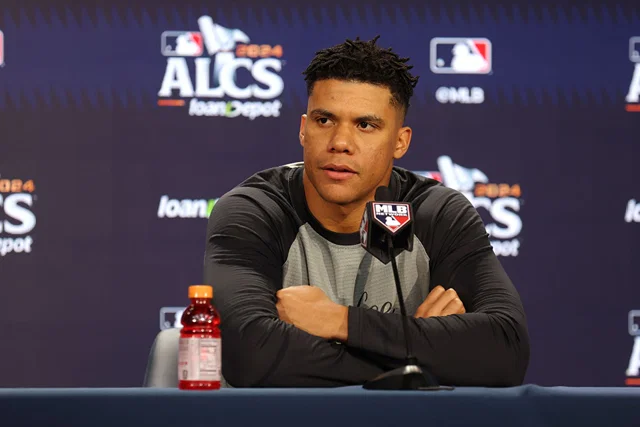
12. Juan Soto
Juan Soto was already one of the most dangerous hitters in baseball when the Yankees acquired him from the San Diego Padres ahead of the 2024 season. New York surrendered five players in the deal, including promising young pitcher Michael King, to bring the superstar outfielder to the Bronx.
Soto delivered an outstanding first season in pinstripes, hitting .288 with 41 home runs, 109 RBIs and a .419 on-base percentage. His combination of power and plate discipline made him one of the most important players in the Yankees lineup.
He also formed a devastating offensive partnership with Aaron Judge. The two hitters gave opposing pitchers a difficult challenge, with both capable of changing a game through their power and ability to reach base.
Soto helped the Yankees reach the 2024 World Series, making the trade an immediate success in terms of on-field production and postseason achievement. His outstanding season demonstrated the impact a superstar hitter can have on a championship-contending team.
13. Giancarlo Stanton
The Yankees acquired Giancarlo Stanton from the Miami Marlins in 2017, bringing one of baseball’s most powerful hitters to New York. Stanton had already developed a reputation for hitting towering home runs, and the move added another major power threat to the Yankees lineup.
His ability to hit the ball out of the park made him an important part of the team’s offensive plans. Although injuries have affected his availability in recent seasons, his quality has remained clear whenever he has been fully fit and able to play.
Stanton delivered a particularly memorable performance during the 2024 postseason. He hit seven home runs and recorded 16 RBIs across 14 games, helping the Yankees reach the World Series.
His postseason production demonstrated why the franchise had targeted him as a major offensive addition. When healthy, Stanton’s power gives New York a hitter capable of changing the direction of a game with one swing.
14. Didi Gregorius
Didi Gregorius joined the Yankees through a three-team trade before the 2015 season. His arrival came with considerable expectations because he was stepping into the high-pressure role of replacing longtime Yankees captain Derek Jeter at shortstop.
Gregorius gradually established himself as a productive player in New York. His performances at the plate helped him build his own identity rather than simply being viewed as Jeter’s replacement.
In 2017, Gregorius hit 25 home runs, breaking Jeter’s single-season franchise record for a shortstop. Jeter had previously set the mark with 24 home runs in 1999. Gregorius then surpassed his own record in 2018 by hitting 27 home runs.
His performances earned wider recognition. He finished 20th in American League MVP voting in both 2017 and 2018 and received AL Player of the Month honours in April 2018.
Gregorius’ development and offensive production made the three-team trade an important move for the Yankees as they entered a new era at shortstop.
15. Curtis Granderson
The Yankees acquired Curtis Granderson from the Detroit Tigers as part of a three-team trade ahead of the 2010 season. The move brought an experienced outfielder to New York, and Granderson quickly established himself as a valuable part of the team’s offensive plans.
During his four seasons in pinstripes, Granderson became one of the franchise’s leading power hitters. He hit 115 home runs and recorded 307 RBIs across 513 games, providing consistent power production from the outfield.
Granderson’s ability to hit home runs and contribute runs made him an important offensive option. His performances helped strengthen the Yankees lineup during a period when the team continued to compete at a high level.
The trade proved to be a valuable acquisition for New York, with Granderson delivering several productive seasons in the iconic pinstripes.
How these trades shaped Yankees history
The Yankees’ history is filled with major acquisitions that helped the franchise remain competitive across different generations. These 15 trades demonstrate the different ways a team can improve its roster, whether by bringing in an established superstar, adding an experienced pitcher or identifying a player capable of developing into a key contributor.
Players such as Alex Rodriguez, Roger Clemens and Juan Soto arrived with significant reputations and delivered major performances in New York. Meanwhile, Tino Martinez, Scott Brosius, Paul O’Neill and Didi Gregorius became important parts of the team through their consistency and contributions over multiple seasons.
Some of these deals directly strengthened World Series-winning teams, while others provided memorable individual achievements and helped shape the Yankees’ identity. Together, they illustrate how effective trades can influence a franchise far beyond the moment a player arrives in the Bronx.
For breaking news and live news updates, like us on Facebook or follow us on Twitter and Instagram. Read more on Latest MLB on thefoxdaily.com.



COMMENTS 0