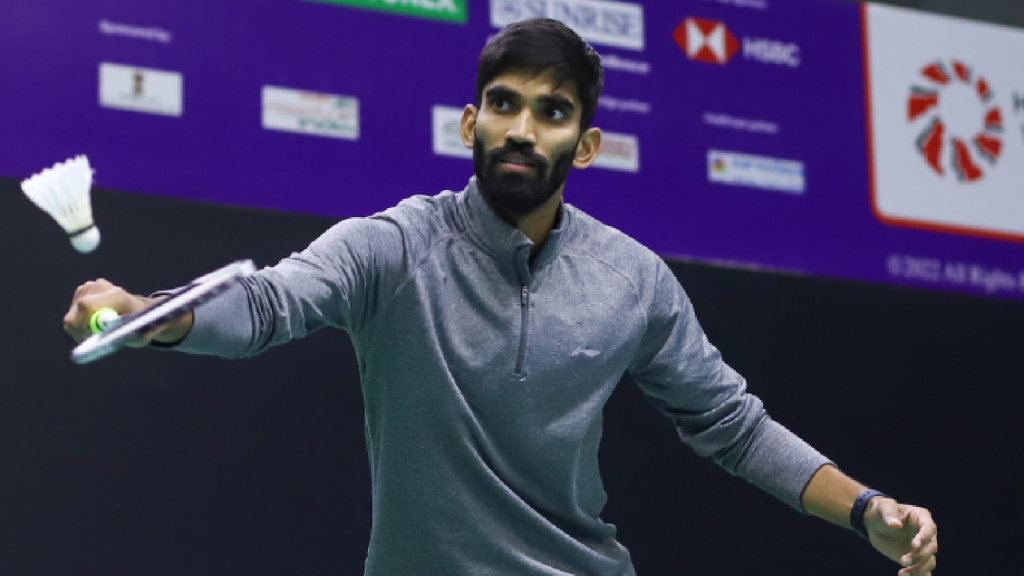
French badminton star Alex Lanier had to dig deep to overcome India’s Kidambi Srikanth in a thrilling three-game encounter at the Denmark Open. The reigning world champion eventually secured a 11-21, 21-15, 21-15 victory in 65 minutes, but not before Srikanth’s extraordinary net play left him struggling to find answers.
Srikanth, who is 12 years older than Lanier, produced a performance that showcased the skill, deception and precision that made him one of India’s most celebrated badminton players. His spinning net shots and sharply angled dribbles repeatedly unsettled the Frenchman, forcing Lanier to rethink his approach during the match.
Lanier’s coach, Kestutis Navickas, recognised the problem early and repeatedly instructed his player to move away from the net and build attacks from deeper positions. The Frenchman eventually found a solution through speed, defensive discipline and more proactive movement, turning the match around after losing the opening game.
Although Srikanth ultimately suffered defeat in the pre-quarterfinal of the Super 750 tournament, his performance demonstrated that his technical brilliance remains a formidable weapon against elite opposition.
Kidambi Srikanth’s Spinning Net Shots Leave World Champion Alex Lanier Baffled
Kidambi Srikanth may not have won a World Tour title in the current tournament era, but his performance against Lanier offered a reminder of his extraordinary ability at the net. The Indian veteran has six Super Series titles to his name, and his experience was evident throughout the opening game.
Playing with confidence and precision, Srikanth controlled the front court with spinning tumbles, deceptive dribbles and delicate angled shots. His ability to make the shuttle rotate sharply after crossing the net left Lanier struggling to anticipate where it would land and how he could return it effectively.
The Frenchman often found himself waiting for the shuttle to settle, even when positioned close to the net. That hesitation gave Srikanth the opportunity to push the next shot behind his opponent, forcing Lanier to move quickly and disrupting his rhythm.
Srikanth’s technique was particularly effective because he combined his net variations with a smooth and efficient attacking game. His smash remained a major weapon, while his ability to disguise shots made it difficult for Lanier to predict the direction of the shuttle.
One memorable moment came in the second game when Srikanth finished a fast-paced rally at 5-3 with a reverse slice down the line. The shot was so well executed that Lanier appeared impressed, responding with an audible expression of surprise.
It was a small moment in a match that ultimately went against Srikanth, but it captured the quality of his performance. Even against a newly crowned world champion, the Indian was capable of producing shots that demanded an immediate tactical response.
Alex Lanier’s Coach Kestutis Navickas Identifies the Problem
Lanier’s difficulties became clear during the first-game interval. His coach, Kestutis Navickas, questioned what was going wrong, and the Frenchman pointed directly to Srikanth’s spinning net shots and speed.
“It’s spinning too much. He’s too fast,” Lanier complained.
The exchange illustrated how thoroughly Srikanth had disrupted the world champion’s rhythm. Lanier was not simply losing rallies; he was struggling to find a comfortable way to approach the net without giving the Indian another opportunity to dictate the exchange.
Navickas recognised that continuing to challenge Srikanth at the front court would play into the Indian’s strengths. He therefore encouraged Lanier to retreat from the net and begin constructing his attacks from farther back, where he could use his speed and power more effectively.
The coach also urged his player to become more proactive instead of waiting for confidence or the right feeling to arrive naturally.
“You don’t wait until you get the feeling of being proactive. Force the feeling to push your legs into moving,” Navickas told Lanier.
The message was straightforward: Lanier needed to move his feet, take the initiative and stop allowing Srikanth to dictate the pace of every exchange.
The Frenchman gradually responded to those instructions. Rather than allowing the Indian to dominate the front court, he began using his speed to pressure Srikanth and attack the shuttle more decisively.
Why Srikanth’s Net Game Was So Difficult to Handle
Srikanth’s effectiveness at the net came from a combination of spin, deception and precise placement. His shots were not merely designed to bring the shuttle close to the tape; they forced Lanier to make difficult decisions about when and where to move.
A spinning net shot can be particularly challenging because the shuttle’s rotation affects the way it travels and falls after crossing the net. When executed with sufficient precision, it can make an opponent hesitate or attempt a hurried return, creating an opening for the next shot.
Srikanth used those variations to keep Lanier uncertain. Sometimes, he played a delicate dribble that forced the Frenchman forward. On other occasions, he pushed the shuttle behind him, exploiting the space created by his movement towards the net.
That uncertainty was central to the Indian’s strong opening game. Lanier struggled to establish a consistent response, while Srikanth continued to find ways to take control of rallies through his touch and anticipation.
The veteran also demonstrated that his game was not limited to delicate net exchanges. His reverse slice and attacking shots gave him alternative ways to finish rallies, preventing Lanier from focusing exclusively on defending the front court.
For Lanier, the challenge was to recognise when to challenge Srikanth’s spin and when to avoid playing into his hands. His coach’s instructions during the intervals reflected the importance of making better tactical decisions rather than attempting spectacular returns in every rally.
Alex Lanier Turns the Match Around With Speed and Aggression
After losing the opening game 21-11, Lanier returned with a different approach. He began to use his speed more effectively, attacking Srikanth’s returns and reducing the Indian’s opportunities to dominate at the net.
The shift in tactics gradually changed the match. Instead of allowing Srikanth to dictate the exchanges, Lanier applied greater pressure and forced him to respond at a faster pace.
Srikanth’s net game remained dangerous, but the increased intensity began to produce errors. As Lanier attacked more decisively, the Indian found it harder to maintain the same level of control that had characterised the opening game.
The Frenchman took the second game 21-15 to level the contest. His improvement was not simply a matter of hitting harder; it came from changing where he played the rally and how quickly he moved into attacking positions.
Lanier’s coach continued to emphasise that the Frenchman should not allow Srikanth to draw him into a battle at the net on the Indian’s terms. The focus was on lifting the shuttle when necessary, using slices and moving forward only when the opportunity was right.
“He would want to control the net. Just lift. No need to play crazy good shot,” Navickas advised.
The guidance encouraged Lanier to prioritise consistency and court positioning over unnecessarily ambitious shots. By keeping the rally under control and choosing the right moment to attack, he could reduce the effectiveness of Srikanth’s favourite weapon.
Srikanth Starts the Decider Strongly Despite Lanier’s Comeback
The third game began with Srikanth showing that he was far from beaten. After the change of ends, the Indian raised his intensity and moved into a 5-2 lead, putting immediate pressure on the world champion.
Srikanth also demonstrated his tactical flexibility by varying the height and depth of his shots. Instead of relying exclusively on spinning net dribbles, he sent high clears and deeper shots that forced Lanier to cover more ground.
Those changes helped the Indian disrupt the Frenchman’s rhythm once again. By moving Lanier backwards and then bringing him forward, Srikanth attempted to prevent his opponent from settling into a comfortable attacking pattern.
At one stage, the Indian held an 11-9 lead. One particularly effective exchange saw Lanier become caught around mid-court before Srikanth used a flick to send the shuttle past him. The Frenchman had attempted to be clever at the net, but the Indian anticipated the opportunity and exploited the space.
The rally underlined Srikanth’s ability to read his opponent’s movement and respond with a deceptive shot. Even as Lanier began to find solutions, the Indian continued to create moments that threatened to swing the contest back in his favour.
Navickas, however, remained focused on the strengths that could help his player recover. He advised Lanier to avoid unnecessary jumps, use angled smashes and trust his speed.
“No need to jump. Just smash with an angle,” Navickas told his player.
The advice reflected the tactical direction of the match. Lanier needed to use his physical attributes and attacking ability to overcome Srikanth’s technical control, rather than attempting to outplay the Indian in the very areas where he was most dangerous.
‘Crazy Stuff’: Coach Urges Lanier to Challenge Srikanth’s Spin
The exchanges between Lanier and Navickas showed just how unusual Srikanth’s net play had become for the Frenchman. The coach and his player described the Indian’s shots as “crazy stuff” while trying to develop a response that would prevent the same pattern from repeating.
Navickas understood that simply retreating from the net would not be enough. Lanier also needed to learn how to challenge the spin when appropriate and avoid allowing Srikanth to dictate the next shot automatically.
The coach encouraged him to lift the shuttle when necessary, vary his response and wait for the right opportunity to launch a hard attack. The objective was to stop treating every spinning return as an invitation to attempt an extraordinary counter-shot.
That distinction proved important. Against a player as skilled as Srikanth, trying to produce a spectacular response on every occasion can lead to unnecessary errors. A more measured approach gives the opponent fewer opportunities to exploit impatience.
Lanier gradually found the right balance between defence and attack. His speed allowed him to recover from difficult positions, while his improved decision-making helped him turn more rallies into attacking opportunities.
Once the Frenchman began to apply sustained pressure, Srikanth’s margin for error narrowed. The Indian could still produce moments of brilliance, but maintaining control became increasingly difficult against Lanier’s pace and defensive resilience.
How Lanier’s Speed Finally Overpowered Srikanth
The decisive factor in the match was Lanier’s ability to turn the contest into a faster and more physically demanding battle. Srikanth had enjoyed considerable success when he could control the net and dictate the direction of rallies, but the Frenchman’s speed disrupted that advantage.
By attacking more aggressively and moving forward with greater confidence, Lanier forced Srikanth to make quicker decisions. The Indian began to produce net errors, while the Frenchman gained confidence from taking the initiative instead of reacting passively.
Lanier’s defence also played an important role. His ability to retrieve difficult shots and maintain pressure allowed him to survive exchanges that might otherwise have ended in Srikanth’s favour.
The match therefore became a contest between two contrasting strengths. Srikanth relied on touch, deception, placement and his understanding of the front court. Lanier countered with speed, movement, defence and increasingly assertive attacking play.
After taking the second game 21-15, Lanier maintained that approach in the decider. Although Srikanth briefly regained the advantage and led 11-9, the Frenchman eventually imposed his pace and completed the comeback.
Lanier won the deciding game 21-15, sealing an 11-21, 21-15, 21-15 victory after 65 minutes. The result sent the world champion through, but the performance also showed how effectively Srikanth could challenge a younger opponent through technical quality.
Kidambi Srikanth’s Performance Offers Encouragement Despite Defeat
For Srikanth, the loss will have been disappointing, but his display offered several positives. The Indian veteran demonstrated that his net game remains capable of troubling elite players and forcing them to make significant tactical adjustments.
His ability to control the opening game and establish an early advantage against the reigning world champion was particularly notable. Lanier needed guidance from his coach and a substantial change in approach before he could turn the match around.
Srikanth’s performance also highlighted the value of adding new dimensions to an established playing style. His spinning net shots gave him a weapon that continued to create problems even after Lanier began to understand the pattern.
The challenge for Srikanth was maintaining that effectiveness as the Frenchman increased the pace. Lanier’s aggression reduced the time available for the Indian to set up his preferred net exchanges, while the growing pressure contributed to errors.
At 33, Srikanth faced a world champion 12 years younger than him, yet he managed to make the encounter highly competitive. His performance was a reminder that experience and technical precision can still create serious problems for younger opponents with greater speed and athleticism.
Although the result went against him, Srikanth’s display at the Denmark Open showed that his most distinctive skills remain relevant at the highest level. Lanier advanced by finding a solution, but he had to work through a difficult tactical puzzle to get there.
Alex Lanier vs Kidambi Srikanth: Match Result and Key Details
| Match Detail | Information |
|---|---|
| Tournament | Denmark Open |
| Round | Pre-quarterfinal |
| Players | Alex Lanier vs Kidambi Srikanth |
| Winner | Alex Lanier |
| Final score | 11-21, 21-15, 21-15 |
| Match duration | 65 minutes |
| Key tactical factor | Lanier’s speed, defence and attacking pressure |
| Srikanth’s standout weapon | Spinning net shots and deceptive dribbles |
| Lanier’s coach | Kestutis Navickas |
Conclusion
Alex Lanier survived a major test from Kidambi Srikanth at the Denmark Open, recovering from an 11-21 opening-game defeat to win 15-21 in the next two games. The French world champion’s victory was built on tactical adjustments, speed and defensive resilience.
Yet the match will also be remembered for Srikanth’s remarkable net play. His spinning tumbles and deceptive dribbles left Lanier struggling for answers, prompting coach Kestutis Navickas to repeatedly advise his player to avoid being drawn into the Indian’s preferred front-court exchanges.
Lanier eventually found a way to impose his pace and turn the match around, but Srikanth had already demonstrated that his technical brilliance remains a threat. The Indian veteran may have exited the tournament, but his performance proved that his net game still has plenty of sting.
Frequently Asked Questions
Who won the Alex Lanier vs Kidambi Srikanth match at the Denmark Open?
Alex Lanier defeated Kidambi Srikanth 11-21, 21-15, 21-15 in 65 minutes in their Denmark Open pre-quarterfinal encounter.
Why did Alex Lanier struggle against Kidambi Srikanth?
Lanier initially struggled to handle Srikanth’s spinning net shots, deceptive dribbles and precise placement. The Indian’s control of the front court made it difficult for the Frenchman to establish his preferred attacking rhythm.
What advice did Kestutis Navickas give Alex Lanier?
Navickas advised Lanier to retreat from the net, use his speed, move proactively and construct attacks from deeper positions. He also encouraged the Frenchman to lift the shuttle when necessary and attack with angled smashes instead of attempting difficult shots at every opportunity.
How long did the Alex Lanier vs Kidambi Srikanth match last?
The match lasted 65 minutes, with Lanier recovering from a first-game defeat to win the next two games and advance.
What was Kidambi Srikanth’s standout strength in the match?
Srikanth’s spinning net shots and deceptive dribbles were his most effective weapons. They repeatedly unsettled Lanier and forced the Frenchman to change his tactics during the match.
What was the final score of the match?
Alex Lanier defeated Kidambi Srikanth 11-21, 21-15, 21-15 to secure his place in the next round of the Denmark Open.
For breaking news and live news updates, like us on Facebook or follow us on Twitter and Instagram. Read more on Latest Sports on thefoxdaily.com.



COMMENTS 0