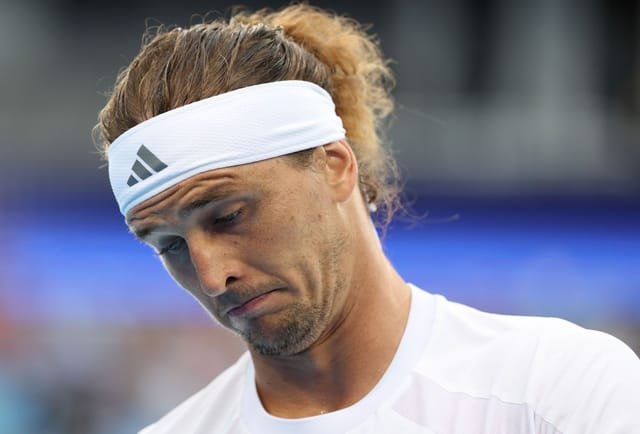
Alexander Zverev‘s Cincinnati Open campaign ended in frustration as Tommy Paul produced a dramatic comeback to defeat the World No. 3 in the final round. However, the German’s performance was not the only talking point after the match, with his confrontation with the chair umpire over a foot-fault call drawing significant attention from fans.
Zverev appeared certain that he had not committed a foot fault and challenged the umpire’s decision during the match. A subsequent replay shown by the broadcaster appeared to confirm that Zverev had indeed moved his foot into the restricted area, turning the dispute into one of the most discussed moments of his Cincinnati campaign.
The controversy came during an already tense contest. Zverev won the opening set but eventually lost 4-6, 7-6 (6), 6-4 against American player Tommy Paul after surrendering a strong position in the deciding set.
What Happened Between Alexander Zverev and the Chair Umpire?
The incident occurred after the chair umpire called a foot fault against Zverev. The German player immediately questioned the decision and approached the umpire’s chair to challenge the call.
The umpire explained that Zverev’s left foot had been very close to the line.
“The left one was very close.”
Zverev strongly disagreed with the explanation and insisted that his movement had not crossed the line.
“Yeah, but I don’t move it. So it’s impossible. I’ve never foot-faulted in my entire career. Not once.”
The situation became more controversial when a replay was subsequently shown during the broadcast. The replay appeared to show that Zverev had committed the foot fault, directly contradicting his immediate assessment of the incident.
That contrast between Zverev’s certainty and the replay quickly became a major talking point among viewers.
Why Fans Turned on Zverev
Tennis fans reacted strongly to Zverev’s argument with the chair umpire. Some accused the German of showing arrogance, while others focused on what they perceived as a lack of self-awareness during the dispute.
Several social-media users criticised Zverev for dismissing the call before seeing the replay.
One fan described his reaction as “entitled”, while another questioned how Zverev could be so certain that the call was impossible without first reviewing the incident.
The criticism was not necessarily about the existence of an argument itself. Players regularly challenge calls and question officials during high-pressure matches. The stronger reaction came because the later replay appeared to support the umpire’s decision.
Foot Faults Are More Important Than They Look
A foot fault can appear like a minor technical infringement, but it directly affects the legality of a serve.
When serving, a player must remain behind the appropriate baseline until the ball is struck. If the server steps on or crosses the baseline too early, the serve can be called a foot fault.
The importance of the rule becomes clearer in a professional match because serving is one of the biggest weapons available to elite players. A foot fault can result in the loss of a first serve and force the player to rely on a second serve, which can significantly change the point.
For a player such as Zverev, whose serve is one of the strongest aspects of his game, losing a first serve through a foot fault can be particularly frustrating.
Zverev’s Serving Numbers Tell Another Story
The foot-fault controversy occurred during a match in which Zverev’s serve was already producing mixed results.
He fired 14 aces, demonstrating the enormous power and effectiveness of his delivery. However, he also committed nine double faults.
| Alexander Zverev vs Tommy Paul | Performance |
|---|---|
| Match result | Tommy Paul won |
| Score | 4-6, 7-6 (6), 6-4 |
| Aces by Zverev | 14 |
| Double faults by Zverev | 9 |
| Sets won by Zverev | 1 |
| Sets won by Paul | 2 |
The numbers highlight the contrast in Zverev’s performance. His first serve remained a major weapon, but the number of double faults gave Paul additional opportunities throughout the match.
Against an opponent capable of staying mentally composed in long rallies, those free points can become extremely costly.
How Tommy Paul Turned the Match Around
Zverev appeared to have control after winning the opening set 6-4.
Paul, however, refused to allow the match to slip away. The American remained competitive during the second set and eventually forced a tiebreak, where he held his nerve to level the contest.
The match was also interrupted by rain, adding another layer of difficulty for both players.
After play resumed later in the day, Zverev initially appeared to regain control. He moved into a 4-2 lead in the deciding set and seemed positioned to close out the contest.
Instead, Paul produced the decisive comeback.
Paul Wins Four Consecutive Games
The turning point came when Paul won four games in succession after trailing 2-4 in the final set.
That sequence transformed the match completely.
Rather than allowing Zverev to dictate the final stages, Paul became increasingly aggressive and composed. Zverev, meanwhile, struggled to regain the momentum he had enjoyed earlier in the set.
Paul’s ability to remain focused after falling behind was arguably more important than any individual shot. In a deciding set against a top-three opponent, protecting concentration after a momentum shift is often the difference between advancing and going home.
Zverev’s Cincinnati Exit Was About More Than One Call
It would be easy to make the foot-fault incident the entire story of the match, but doing so would overlook the bigger issue in Zverev’s defeat.
The German had several opportunities to win the contest.
He led by a set, later held a 4-2 advantage in the deciding set and produced 14 aces. Yet those advantages were not enough to prevent Paul’s comeback.
The nine double faults also indicate that Zverev did not have complete control over his serving performance. At critical moments, the difference between a clean first serve and a second serve can dramatically affect the outcome of a point.
Rain Break Changed the Rhythm
The rain interruption added an unusual element to the contest.
Zverev was leading when play was stopped, meaning both players had to deal with the mental challenge of leaving the court and returning later with the match still unresolved.
Such interruptions can benefit either player. The leading player may lose momentum, while the trailing player receives time to reset and rethink tactics.
In this case, Paul appeared to use the break effectively.
When play resumed, he eventually found a way to recover from his 2-4 deficit in the deciding set and close out the match.
Why Paul’s Comeback Matters
Defeating a player ranked inside the world’s top three is significant, but Paul’s performance was particularly impressive because he had to recover from several difficult situations.
He lost the first set, survived a close second-set tiebreak and then found himself behind 2-4 in the deciding set.
Instead of becoming passive, Paul continued competing for every game.
That resilience ultimately exposed one of the most important lessons from the match: a lead is only valuable if the player can protect it.
Zverev’s Grand Slam Ambitions Remain Intact
Despite the disappointing Cincinnati result, Zverev still has a major opportunity ahead at the US Open.
The German enters the final Grand Slam tournament of the season with the ambition of adding another major title to his career. Having already won the 2026 French Open, he has demonstrated that he is capable of performing at the highest level over two weeks.
The challenge now is to turn the lessons from Cincinnati into improvements before the US Open begins.
What Zverev Needs to Fix Before the US Open
The Cincinnati defeat provides several areas for Zverev and his team to examine.
- Reduce double faults: Nine double faults is a significant number in a high-level three-set match.
- Protect leads: A 4-2 advantage in the deciding set eventually became a defeat.
- Improve closing moments: Big matches are often decided by a handful of points late in sets.
- Control emotions: Arguments with officials can consume valuable mental energy during crucial moments.
- Maintain focus after interruptions: The rain delay required a fresh mental approach when play resumed.
The Mental Side Could Be Crucial in New York
Zverev’s biggest challenge may not be his technical game.
He possesses a powerful serve, strong baseline skills and the experience of competing in major finals. His 2026 French Open victory also provides evidence that he can handle the pressure of Grand Slam tennis.
The more important question is how he responds when matches begin moving away from him.
Against Paul, Zverev had opportunities to regain control but could not stop the American’s four-game winning streak. At the US Open, similar lapses could be even more costly because the quality of opposition becomes stronger as the tournament progresses.
Comparison: Winning the French Open vs Losing in Cincinnati
The contrast between Zverev’s Grand Slam success and his Cincinnati exit makes the result particularly interesting.
| Factor | French Open 2026 | Cincinnati Open 2026 |
|---|---|---|
| Outcome | Grand Slam champion | Eliminated |
| Opponent in highlighted result | Various opponents | Tommy Paul |
| Key challenge | Managing a two-week tournament | Protecting a deciding-set lead |
| Serve-related issue | Elite-level weapon | 14 aces, 9 double faults |
The comparison shows why one disappointing tournament should not completely change the perception of Zverev. He remains a Grand Slam champion, but Cincinnati highlighted vulnerabilities that opponents may attempt to exploit in New York.
Could the Cincinnati Defeat Actually Help Zverev?
There is another way to view the defeat.
Early exits before a Grand Slam can provide valuable information. Zverev and his coaching team now have a clear example of what happens when a significant lead is not converted into victory.
The foot-fault controversy also offers a reminder about emotional control. Questioning an official is part of competitive sport, but allowing frustration to dominate the next few points can be more damaging than the original call.
If Zverev uses the defeat as preparation rather than allowing it to become a confidence problem, the Cincinnati loss could ultimately prove useful.
What Fans Should Expect From Zverev at the US Open
Zverev remains one of the leading contenders heading into the US Open. His Grand Slam experience, serving power and ability to compete in long matches make him a dangerous opponent for any player in the draw.
However, his Cincinnati performance suggests that his route to another major title will require greater consistency in pressure moments.
The German cannot afford to give opponents repeated opportunities through double faults or allow frustration to take over during controversial moments.
At Grand Slam level, small lapses can quickly become tournament-ending mistakes.
Conclusion
Alexander Zverev’s Cincinnati Open defeat to Tommy Paul produced controversy as well as disappointment. The World No. 3 questioned a foot-fault call during the match and insisted that he had never committed such an error, but a replay appeared to support the chair umpire’s decision.
The incident triggered strong reactions from tennis fans, with some accusing Zverev of entitlement and a lack of self-awareness. However, the larger issue for the German is what happened on the scoreboard.
Zverev hit 14 aces but also produced nine double faults, won the opening set and later led 4-2 in the deciding set. Paul nevertheless won four consecutive games to complete a remarkable comeback.
With the US Open now approaching, Zverev has little time to dwell on the defeat. His 2026 French Open triumph proves that he has the quality to win another Grand Slam, but Cincinnati has exposed several areas that need attention.
If Zverev can improve his serving consistency, manage his emotions and close out matches more effectively, the Cincinnati disappointment could become a useful lesson. If the same problems continue in New York, however, his path toward a second Grand Slam title of the season could become considerably more difficult.
For breaking news and live news updates, like us on Facebook or follow us on Twitter and Instagram. Read more on Latest Sports on thefoxdaily.com.





COMMENTS 0