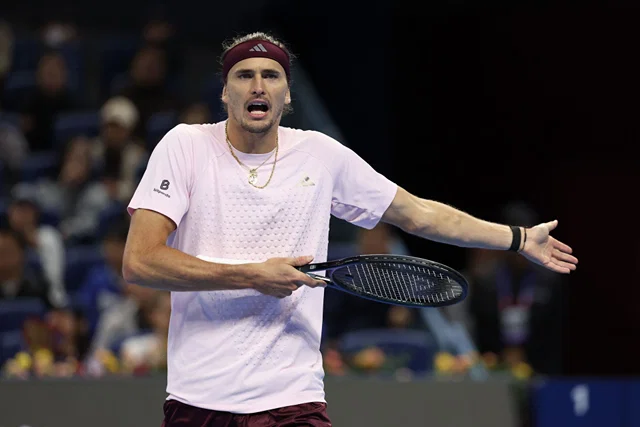
Alexander Zverev‘s rise to the World No. 1 position has sparked debate in the tennis world, with a French journalist delivering a particularly blunt assessment of the German’s achievement ahead of the Paris Masters. While acknowledging that Zverev deserves the ranking, Eurosport France commentator Frédéric Verdier questioned the quality of his season and argued that the absence of Carlos Alcaraz and Jannik Sinner due to injuries played a significant role.
The 29-year-old became the 30th man to reach the top of the ATP rankings when the latest standings were updated on Monday. He also became the oldest first-time World No. 1 in more than 50 years, adding another major milestone to a career that includes two Grand Slam titles.
Zverev won his first Grand Slam title at Roland Garros in June before claiming his second at the US Open in September. However, his achievement has not been free from criticism, particularly because two of his biggest rivals spent significant periods away from competition through injury.
Speaking during the Paris Masters, on the day Zverev received the World No. 1 trophy, Verdier questioned the German’s record against elite opponents. He pointed to Zverev’s 3-9 win-loss record against other Top 10 players and described the season as unusual for someone occupying the highest position in men’s tennis.
French Journalist Questions Alexander Zverev’s World No. 1 Season
Verdier made it clear that he was not disputing Zverev’s right to become World No. 1. Instead, his criticism focused on how the German reached the position and the relatively small number of victories he recorded against Top 10 opponents during the season.
According to the journalist, it was unusual for a player at the top of the rankings to have won only three matches against other members of the Top 10. He described the situation as a peculiar feature of a season shaped by injuries to several leading players.
“He deserves that spot, but it’s practically unheard of for a world No. 1 to beat just three Top 10 players in a season. I said three matches! No world No. 1 has ever had to beat such a tiny number of Top 10s. It was really a peculiar season, a baffling one,” Verdier said.
The statistic became central to Verdier’s argument. Although Zverev accumulated enough results across the season to reach the top of the rankings, his record against the highest-ranked opponents raised questions for the commentator about the strength of his campaign.
The timing of Zverev’s rise also contributed to the discussion. Carlos Alcaraz and Jannik Sinner, widely regarded as two of the leading players in men’s tennis, were forced to spend months away from the tour because of injuries. Their absence created an opportunity for other contenders to collect important ranking points and compete for the No. 1 position.
Verdier also brought Novak Djokovic into the conversation. The Serbian continued to demonstrate his ability to challenge the leading players, defeating Zverev in their China Open meeting in October.
Djokovic claimed a 4-6, 6-4, 6-4 victory over the German, a result that Verdier used to support his argument that the veteran remained capable of producing a higher level of tennis than the newly crowned World No. 1 on a good day.
“The two best players, Sinner and Alcaraz, were sidelined one after the other due to injuries. Novak Djokovic remains this kind of immense sacred ectoplasm, who, on a good day, like he proved in Beijing against Zverev, is better than this particular world No. 1,” he continued.
Verdier’s comments therefore centred on the difference between achieving the ranking and demonstrating superiority over the strongest opponents. While Zverev’s consistency helped him reach the top, the journalist argued that his results against elite competition did not fully reflect the standard usually associated with a World No. 1.
Verdier Criticises Zverev’s Playing Style and Recent Results
The French journalist’s assessment went beyond statistics. He acknowledged Zverev’s physical endurance and ability to remain competitive throughout a demanding season, but questioned the entertainment value of his performances.
Verdier suggested that Zverev had benefited from his consistency and physical durability but did not regularly produce the kind of exciting tennis expected from a player holding the top ranking. He described many of the German’s matches as tedious and argued that his performances often lacked an additional element of excitement.
“It’s special to see a player who gets crowned, through sheer endurance, for the body of his work, but who, on the court, brings nothing extra and delivers no emotion, very little thrill. His matches are generally tedious. Except when he faces stiff competition. And unfortunately, when that’s the case (I’m talking Top 10 players, even guys like De Minaur in Vienna), it usually doesn’t go well for him at all,” he said.
Verdier also referred to Zverev’s recent defeat against Alex de Minaur in the Vienna Open semifinals. The result was another example cited by the journalist when discussing the German’s difficulties against high-level opposition.
His comments were particularly direct because Zverev had just achieved one of the biggest milestones of his career. Becoming World No. 1 is a significant accomplishment, but Verdier’s remarks highlighted the debate surrounding the circumstances of the German’s rise and whether his performances against the strongest players matched the status.
Nevertheless, Zverev’s position at the top of the rankings reflects the results he accumulated over the season. His ability to remain fit, compete consistently and collect ranking points across tournaments has been a major part of his success.
Alexander Zverev Responds to Criticism Over His World No. 1 Ranking
Zverev has already addressed criticism surrounding his rise to the top of the ATP rankings. During a press conference at the Vienna Open, the German responded to suggestions that he benefited from injuries to Alcaraz and Sinner.
Rather than dismissing the importance of his rivals, Zverev acknowledged Sinner’s quality and admitted that the Italian had been the best player in the world when fully fit. However, he argued that physical fitness and the ability to remain available for competition are essential parts of professional tennis.
“Many people can say that I only became No. 1 because of Sinner and Alcaraz’s injuries, but physical fitness and health are an integral part of the sport. When Jannik was healthy, he was the best player in the world, there’s no doubt about that. I’d be an idiot to claim that I was as good as him at that time,” Alexander Zverev said.
Zverev’s response reflected his view that staying healthy is not separate from sporting performance. Players must manage their bodies, maintain their fitness and remain available to compete throughout a demanding calendar. From his perspective, those factors are part of what makes a successful tennis season.
The German also made a case for his overall consistency, arguing that his results across the year justified his position even though he had not managed to defeat Sinner in their direct meetings.
Zverev revealed that he lost all five matches he played against Sinner in 2026 but maintained that his overall season had been strong enough to put him in contention for the top ranking.
“But I think I’ve had the best season, even if I didn’t beat him. I was the second best player because Carlos was injured and he was not able to compete. When I look at my off-season preparation in December, I do about 5 to 6 hours of physical training per day, compared to 1 hour 30 of tennis. That’s precisely to stay healthy and avoid injuries,” he added.
His comments underline the importance he places on physical preparation. Zverev believes that the work he puts into maintaining his fitness allows him to compete consistently and avoid the injury problems that have affected some of his biggest rivals.
Although he acknowledged Sinner’s superiority during the Italian’s healthy periods, Zverev defended the value of his own season. His argument is that the rankings reward performances over an extended period rather than being determined solely by head-to-head results against particular opponents.
Zverev Targets Another Paris Masters Title
Despite the discussion surrounding his World No. 1 ranking, Zverev will now turn his attention to the Paris Masters as he looks to add another title in the French capital.
The German previously won the tournament in 2024 and is now chasing a second triumph. He will begin his campaign against Lorenzo Musetti after receiving a first-round bye.
The Paris Masters represents another opportunity for Zverev to strengthen his position through performances on the court. A strong run would also give him a chance to respond to the criticism surrounding his results against other Top 10 players.
His opening match against Musetti will be an important test as he begins his pursuit of another major indoor title. The Italian is a challenging opponent, meaning Zverev will need to produce a focused performance if he wants to progress deep into the tournament.
However, the German can approach the event knowing that he is already assured of finishing the year as World No. 1. That gives him the opportunity to concentrate on his performance in Paris without worrying about losing the top position before the season concludes.
Can Alexander Zverev Silence His Critics?
Zverev’s rise to World No. 1 has created two contrasting conversations around his season. His supporters can point to his consistency, physical preparation and achievements across the year, including two Grand Slam titles. Critics, meanwhile, have focused on his limited number of victories against Top 10 opponents and the injuries that kept Alcaraz and Sinner away from competition.
Verdier’s comments have brought those questions into sharper focus. The journalist accepted that Zverev deserved the ranking but argued that his performances did not provide the same level of excitement or dominance expected from a player at the top of men’s tennis.
Zverev has responded by defending the importance of fitness and consistency, insisting that remaining healthy is an essential part of the sport. His record against Sinner may not support his claim to have been the strongest player in their direct meetings, but he believes his overall results justified his position.
The Paris Masters now offers him another opportunity to demonstrate his quality against a competitive field. With a second title in the tournament within reach and the year-end No. 1 position already secured, Zverev will be keen to make his performances the main focus rather than the debate surrounding his ranking.
For breaking news and live news updates, like us on Facebook or follow us on Twitter and Instagram. Read more on Latest Sports on thefoxdaily.com.





COMMENTS 0