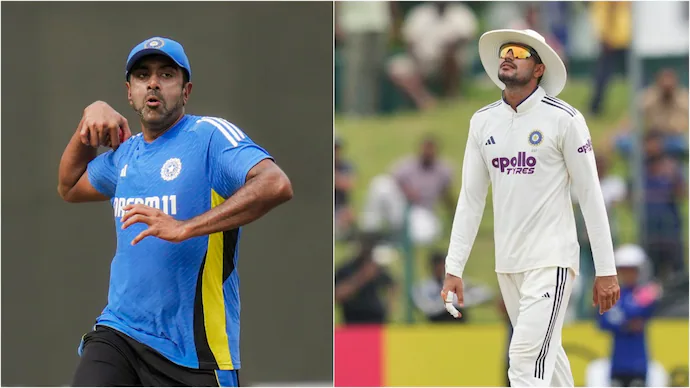
Former India spinner Ravichandran Ashwin has questioned India’s approach during the final stages of the drawn Wellington Test against New Zealand, arguing that Shubman Gill’s team should have continued playing for the remaining 15 overs instead of agreeing to end the contest early.
India had established a commanding position after declaring their first innings at 720 for nine, securing a 352-run lead. However, the visitors could not take the remaining five New Zealand wickets in the second innings. The hosts finished on 239 for five after batting for 120 overs, with Daryl Mitchell and Glenn Phillips helping their team hold on for a draw at Basin Reserve on Monday.
Although the pitch had become increasingly difficult for the bowlers, Ashwin believed India should have maintained their attacking intent until the scheduled end of the final day. He acknowledged that taking five wickets in the remaining overs would have been difficult, but felt the team needed to demonstrate greater urgency and belief in its ability to win.
Ashwin Questions India’s Decision to Settle for a Draw
India entered the final stages of the Wellington Test with a significant advantage after their impressive first-innings performance. The 352-run lead gave the visitors an opportunity to put New Zealand under pressure and push for a result.
However, Mitchell and Phillips resisted the Indian bowling attack, gradually reducing the possibility of a late victory. With 15 overs remaining, both teams agreed to call off the contest, leaving India with a draw rather than a potential win.
Ashwin felt the decision reflected a lack of conviction from the Indian side. According to the former spinner, the team should have continued attacking and forced New Zealand to defend every remaining delivery.
“I didn’t see the belief in them to win the match,” Ashwin said, pointing to what he felt was a lack of urgency in the field.
His criticism was not necessarily about the final result. Instead, Ashwin focused on the attitude and intensity India displayed when the opportunity to take a few more wickets was still available.
He argued that teams must continue looking for victories even when the chances of achieving them appear limited. In his view, a dominant position in a Test match should encourage a side to maintain pressure rather than become comfortable with a draw.
Ashwin Uses Virat Kohli’s Captaincy as an Example
To explain the kind of intensity he expected from India, Ashwin referred to Virat Kohli’s captaincy. He did not claim that Kohli or another captain would necessarily have secured victory from the same situation. Instead, he highlighted the urgency that Kohli often demanded from his players.
“There is one thing you can learn from Virat Kohli’s captaincy. I will never say that another captain or another bowler would have won you the Test match from that situation. But, urgency helps,” Ashwin said.
The former India spinner believes that maintaining an aggressive approach is an important part of competing in Test Cricket, particularly when playing overseas. Even if the pitch and match situation make wickets difficult to find, the fielding side can still create pressure through its field placements, bowling changes and energy in the field.
Ashwin’s reference to Kohli was therefore focused on the mentality required to keep pursuing a result. He suggested that India needed to show the same willingness to fight rather than allow New Zealand’s batters to settle into a comfortable rhythm.
Ashwin Criticises India’s Fielding Intensity Against Daryl Mitchell
Ashwin also questioned how the Indian fielders interacted with Daryl Mitchell during his innings. The New Zealand batter played an important role in frustrating India’s attempts to take wickets, and Ashwin felt the fielding side allowed him to become too comfortable at the crease.
He recalled instances in which Mitchell appeared relaxed enough to engage in conversations with Indian players and even share jokes with the fielders. Ashwin believed such interactions were not appropriate when the team was still trying to force a result.
“I noted Daryl Mitchell wasting time by trying to fix the sight screen. He was talking to our captain, our players. He was laughing and sharing jokes with our fielders. These things never happened in our team,” Ashwin said.
He explained that India’s players could enjoy themselves when they were firmly in control of a match, but their approach needed to change when they were chasing a result.
“Yes, when we had the upper hand, we would find time to enjoy. But, when we are chasing a result, we were always ready for a fight. You can’t let the batter go into his comfort zone. The fielders were not coming close.”
Ashwin’s comments highlighted the importance of maintaining concentration and competitive intensity throughout a Test match. He felt the Indian fielders should have stayed closer to the batters and made the final period more uncomfortable for New Zealand.
Mitchell and Phillips were able to remain at the crease and frustrate the bowling attack, helping New Zealand survive until the two teams agreed to a draw. For Ashwin, India’s inability to maintain pressure was an important part of the discussion surrounding the final day’s approach.
Slow Pitch Made Wicket-Taking Difficult
Despite his criticism, Ashwin acknowledged that the conditions had become increasingly challenging for India’s bowlers. The pitch at Basin Reserve had slowed considerably, reducing the assistance available to the bowling attack as the match progressed.
He explained that New Zealand conditions can become particularly difficult for spinners when a surface loses its pace and stops offering sharp turn. According to Ashwin, the pitch would have needed several additional days of wear before producing the kind of turn that could significantly help the spinners.
“The pitch had slowed down a lot. I have seen this in New Zealand. You would have got sharp turn only if this Test went onto Day 8,” he said.
The observation acknowledged the practical difficulty India faced while trying to take five wickets in the closing overs. However, Ashwin maintained that difficult conditions should not automatically lead a team to abandon its pursuit of victory.
He believed the bowling attack needed a more inventive approach, with the fielders positioned aggressively and the spinners given an opportunity to create pressure. Even if the result remained unchanged, India could have made New Zealand work harder to secure the draw.
Ashwin Responds to Shubman Gill’s Explanation
India captain Shubman Gill had explained that the fast bowlers had already delivered close to 50 overs and faced a short turnaround before the next Test. Managing the workload of the bowling attack was therefore an important consideration when the teams decided to end the match.
Ashwin recognised that teams sometimes need to make realistic decisions about player fitness and workload. However, he argued that the demands of Test cricket require players to remain prepared for physically demanding situations, particularly when a victory is still possible.
He suggested that India could have adjusted its bowling strategy rather than ending the contest with 15 overs remaining. If the fast bowlers were tired, the team could have relied more heavily on its spinners and brought the fielders closer to the batters.
“Sometimes you have to be realistic, yes. But, this is the demand of Test cricket. Test players have to be prepared for this. If you thought Bumrah was overworked, then bowl seven overs with the spinners, crowd the batters. Show the urgency to win the Test,” he said.
Ashwin’s suggestion was based on the belief that India still had options available to maintain pressure. Rather than expecting the fast bowlers to continue carrying the entire workload, the team could have changed its approach and used the remaining overs to challenge New Zealand.
He also made it clear that dominating a match is not the same as winning it. India’s strong first innings had put them in control, but the inability to complete the job meant they could not claim the full reward.
“Yes, we dominated the Test match, but we didn’t nail it. You won’t win a Test match for dominating, no?”
Ashwin Says India Did Not Have to Take All Five Wickets
Ashwin clarified that his criticism should not be interpreted as a claim that India would definitely have won if they had continued playing. He understood that taking the remaining five wickets in 15 overs was a difficult task, particularly on a slowing surface against determined batters.
His central argument was that India needed to show a stronger desire to force a result. Even if New Zealand eventually survived, continuing to attack would have demonstrated that the visitors were unwilling to accept a draw while time remained.
“I am not even saying India should have taken those five wickets. But, they needed to show the urgency. When you travel overseas and play Tests, you often don’t get into such dominant positions. After coming here, taking a backfoot should irritate you.”
The comments underline the importance Ashwin places on mentality in overseas Test cricket. Teams do not always get opportunities to build a substantial lead and put their opponents under pressure. When such an opportunity arrives, he believes they should make every effort to convert it into a victory.
Wellington Draw Affects India’s World Test Championship Campaign
The drawn result also has implications for India’s World Test Championship campaign. Instead of collecting the 12 points available for a victory, India secured four points from the Wellington Test.
The difference could prove important as the competition progresses, with every result influencing the standings and the teams’ chances of reaching the final. India’s inability to finish the match with a win therefore represents a missed opportunity in their pursuit of a place in the championship final.
Although the team dominated significant portions of the contest, the final result left India with fewer points than they would have earned through victory. Ashwin’s criticism of the team’s approach was partly connected to this wider consequence.
India will now have an opportunity to respond in the second Test against New Zealand. The match is scheduled to take place at Hagley Oval in Christchurch from November 27 to December 1.
India Must Show Greater Urgency in Christchurch
The Wellington Test has raised questions about India’s ability to turn strong positions into victories. The team produced a huge first-innings total and established a 352-run advantage, but New Zealand’s resistance prevented the visitors from completing the job.
Ashwin’s remarks have placed the spotlight on India’s mentality, fielding intensity and tactical decisions during the closing stages. His argument is that teams must continue searching for a result even when the conditions become difficult and the remaining time is limited.
Gill and the Indian coaching staff will now have to assess the lessons from Wellington ahead of the Christchurch encounter. Managing fast-bowler workloads will remain important, but the team will also need to find ways to maintain pressure and make better use of its bowling options.
For India, the next Test offers an opportunity to respond on the field and strengthen their World Test Championship campaign. Ashwin’s message is clear: dominating a match is not enough if the team does not make every possible effort to win it.
For breaking news and live news updates, like us on Facebook or follow us on Twitter and Instagram. Read more on Latest Cricket on thefoxdaily.com.






COMMENTS 0