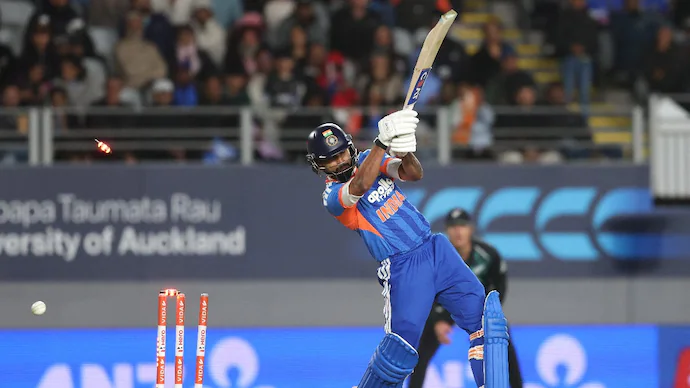
India captain Shreyas Iyer focused on his team’s bowling struggles and Glenn Phillips’ outstanding century after New Zealand secured an 87-run victory in the fourth T20I in Auckland. However, the Indian skipper made no direct assessment of his side’s batting collapse, despite the visitors falling well short while chasing a massive target of 260 runs.
India’s defeat exposed problems with both the bowling and batting departments. New Zealand produced an explosive performance with the bat, powered by Phillips and Michael Bracewell, before their bowlers dismantled India’s top order during the opening over of the chase.
Sanju Samson and Ishan Kishan were dismissed in the first over, leaving India under immediate pressure. The visitors eventually slipped to 61 for four during the powerplay and finished their innings at 172 for nine, suffering a heavy defeat in the penultimate match of the series.
While Iyer acknowledged India’s shortcomings with the ball and praised Phillips’ exceptional performance, his post-match comments largely avoided the batting failure that played a major role in the result.
Shreyas Iyer Focuses on India’s Bowling After 87-Run Defeat
Speaking during the post-match presentation ceremony, Iyer admitted that India’s bowling unit had failed to contain New Zealand’s aggressive approach, particularly during the powerplay.
The hosts made a powerful start and maintained their scoring momentum throughout the innings. Phillips and Bracewell accelerated the scoring dramatically, putting the Indian bowlers under pressure and helping New Zealand reach 259 for seven in their allotted 20 overs.
Iyer identified the early overs as a major problem and acknowledged that India had struggled to execute its bowling plans.
“We fell short in our bowling. The powerplay, especially in the third over, they got the momentum thereon. Exceptional shots from Glenn, some phenomenal shots, pure bliss,” Iyer said.
The Indian captain’s comments reflected his disappointment with the bowling performance, particularly the inability to stop New Zealand from building momentum during the middle and death overs.
Although India had opportunities to restrict the scoring, the New Zealand batters consistently found boundaries and punished loose deliveries. The result was a total that placed enormous pressure on India’s batting lineup.
Glenn Phillips Smashes Stunning 107 off 49 Balls
Glenn Phillips was the standout performer for New Zealand, producing an explosive innings of 107 runs from just 49 deliveries. His century transformed the hosts’ innings and gave them the platform to post a formidable total.
Phillips combined power hitting with aggressive shot selection, regularly finding the boundary against India’s bowling attack. His innings included a series of remarkable sixes that left the visitors struggling to control the scoring rate.
One of the most damaging moments came during the 16th over, when Phillips attacked Nitish Kumar Reddy and collected 32 runs. He struck four consecutive sixes in the over, further shifting the momentum firmly towards New Zealand.
The Indian bowlers struggled to find an effective response as Phillips continued his assault. His ability to target different areas of the ground made it difficult for India to settle on a consistent bowling plan.
Iyer praised the New Zealand batter’s performance and described his shot-making as exceptional. He also acknowledged that Phillips had been consistent throughout the series, giving India plenty to learn from his approach.
Michael Bracewell Provides Perfect Support With 65 off 25
While Phillips dominated the innings, Michael Bracewell played an equally important role in New Zealand’s batting success. The left-handed batter smashed 65 runs from only 25 deliveries, maintaining the pressure on India’s bowlers.
The pair produced a devastating fifth-wicket partnership worth 115 runs from just 41 balls. Their aggressive approach completely changed the tempo of the innings and helped New Zealand finish with 259 for seven.
Phillips and Bracewell combined for 16 sixes, accounting for a significant portion of New Zealand’s 20 maximums during the innings.
The partnership demonstrated how quickly a T20 innings can accelerate when two batters find their rhythm together. India struggled to break the momentum, and the New Zealand pair repeatedly punished deliveries that missed their intended lengths.
For Iyer and the Indian coaching staff, the partnership will provide several areas to review before the final match. India’s bowlers will need to improve their execution, particularly when facing batters capable of scoring boundaries from almost every delivery.
India’s Batting Collapse Begins With Two Early Wickets
Despite New Zealand’s outstanding batting performance, India’s response with the bat was another major concern. Chasing 260, the visitors needed a strong start to maintain a realistic chance of completing the target.
Instead, the chase suffered an immediate setback when Sanju Samson and Ishan Kishan were dismissed during the opening over. Losing two wickets so early left India with little opportunity to build momentum or establish a stable partnership.
The situation became increasingly difficult as New Zealand continued to take wickets. India reached 61 for four during the powerplay, leaving the middle order with an enormous task.
Abhishek Sharma managed only 27 runs, while captain Shreyas Iyer scored 22 before being bowled by Adam Milne. The early dismissals meant India never developed the partnerships required to keep pace with the demanding run rate.
The visitors eventually finished at 172 for nine, falling 87 runs short of New Zealand’s target.
Although chasing 260 was always going to be difficult, the loss of two wickets in the opening over made the challenge considerably harder. India’s batting unit failed to recover from that early damage.
Why Shreyas Iyer’s Post-Match Comments Raised Questions
The most noticeable aspect of Iyer’s post-match assessment was his limited discussion of India’s batting performance. The captain spoke about the bowling struggles, praised Phillips and acknowledged the challenge of adapting to Eden Park’s dimensions.
However, he did not offer a direct explanation for the batting collapse that left India far behind in the chase.
Samson and Kishan’s early dismissals, the powerplay score of 61 for four and the lack of substantial partnerships were important factors in the defeat. India’s middle order also failed to produce the kind of innings needed to make the target competitive.
The absence of a detailed batting assessment does not necessarily indicate that the team will ignore those problems. Iyer did say that India needed to review its performance and return to the drawing board before the final match.
Nevertheless, the batting display will be difficult to overlook when the team analyses the Auckland defeat. India’s top order will need to improve its decision-making and avoid putting the middle order under immediate pressure.
Shreyas Iyer Admits Eden Park Conditions Were Difficult to Adapt To
Iyer also discussed the challenge of playing at Eden Park, a venue known for its unusual dimensions and relatively short boundaries in certain areas.
The Auckland ground can create different challenges for batters and bowlers. Players must adjust their shot selection, field placements and bowling lengths according to the dimensions rather than relying entirely on familiar plans.
Iyer acknowledged that some members of the Indian team were experiencing those conditions for the first time.
“We knew the dimensions were going to be like this. First time for some of them. Not easy to adapt. The way they executed in the first three games was magnificent. Great learning curve,” he said.
The captain’s comments suggested that adapting to the venue had been an important learning experience for the team. He also recognised the performances India had produced in the first three matches.
However, New Zealand managed to use the conditions effectively in the fourth T20I. Their batters repeatedly targeted the shorter boundaries, while India’s bowlers struggled to prevent the flow of runs.
India Look to Bounce Back in Hamilton for Fifth T20I
With the series already secured, India will have one final opportunity to respond when the two teams meet in Hamilton for the fifth and final T20I.
The remaining fixture gives India a chance to address the problems exposed in Auckland and finish the series with a stronger performance.
Iyer stressed the importance of reviewing the defeat and finding a way to execute the team’s plans more effectively.
“Important to retrospect, we have to see how to bounce back. I feel we can go back to the drawing board and execute,” the Indian captain said.
His comments indicate that the team intends to examine its performance before the final encounter. The bowling attack will need to find ways to restrict New Zealand’s aggressive batters, while the batting lineup must avoid another disastrous start.
For India’s top order, the immediate priority will be building partnerships and ensuring that early wickets do not leave the team chasing an unrealistic situation. A more controlled powerplay could give the middle order a better opportunity to settle into the innings.
India’s Batting and Bowling Both Need Attention
The Auckland defeat highlighted two separate problems for India. New Zealand’s explosive batting exposed weaknesses in the bowling performance, while India’s response showed how quickly a chase can collapse after losing early wickets.
Phillips and Bracewell deserve credit for their exceptional partnership, but India’s inability to build a meaningful response also contributed significantly to the result.
The team will need to assess its bowling combinations, execution and plans against aggressive batting. At the same time, the top order must take responsibility for providing a more reliable start.
Iyer’s praise for Phillips was understandable given the quality of the New Zealand batter’s innings. However, India’s own batting performance will also require serious attention before the final T20I.
India vs New Zealand 4th T20I: Key Takeaways
New Zealand defeated India by 87 runs in the fourth T20I in Auckland after scoring 259 for seven. Glenn Phillips led the hosts with 107 off 49 balls, while Michael Bracewell contributed 65 from just 25 deliveries. Their fifth-wicket partnership produced 115 runs in only 41 balls.
India’s chase collapsed early after Sanju Samson and Ishan Kishan were dismissed in the opening over. The visitors slipped to 61 for four in the powerplay before finishing at 172 for nine.
Captain Shreyas Iyer focused his post-match comments on India’s bowling struggles, Phillips’ century and the difficulty of adapting to Eden Park. He did not directly assess the batting collapse, although he called for the team to review its performance and prepare for the final match in Hamilton.
India now have one more opportunity to respond and address the shortcomings exposed by the heavy defeat. Improving the powerplay performance with both bat and ball will be central to their efforts in the fifth T20I.
For breaking news and live news updates, like us on Facebook or follow us on Twitter and Instagram. Read more on Latest Cricket on thefoxdaily.com.






COMMENTS 0