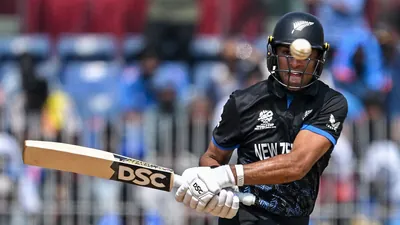
Rachin Ravindra is a doubt for New Zealand’s upcoming T20I series against India after suffering a right shoulder injury during a promotional shoot in Auckland. The setback comes just days before New Zealand are expected to announce their squad for the series, creating uncertainty over the availability of one of their important all-rounders.
New Zealand Cricket confirmed that Ravindra dislocated his right shoulder while attempting a diving catch during filming with Sky earlier this week. Initial assessments conducted on Friday, September 18, found no major structural damage, but the left-handed batter’s return-to-play timeline will depend on how he responds during rehabilitation.
The injury does not automatically rule Ravindra out of the India series. However, with the five-match T20I contest approaching and a demanding Test schedule also ahead, New Zealand will have to balance his short-term availability against his longer-term fitness.
How Rachin Ravindra Suffered the Shoulder Injury
Ravindra’s injury occurred away from a cricket match. According to New Zealand Cricket, the 27-year-old was participating in a promotional shoot in Auckland when he attempted a diving catch.
He landed awkwardly on a safety mat and dislocated his right shoulder.
The incident is an unusual way for an international cricketer to pick up an injury, particularly because the activity was not part of a competitive fixture. New Zealand Cricket’s performance management team said the shoot had been agreed in advance and appropriate safety measures were in place.
The organization also described the incident as a freak accident and indicated that its processes surrounding similar events would continue to be reviewed.
Initial Tests Provide Some Encouragement
The immediate medical assessment offered a relatively positive development.
New Zealand Cricket said the initial examinations did not identify major structural damage. That is important because the severity of a shoulder dislocation can vary significantly, and the rehabilitation period depends on the nature of the injury and the player’s recovery.
However, the absence of major structural damage does not mean Ravindra has been cleared to play.
His return will depend on his rehabilitation progress, and New Zealand have not provided a definite date for his return to competitive cricket.
That uncertainty is why Ravindra remains in doubt for the upcoming T20I series against India.
New Zealand Are Not Taking Any Risks With Ravindra
New Zealand head coach Rob Walter has emphasized that Ravindra’s long-term fitness is the priority.
The Blackcaps have a busy period of Test cricket ahead, and Walter indicated that the team does not want to rush the all-rounder back simply to make him available for the T20I series.
This approach could become particularly important if Ravindra’s recovery takes longer than initially expected. A premature return could potentially create additional problems, while a carefully managed rehabilitation program gives him more time to regain full confidence and function in the injured shoulder.
For New Zealand, the decision is therefore bigger than one five-match series.
Ravindra is viewed as an important part of the team’s wider plans across formats, making his long-term fitness more valuable than forcing a quick comeback.
Why Rachin Ravindra Is Important to New Zealand
Ravindra provides New Zealand with a combination that is difficult to replace: a left-handed top-order batter who can also contribute with the ball.
His role gives the team additional flexibility when constructing its XI. A player who can contribute in more than one discipline allows the captain and selectors to balance the side differently depending on conditions and opposition.
That versatility becomes especially useful in T20 cricket, where teams often need players capable of contributing in multiple phases of a match.
Ravindra’s absence would therefore not simply remove one batter from New Zealand’s lineup. It could force the selectors to rethink the team’s overall combination.
What Ravindra’s Absence Could Mean Against India
If Ravindra is unavailable, New Zealand will have to find a replacement for his contribution at the top of the batting order and potentially compensate for his left-arm spin.
The exact solution will depend on the squad selected for the series.
New Zealand could choose a specialist batter to cover his position or use another all-rounder to maintain the team’s balance. Each option would create a slightly different combination.
That is particularly relevant against India, where matchups can play an important role in T20 cricket. The absence of a left-handed batter can also affect how a team approaches its opening combination and middle overs.
However, the final squad and playing XI will determine exactly how New Zealand respond.
New Zealand’s T20I Series Against India
The upcoming contest is scheduled as a five-match T20I series between New Zealand and India.
New Zealand’s squad is expected to be announced soon, with Mitchell Santner tipped to lead the side. India enter the contest as the defending T20 World Cup 2026 champions, adding another layer of significance to the series.
Ravindra’s availability could therefore be an important selection question when New Zealand finalize their group.
| Rachin Ravindra Detail | Information |
|---|---|
| Role | Top-order batter and all-rounder |
| Batting style | Left-handed |
| Injury | Right shoulder dislocation |
| How it happened | Diving catch during a promotional shoot |
| Location | Auckland, New Zealand |
| Initial assessment | No major structural damage reported |
| Return timeline | Dependent on rehabilitation progress |
| India series status | In doubt |
Ravindra’s T20I Record Shows What New Zealand Could Miss
Ravindra has already accumulated significant international T20 experience. He has played 52 T20Is, scoring 759 runs, with a highest score of 69.
He has also contributed with the ball, taking 26 wickets in the format. His best T20I bowling figures are 4/27.
Those numbers illustrate why his role is valuable. Ravindra is not solely selected for his batting, nor is he primarily a bowler. His ability to contribute in both areas gives New Zealand an additional tactical option.
At the same time, his numbers should be viewed in context. Statistics alone do not guarantee selection for a particular match, especially when a player is returning from injury. Fitness and the medical team’s assessment will remain central to the decision.
Why the Shoulder Injury Is Particularly Relevant
Shoulder health is especially important for a cricketer because the joint is involved in several aspects of the sport.
Batters use their shoulders throughout their stroke-making, while fielders depend on the upper body for throwing and catching. Bowlers also require coordinated upper-body movement to generate pace, spin or control.
For an all-rounder such as Ravindra, recovering fully before returning is therefore particularly important.
Even if he is able to bat, New Zealand would still need to consider whether he is ready to field and bowl at international intensity. His eventual return-to-play decision will need to take his complete role into account rather than focusing on batting alone.
The Test Schedule Could Influence the Decision
Rob Walter’s comments about the next six months of Test cricket are significant.
New Zealand will not want a short-term T20I appearance to compromise Ravindra’s availability for a longer international campaign. Test cricket places different physical demands on players, including extended periods of batting, fielding and bowling.
That means New Zealand have an incentive to take a broader view of his rehabilitation.
If Ravindra is not completely ready for the India series, the selectors may prefer to allow him additional recovery time rather than accelerate his return.
Ravindra’s IPL Connection Adds Another Layer
Ravindra has also gained experience in the Indian Premier League, having represented Chennai Super Kings in the competition.
However, during the 2026 IPL edition, he was part of the Kolkata Knight Riders squad and did not play a match.
His familiarity with Indian conditions and the wider cricket environment could have been useful during a T20I series in India. Nevertheless, his previous IPL experience cannot substitute for match fitness following a shoulder injury.
The priority remains ensuring that he is physically ready before returning to international cricket.
Who Could Replace Rachin Ravindra?
New Zealand have several ways to respond if Ravindra is unavailable, although the exact replacement will depend on the final squad.
The selectors could choose a specialist top-order batter and redistribute the bowling responsibilities among the other all-rounders and spin options. Another possibility would be selecting a player who can contribute in both departments, allowing the team to maintain a similar balance.
The second approach would more closely replicate Ravindra’s role, but the ideal replacement will depend on the opposition, pitch conditions and the team’s preferred combination.
Either way, replacing an established all-rounder is rarely a direct one-for-one exercise.
What New Zealand Should Consider Before His Return
- Shoulder stability: Ravindra needs to regain sufficient function before returning to competitive cricket.
- Batting readiness: He must be comfortable playing a full range of cricket strokes.
- Fielding ability: Catching and throwing place additional demands on the shoulder.
- Bowling workload: His readiness to bowl should also be assessed because he contributes as an all-rounder.
- Long-term schedule: New Zealand must consider the wider Test calendar rather than only the India T20Is.
The Bigger Picture for New Zealand
Ravindra’s injury arrives at an inconvenient time because the squad announcement for the India series is approaching.
New Zealand now have to make selection decisions without knowing exactly when one of their important all-rounders will be available.
The good news is that the initial assessment did not reveal major structural damage. The uncertainty lies in the rehabilitation period and how quickly Ravindra can safely return to full cricket activity.
That makes the next few weeks important. His progress during rehabilitation should provide the selectors with a clearer picture of whether he can join the squad or needs additional recovery time.
Conclusion
Rachin Ravindra’s shoulder injury has created an early selection headache for New Zealand ahead of their five-match T20I series against India.
The all-rounder dislocated his right shoulder while attempting a diving catch during a promotional shoot in Auckland. Initial examinations found no major structural damage, but his return-to-play timeline remains dependent on rehabilitation.
New Zealand coach Rob Walter has made it clear that Ravindra’s long-term fitness is more important than rushing him back for one series. That approach is understandable given the team’s heavy Test schedule over the coming months.
If Ravindra misses the India T20Is, New Zealand will need to replace not just his batting but also the balance he provides as an all-rounder. His 52 T20I appearances, 759 runs and 26 wickets underline the range of his contribution.
For now, Ravindra’s availability remains uncertain. The next stage of his rehabilitation will determine whether he can return in time for the India series or whether New Zealand will have to move forward without one of their key multi-format players.
For breaking news and live news updates, like us on Facebook or follow us on Twitter and Instagram. Read more on Latest Cricket on thefoxdaily.com.






COMMENTS 0