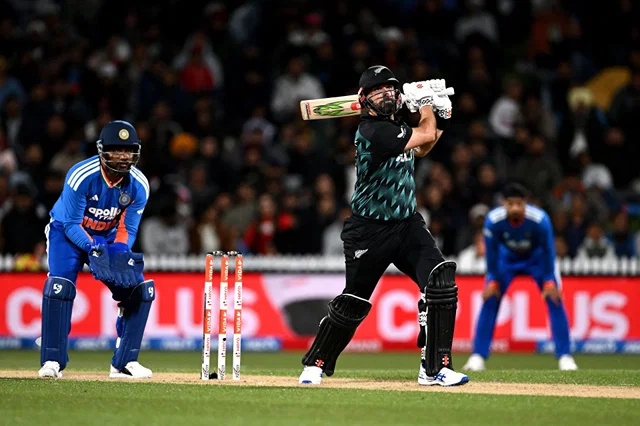
Abhishek Sharma produced a brilliant moment in the field during the fifth T20I between India and New Zealand, taking a superb diving catch to help dismiss the dangerous Daryl Mitchell. The Indian opener made an important contribution with his fielding after struggling to make an impact with the bat earlier in the match.
The fifth and final T20I of the series is being played in Hamilton, where India are defending a target of 192 runs. With New Zealand building momentum during the chase, Mitchell’s dismissal proved to be an important breakthrough for the visitors.
India spinner Varun Chakaravarthy, who returned to the playing XI for the match, picked up the crucial wicket. However, the dismissal would not have been possible without Abhishek’s excellent effort at long-off. The left-handed batter showed great awareness, athleticism and composure to complete a difficult low catch.
Mitchell was looking to accelerate the scoring and take control of New Zealand’s chase. Instead, his attempt to clear the boundary ended with Abhishek producing one of the standout fielding moments of the match.
Abhishek Sharma Takes Stunning Diving Catch to Dismiss Daryl Mitchell
The important moment arrived on the third delivery of the ninth over. Varun Chakaravarthy bowled a full delivery in the slot, giving Daryl Mitchell an opportunity to attack. The New Zealand batter attempted to hit the ball over long-off but failed to get the required connection.
The ball travelled towards Abhishek Sharma, who was stationed in the deep. Recognising that it was dropping quickly, the Indian fielder moved forward and launched himself into a well-timed dive.
Abhishek managed to get both hands underneath the ball and completed an excellent low catch. The ball was dying on him, making the effort particularly difficult, but he kept his fingers underneath it throughout the process to ensure that he maintained control.
It was a moment of excellent fielding under pressure. The catch gave Varun Chakaravarthy a valuable wicket on his return to the Indian playing XI and brought an end to Mitchell’s dangerous innings.
The dismissal also demonstrated how an important contribution in the field can change the momentum of a T20 match. Abhishek had not enjoyed a successful outing with the bat, but his athletic effort helped India remove one of New Zealand’s most threatening batters.
Varun Chakaravarthy Breaks New Zealand’s 73-Run Partnership
Daryl Mitchell’s wicket was particularly important because he and Tim Seifert had started building a strong partnership. The pair added 73 runs for the second wicket, giving New Zealand a platform to continue their pursuit of India’s target.
Mitchell was looking dangerous during his stay at the crease. He scored 29 runs from just 16 deliveries, including four sixes. His aggressive approach had put pressure on the Indian bowlers, and he appeared capable of taking the chase forward.
India needed a breakthrough to prevent the partnership from becoming more damaging. Varun Chakaravarthy delivered at the right moment, while Abhishek completed the catch to end Mitchell’s innings.
The wicket was a timely boost for the visitors, particularly because India were defending 191 runs. Removing a well-set batter during the middle overs can be crucial in T20 Cricket, where a single partnership can significantly change the required run rate and the direction of a chase.
For Varun, the dismissal also made his return to the playing XI more significant. He provided India with an important breakthrough, while Abhishek’s contribution ensured that the opportunity was not wasted.
Abhishek Sharma Had a Disappointing Outing With the Bat
Interestingly, Abhishek Sharma had endured a difficult start to the match before producing his excellent effort in the field. Opening the batting for India, he was dismissed for just one run from two deliveries during the powerplay.
The Indian opener would have wanted to provide his team with another explosive start, but he could not spend much time at the crease. His early dismissal meant that he missed an opportunity to make a significant contribution with the bat in the series finale.
However, his performance in the field helped him make up for the disappointing batting effort. The catch to dismiss Mitchell was not just visually impressive but also important in the context of India’s defence.
Abhishek has built a reputation as an aggressive T20 batter, but his athletic fielding can also provide India with valuable contributions. The dismissal showed his ability to remain involved in the game even after an early batting failure.
Abhishek Sharma’s Explosive 113-Run Knock Was a Series Highlight
Although Abhishek did not produce consistent big scores throughout the series, he delivered one outstanding performance in the third T20I. During that match, India successfully chased a target of 199 runs in just 13.2 overs, with the opener playing a remarkable innings.
Abhishek smashed 113 runs from only 38 deliveries, including nine fours and 11 sixes. His extraordinary strike rate of 297.37 reflected the attacking nature of the innings and helped India complete a dominant run chase.
The century was the standout batting performance of his series. Abhishek combined powerful hitting with an impressive ability to find boundaries regularly, putting the New Zealand bowling attack under tremendous pressure.
His performance in the third match also demonstrated why he remains an important part of India’s T20 batting plans. When he gets going, his ability to score quickly can change the match within a few overs.
However, the left-handed opener also had some missed opportunities. He got starts in three matches but could not convert all of them into substantial scores. The difference between his exceptional century and his shorter innings highlighted the challenge of maintaining consistency in an aggressive batting role.
Abhishek Sharma Finishes the Series With 197 Runs
Across the five matches, Abhishek Sharma finished the series with 197 runs at an average of 39.40 and an impressive strike rate of 223.86. His tally included one century, which came in the third T20I.
Those numbers underline his ability to score at a rapid pace, even though he would have wanted to deliver more consistently across the series. His 113-run knock accounted for a major portion of his overall contribution, while his other innings included starts that he could not always turn into big scores.
For an attacking opener, converting promising starts into substantial innings remains an important area of improvement. Abhishek’s aggressive approach gives India the opportunity to make quick starts, but consistency will be important as he continues to develop his role in the national side.
Nevertheless, his spectacular catch against Daryl Mitchell provided another reminder of his value to the team. Even on a day when his batting did not go according to plan, he contributed to an important moment in India’s bowling effort.
Why Daryl Mitchell’s Dismissal Was Important for India
India entered the New Zealand chase with 191 runs to defend, making early and middle-over wickets important. Mitchell had already shown his attacking intent by scoring four sixes, and his partnership with Tim Seifert had helped the hosts build momentum.
His departure broke the 73-run stand and gave India an opportunity to regain control. It also brought an end to the innings of a batter who was scoring quickly and could have made the chase more difficult for the visitors.
Varun Chakaravarthy’s return to the side added another positive element to the dismissal. The spinner produced the delivery that created the opportunity, while Abhishek’s sharp fielding completed the breakthrough.
The catch was a reminder that T20 cricket is not decided by batting and bowling alone. Fielding efforts, particularly those that remove dangerous batters, can have a major influence on the outcome of a match.
Final Thoughts
Abhishek Sharma’s diving catch to dismiss Daryl Mitchell was one of the key moments of the fifth T20I between India and New Zealand in Hamilton. After scoring just one run from two balls, the Indian opener responded with an outstanding fielding effort that helped Varun Chakaravarthy claim a crucial wicket on his return.
Mitchell’s 29-run innings from 16 deliveries had given New Zealand momentum, and his partnership with Tim Seifert was beginning to develop into a threat. Abhishek’s catch ended that stand and provided India with an important breakthrough while defending 191 runs.
Although Abhishek would have preferred a stronger batting performance in the final match, his overall series included a remarkable 113-run century and 197 runs across five games. His contribution in the field added another memorable moment to his campaign.
His effort also highlighted the importance of athletic fielding in modern T20 cricket, where one outstanding catch can prove just as valuable as a big innings or a crucial spell with the ball.
For breaking news and live news updates, like us on Facebook or follow us on Twitter and Instagram. Read more on Latest Cricket on thefoxdaily.com.






COMMENTS 0