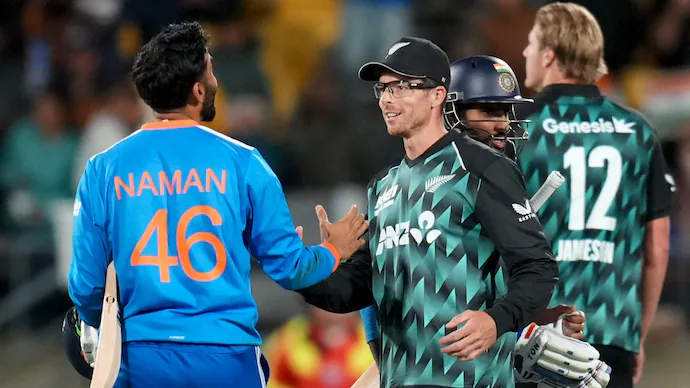
New Zealand captain Mitchell Santner believes the five-match T20I series against India could have produced a completely different result if his team had converted their opportunities in the opening two matches. India eventually secured a 3-2 series victory after winning the final T20I by seven wickets in Hamilton on Sunday, but Santner felt the scoreline did not fully reflect how closely contested the series had been.
New Zealand suffered narrow defeats in the first two matches in Christchurch before responding with victories in the next two games. Their comeback brought the series level at 2-2 and ensured that the fifth T20I would decide the winner.
However, India finished the contest strongly to claim the series 3-2. Despite the disappointment of losing at home, Santner was encouraged by several aspects of New Zealand’s performances, particularly their batting consistency, bowling depth and ability to adjust their strategies against a strong Indian side.
Speaking after the final match, the New Zealand skipper admitted that missed opportunities in the opening games had ultimately proved costly. He also praised the team’s response after falling behind and highlighted the lessons his players could take from the series.
Mitchell Santner believes New Zealand could have won the T20I series against India
India’s 3-2 series victory came after five competitive matches in which both teams experienced periods of success. New Zealand had an opportunity to turn the contest around after losing the first two games, winning the third and fourth T20Is to take the series into a deciding match.
However, Santner believes the outcome might have been different if his team had handled a few crucial moments more effectively in the opening fixtures. The New Zealand captain felt those narrow defeats made a significant difference to the overall series result.
Reflecting on the contest, Santner acknowledged India’s achievement but insisted that New Zealand had been close to producing a different result.
“It was a very tight series against a very good team. Those small moments in the first couple of games, where we probably could have won those games or should have, meant the series could have looked a lot different. Obviously, the scoreline shows 3-2 to India, but it could have been the other way around,” Santner said after the match.
His comments highlighted how important small moments can be in T20 cricket. A missed opportunity with the bat, an unsuccessful bowling plan or a crucial passage of play can change the direction of a match, particularly when the teams are evenly matched.
New Zealand managed to recover from their early setbacks, but the opening defeats left them with little room for error. Although they won the next two games to level the series, India delivered the decisive performance in Hamilton.
Tim Seifert’s 93 powers New Zealand to victory in the final T20I
New Zealand ended the series with a convincing seven-wicket victory in the fifth T20I at Hamilton. Tim Seifert played a major role in the hosts’ successful chase, producing an outstanding innings of 93 to help his team finish the series on a winning note.
His performance gave New Zealand a strong response after India had taken control of the series. Although the victory was not enough to prevent India from winning 3-2, it demonstrated the hosts’ ability to compete with the visitors and produce an effective batting performance under pressure.
The result also ensured that New Zealand avoided finishing the series with three consecutive defeats. Instead, they won the final two matches after losing the opening games, providing some encouragement despite missing out on the overall series trophy.
For Santner, the batting performances throughout the series were among the biggest positives. He was pleased with the way his team consistently produced competitive totals and showed the ability to respond after difficult situations.
Shreyas Iyer and Ishan Kishan put New Zealand under pressure
Although New Zealand secured victory in the final match, India’s middle order created a difficult period for the home bowlers. Shreyas Iyer and Ishan Kishan combined for a rapid 107-run partnership in a little over seven overs, putting pressure on the New Zealand attack.
Their aggressive approach increased India’s scoring rate and forced the hosts to reconsider their bowling plans. Both batters attacked the bowling and looked to take advantage of scoring opportunities, making it challenging for New Zealand to maintain control.
However, the Kiwi bowlers managed to respond as the innings progressed. Adam Milne delivered an important performance, finishing with figures of 4/19 and helping New Zealand pull things back after India’s middle-order acceleration.
Santner was pleased with the way his seamers adapted their plans instead of continuing with the same approach against the aggressive Indian batters.
“We mixed it up really nicely. Shreyas and Kishan put their foot on the gas, and the seamers kind of mixed it up. Yorkers, wide, a little bit straight with length. It was good learning for us,” he said.
The New Zealand captain highlighted the importance of varying deliveries and changing lines to prevent batters from settling into a rhythm. Using yorkers, wider lines and different lengths allowed the bowlers to challenge India’s attacking approach.
For New Zealand, the experience offered useful lessons about adapting quickly when opponents begin scoring freely. Santner believes the bowling unit showed encouraging signs of learning and adjusting during the series.
New Zealand bowling depth emerges as a major positive
One of Santner’s biggest positives from the series was the depth available in New Zealand’s bowling attack. Injuries to Lockie Ferguson and Matt Henry forced the team to consider alternative options and provide opportunities to other players.
Rather than viewing those absences only as setbacks, Santner was encouraged by the performances of players who stepped into the side. He believes the team’s ability to rotate bowlers and give opportunities to less-established members of the squad could prove valuable in the future.
Matthew Fisher was among the players who made the most of his opportunities. He claimed three wickets across two appearances, providing New Zealand with another option in their bowling group.
Santner explained that the schedule had allowed the team to rotate players more frequently, giving fringe members opportunities to demonstrate their abilities at international level.
“I think we’re in a great spot in terms of depth at the moment. With the schedule, there’s been a lot more rotation than probably would be, but it gives guys opportunities. Some fringe guys who don’t potentially play a lot are showing that they can step up straight away,” he said.
Building a reliable group of bowling options is particularly important in T20 cricket, where teams often need different types of bowlers to handle changing conditions and batting approaches. New Zealand’s experience during the series provided Santner with encouragement about the players available beyond the first-choice attack.
The injuries to Ferguson and Henry created opportunities for others, and the performances of players such as Fisher offered the team additional selection options moving forward.
Glenn Phillips impresses Santner with consistent batting performances
Santner also praised Glenn Phillips for his contributions throughout the five-match series. The New Zealand batter played an important role in helping the hosts build competitive positions with the bat, showing his ability to adapt to different match situations.
Phillips finished the final T20I with an unbeaten 65, providing another example of his value to the team’s batting order. His innings helped New Zealand complete their successful chase and secure a seven-wicket victory.
One aspect of Phillips’ batting that particularly impressed Santner was his ability to assess conditions before increasing the scoring rate. Rather than attacking every delivery immediately, Phillips could spend time at the crease, understand the bowling and then accelerate when the opportunity appeared.
That ability to change gears is valuable in T20 cricket, where batters must balance the need to score quickly with the importance of building an innings. Against quality bowling attacks, selecting the right moments to attack can make a significant difference.
Phillips’ unbeaten 65 in the final match gave New Zealand another positive performance to take away from the series, even though the overall result went India’s way.
India win the series 3-2 despite New Zealand’s late comeback
India’s series victory was achieved after a challenging contest in which New Zealand fought back strongly following their opening defeats. The hosts won the third and fourth matches to level the series, but India responded in the deciding game to secure the trophy.
New Zealand’s final two victories showed that they could compete with India across different match situations. However, the inability to win either of the first two matches ultimately left them needing a strong final result to take the series.
Santner’s assessment focused on the importance of converting opportunities rather than simply looking at the final scoreline. He believes New Zealand were competitive enough to challenge for the series, but small mistakes during the opening matches made the difference.
For India, the 3-2 result represented a successful conclusion to a closely fought five-match contest. The visitors managed to respond when the series was level and produced the performance required to win the final match.
New Zealand, meanwhile, will take encouragement from their comeback, the performances of their emerging bowling options and the contributions of experienced players such as Phillips.
Santner looks at the lessons ahead of future T20 challenges
Although New Zealand missed out on the series victory, Santner believes the team has several positives to carry into future international assignments. The performances of their batters, the development of bowling depth and the ability to adjust strategies during matches were important takeaways.
The captain also recognised that the team must learn from the missed opportunities in the opening two T20Is. Converting close matches into victories will be important if New Zealand want to challenge consistently against leading international teams.
With the next T20 World Cup in the region still some time away, Santner believes the series has provided useful experience for the players. The matches offered opportunities to test different combinations, assess squad depth and understand how the team responds under pressure.
For New Zealand, the final result was disappointing, but the comeback from 0-2 down to level the series demonstrated their ability to recover. The performances of Matthew Fisher, Adam Milne and Glenn Phillips also provided encouraging signs for the team’s future plans.
India leave with the series trophy after winning 3-2, while New Zealand are left reflecting on the early chances they failed to convert. Santner’s assessment captures the narrow margins that often decide T20 cricket: the final scoreline belongs to India, but the New Zealand captain believes the contest could have ended differently if his side had made better use of its opportunities.
For breaking news and live news updates, like us on Facebook or follow us on Twitter and Instagram. Read more on Latest Cricket on thefoxdaily.com.






COMMENTS 0