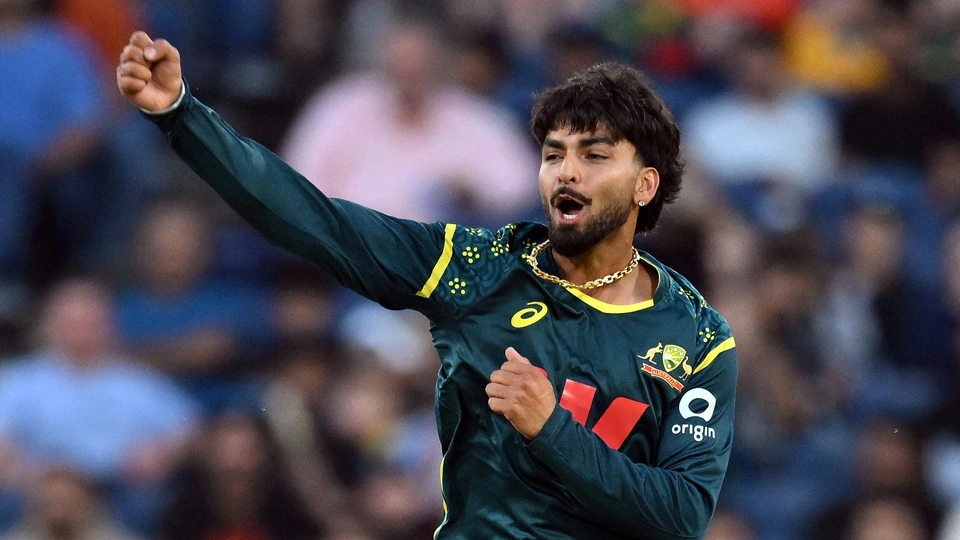
Delhi-born allrounder Nikhil Chaudhary produced a match-winning performance for Australia against England, delivering an impressive all-round display in the first T20I at the Melbourne Cricket Ground. His explosive 66 off 38 balls and two wickets for 21 runs helped Australia secure a thrilling three-wicket victory, earning him the Player of the Match award. For Chaudhary, the occasion was made even more special by the presence of his parents, who had travelled from India to watch him represent Australia for the first time.
The performance marked another significant milestone in a remarkable journey that has taken him from Delhi and India’s domestic cricket system to the international stage with Australia. Chaudhary, who became the first India-born male cricketer in six decades to represent Australia in June, has reached this point through years of persistence, adjustment and belief in an unconventional career decision.
His appearance against England also attracted attention for his confident presence on the field, including the thick gold chain worn over his Australian jersey. But it was his contribution with both bat and ball that made the biggest impression at the MCG.
Nikhil Chaudhary stars in Australia’s thrilling win over England
Australia entered the first T20I against England with a target of 188, but the chase proved far from comfortable. The home side needed important contributions from several batters to stay in contention, and Chaudhary played a central role in keeping the innings on track.
Opening batter Sam Harper provided an early foundation with a brisk 32. Chaudhary then arrived at No. 4 and helped stabilise the chase, building valuable partnerships with captain Mitchell Marsh, who scored 37, and Tim David, who contributed 20.
His 66 from just 38 deliveries gave Australia the momentum required to remain in the contest. Although Chaudhary was dismissed before the finish, his innings left the home side within reach of victory. Jack Edwards completed the job, taking Australia across the line with one ball remaining as the hosts secured a three-wicket win.
Chaudhary had already made an impact with the ball earlier in the match. His spin bowling produced two important breakthroughs, removing England captain Harry Brook, who had scored a rapid 65 from 28 balls, and Sam Curran, who made 21.
The combination of a valuable batting contribution and two wickets made him the standout performer of the contest. Receiving the Player of the Match award in front of his parents gave the achievement an emotional significance beyond the result.
A special moment with his parents watching from the stands
For Chaudhary, having his family at the MCG was one of the most memorable aspects of the evening. His parents had travelled from India and were watching him play in person for the first time. Their presence made the award-winning performance particularly meaningful after the uncertainty and sacrifices that had accompanied his move to Australia.
Speaking to the broadcaster after the match, Chaudhary admitted that he had never imagined reaching such a moment when he began his journey away from India.
“Never imagined that, man,” Chaudhary said when asked whether he had ever envisaged his journey from Delhi to the Melbourne Cricket Ground. “My parents came over from India last night, so it’s nothing better than getting a Man of the Match in front of them. It’s their first game watching me play as well.”
The occasion represented a full-circle moment for the family. When Chaudhary first left India in 2020, his decision was not part of a carefully prepared international cricket plan. His parents had concerns about his future, especially because they believed he had the potential to progress through India’s domestic cricket structure.
Years later, they were watching him deliver a match-winning performance for Australia at one of the country’s most recognisable cricket grounds.
An unexpected move to Australia in 2020
Chaudhary’s move to Australia in March 2020 came about almost unexpectedly. According to his father, Sneh Chaudhary, Nikhil had gone to meet a friend to celebrate a birthday. It was also around the time of his final Ranji Trophy match, and he told his family that he wanted to take a holiday.
Sneh recalled the circumstances of the move while speaking to HT, explaining that the family had not anticipated such a major change in their son’s career.
“He had just gone to meet his friend to celebrate his birthday. It was his last Ranji Trophy match. He said he wanted to go on a holiday,” Sneh recalled. “It was hardly a planned relocation.”
Sneh remembers dropping his son at the airport sometime between March 14 and March 16, 2020. Soon afterwards, the Covid-19 pandemic disrupted international travel and everyday life. What had initially appeared to be a temporary trip turned into a much longer stay, leaving Chaudhary in Australia and setting his career on a different path.
The timing made the transition even more difficult. Instead of returning to India and continuing through the domestic cricket system, he had to adjust to a new country, unfamiliar surroundings and a different cricketing environment.
His family initially worried about his cricketing future
Before moving to Australia, Chaudhary had developed through Punjab’s age-group cricket system. He had also played alongside several cricketers who would later become familiar names in Indian cricket, including Shubman Gill, Abhishek Sharma and Arshdeep Singh.
His family therefore believed that he had a realistic opportunity to continue progressing through India’s domestic structure. They found it difficult to understand why he would leave that pathway for a country where he would have to start building his cricketing career again.
Sneh said the family spoke to Nikhil several months after his move and expressed their concerns about the opportunities available to him in Australia compared with those he had already earned in India.
“After seven, eight or nine months of his decision, we spoke to him. We told him that at the level at which he was playing here, we couldn’t even imagine him getting that elsewhere. But he had belief,” Sneh said.
That belief became central to Chaudhary’s journey. Rather than returning to the familiar domestic structure, he continued working towards establishing himself in Australian cricket. The process required patience, especially because he had to build a new support network while finding opportunities to play and develop his game.
Building a life and cricket career in a new country
Moving to Australia meant that Chaudhary had to manage more than just the challenges of cricket. As an Indian immigrant living far from his family, he had to become independent and find ways to support himself while continuing to pursue professional opportunities.
He initially spent time in Townsville, where his uncle lived, before moving to Brisbane in search of a stronger cricketing environment. He began playing club cricket for Southern Suburbs and Northern Suburbs, gradually working towards establishing himself in the local game.
At the same time, he took up employment to support his living expenses. His work included a part-time job at a Mexican restaurant. Balancing training, matches and employment became part of his everyday routine.
Sneh remembers his son explaining how different the environment was compared with the cricketing system he had experienced in India.
“He used to tell me, ‘Papa, in this circle, we must work and practice too. Everyone does that here.’ He couldn’t just sit at home. It was a completely different environment,” Sneh said.
For the family, understanding this new reality took time. Chaudhary was not simply pursuing cricket in another country; he was also learning to manage the practical responsibilities of life without the familiar support system he had enjoyed at home.
Gradually, his determination and progress helped his parents become more comfortable with the decision. The opportunities he earned through club cricket and subsequent professional appearances began to show that the move could lead to a meaningful career.
From club cricket to Australia’s international team
Chaudhary’s route to international cricket required patience. Australia’s eligibility rules meant he had to complete the required five-year residency period before becoming available for selection. During that time, he continued developing his skills and gaining experience in Australian domestic and franchise competitions.
His progress included opportunities with the Hobart Hurricanes in the Big Bash League and Tasmania. These experiences helped him adapt to higher levels of competition and build a reputation within the Australian cricket system.
He also continued playing in franchise tournaments beyond Australia, including The Hundred, the Caribbean League and Major Cricket League. Exposure to different teams, conditions and formats has added to his experience as an allrounder.
His eventual international breakthrough in June carried historical significance. By representing Australia, Chaudhary became the first India-born male cricketer in six decades to play for the country. It was a milestone that reflected not only his individual progress but also the unusual route he had taken to reach international cricket.
The performance against England provided another demonstration of the value he could bring to the Australian side. His ability to contribute with both batting and bowling gave the team an important option in a closely fought T20 contest.
How Chaudhary transformed his bowling style
One of the most interesting aspects of Chaudhary’s development has been his willingness to change his bowling style. He began as a fast-medium bowler who could also contribute with the bat. Over time, however, he moved towards spin bowling, first developing as an off-spinner before becoming a leg-spinner in Australia.
His father remembers that Nikhil was already making adjustments to his game during his Under-16 days. At the time, the family sometimes felt that he was changing too many things in an attempt to remain in the team. Looking back, Sneh believes those changes helped his son become a more adaptable cricketer.
“At that time, we thought he was making too many changes but today, because of that, he can adjust to everything,” Sneh said.
That adaptability has become an important part of Chaudhary’s identity as an allrounder. Rather than being limited to one bowling style or a fixed role, he has continued to develop according to the opportunities and requirements presented by different teams.
His two wickets against England illustrated how his spin bowling can influence a match. Removing a dangerous batter such as Brook and then dismissing Curran helped Australia restrict England’s progress and set up the chase.
Batting flexibility has added another dimension
Chaudhary’s development has not been limited to bowling. His batting position has also changed over the years. While he often featured lower down the order during his time in India, opportunities with the Hobart Hurricanes allowed him to bat higher up the order.
Those experiences helped him become comfortable with different responsibilities. Against England, his promotion to No. 4 proved valuable as he provided stability after the opening contribution and built partnerships with Marsh and David.
His 66 off 38 balls demonstrated that he could handle the pressure of a run chase while also playing an attacking role. The innings was particularly important because Australia were pursuing a challenging target and needed someone to maintain momentum through the middle overs.
Having spent around two decades playing cricket, Chaudhary has experienced different roles and environments. His journey through Indian age-group cricket, Australian club cricket, domestic competitions and international appearances has helped him develop the flexibility required of a modern allrounder.
A dream of playing in front of the Indian crowd
Despite representing Australia internationally, Chaudhary’s family continues to look forward to the possibility of seeing him play in front of a home crowd in India. For Sneh, that could mean an opportunity in the Indian Premier League or a match against India while Nikhil is wearing Australian colours.
“The main goal now is to play in front of the home crowd in India,” Sneh said.
Such an occasion would add another chapter to a career shaped by movement between two cricketing systems. An IPL opportunity would allow Indian fans to watch a Delhi-born player who developed much of his professional game in Australia. Alternatively, facing India in Australian colours would give him the chance to compete against the country where his cricketing journey began.
A journey built on belief and adaptability
Nikhil Chaudhary’s rise from Delhi to the Australian national team has not followed a conventional route. His move to Australia in 2020 was initially uncertain, his family had doubts about the decision, and he had to combine work with club cricket while adjusting to a new country. He also had to wait for the required residency period before becoming eligible for international selection.
Through those years, he continued to adapt. He changed his bowling style, expanded his batting responsibilities and worked his way through club, domestic and franchise cricket. The result was an international opportunity that once seemed difficult for his family to imagine.
His performance against England at the MCG brought together many elements of that journey. A 66-run innings, two important wickets and a Player of the Match award helped Australia win a close contest. More importantly for Chaudhary, his parents were there to witness it.
For a cricketer whose career took an unexpected turn after leaving India, the night was a reminder of how far persistence and belief can take a player. His journey is still developing, but his match-winning display in Melbourne has given him another memorable milestone in Australian colours.
For breaking news and live news updates, like us on Facebook or follow us on Twitter and Instagram. Read more on Latest Sports on thefoxdaily.com.






COMMENTS 0