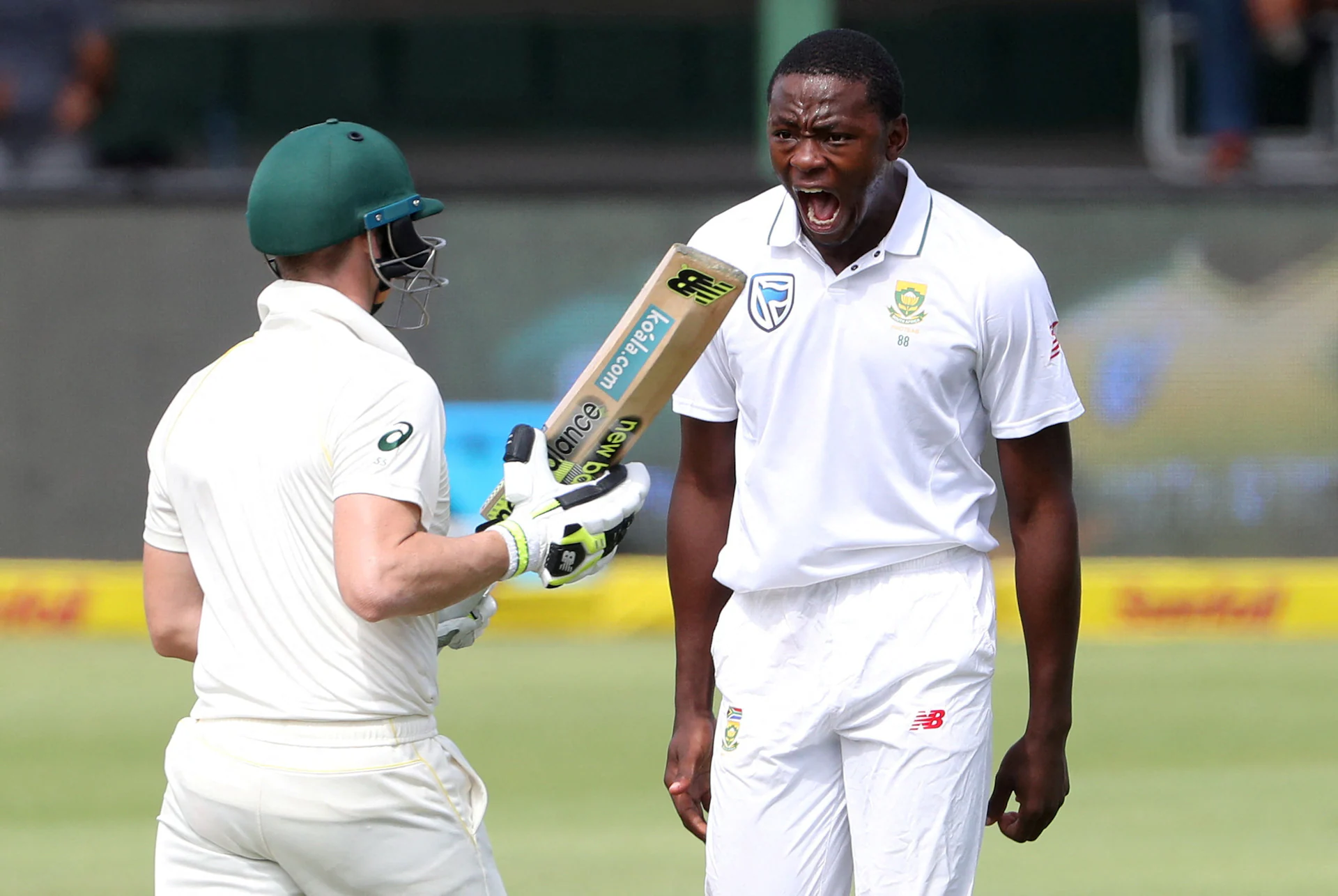
Kagiso Rabada and Steve Smith are preparing to face each other again in a Test series that has taken a dramatic turn, with South Africa’s victory in Gqeberha setting up a decisive third match in Cape Town. Rabada’s return from a lengthy hamstring injury layoff proved influential as the hosts defeated Australia by an innings and 31 runs on Thursday, October 23, levelling the three-match series.
The contest at Newlands, scheduled to begin next Tuesday, carries significance beyond the series result. Rabada and Smith have a history shaped by fierce on-field competition, a controversial confrontation during South Africa’s 2018 home series and Australia’s ball-tampering scandal that followed. Their latest meeting has revived memories of that period, even as both players have indicated that the rivalry is about competition rather than personal animosity.
Rabada claimed four wickets in Australia’s second innings in Gqeberha, including the dismissal of Smith, who reached the milestone of 11,000 Test runs earlier in the match. Smith managed only three runs in the second innings, struggling to make an impact while reportedly dealing with a neck complaint.
With the series level, the focus now shifts to Newlands, where South Africa will look to build on their emphatic recovery and Australia will need a stronger response from their experienced batting lineup. The individual contest between Rabada and Smith could become one of the defining stories of the decider.
Rabada’s Return Changes the Series in South Africa’s Favour
Rabada’s contribution in Gqeberha was significant not only because of the wickets he took but also because of the timing of his return. A prolonged hamstring injury absence had kept the fast bowler away from action, making his availability an important consideration for South Africa heading into the second Test.
His four second-innings wickets helped South Africa complete a comprehensive victory after Australia had struggled to establish a strong position in the match. The hosts won by an innings and 31 runs, bringing the three-match contest back to level terms after Australia had won the opening Test in Durban.
The result also restored the competitive balance before the final match. Australia had entered the second Test with the opportunity to build a commanding series lead, but South Africa’s response ensured that neither side could approach Newlands with the advantage of an unassailable position.
For the home team, Rabada’s return offers more than an encouraging individual performance. His pace and ability to challenge established batters provide an important option in a format where bowlers must repeatedly create pressure over long periods. His presence alongside the other members of South Africa’s attack gives the hosts a stronger platform as they prepare for the series decider.
However, one performance does not eliminate the uncertainty surrounding a player returning from injury. His workload, recovery and ability to sustain his intensity across another Test will be important considerations. South Africa will want to make the most of his availability without overlooking the physical demands of fast bowling.
Why Steve Smith Remains Australia’s Key Batting Figure
Smith’s dismissal in Gqeberha attracted attention because of both his reputation and the circumstances surrounding his innings. The Australian batter had recently crossed 11,000 Test runs, an achievement that underlines his longevity and consistency at the highest level of the game.
Reaching that milestone is a substantial career accomplishment, but it offers no guarantee of success in the next innings. Smith’s second-innings score of three demonstrated how quickly a difficult match situation can compound the pressure on even the most experienced batter.
His attempt to hook Rabada’s bouncer was particularly notable because the shot appeared out of character. With Australia facing the prospect of an innings defeat, Smith’s wicket removed a batter capable of occupying the crease and helping the visitors resist South Africa’s attack.
The neck complaint reported during the match provides additional context, although it does not establish precisely how much the issue affected his batting. Rabada acknowledged that Smith was not fully fit but emphasised his ability to concentrate and provide stability for Australia.
That assessment captures why Smith’s wicket is so valuable to opposing teams. His experience allows him to adapt to changing conditions, absorb pressure and build an innings when Australia need to recover. Removing him can force the remaining batters to take on greater responsibility, particularly when the team is already losing wickets.
The Tactical Importance of Rabada Versus Smith
Fast bowling is not simply a contest of speed against technique. Bowlers must also assess a batter’s movement, shot selection and response to pressure, then adjust their approach to exploit any weaknesses that emerge.
Rabada’s successful use of a bouncer against Smith illustrates that tactical dimension. The short delivery can challenge a batter’s ability to control the ball while moving backward or across the crease. A mistimed hook may produce a catch rather than a scoring opportunity, particularly when the batter fails to get into a comfortable position.
Smith’s dismissal does not prove that the short ball is a guaranteed method of removing him. His record demonstrates that he is capable of handling a wide range of bowling challenges. Nevertheless, the incident gives Rabada and South Africa a specific example to consider when planning their approach in Cape Town.
For Australia, the challenge will be ensuring that Smith can respond to Rabada without allowing the contest to become a distraction from the wider demands of the match. The batter’s task is to make decisions according to the delivery and match situation, not the history attached to the bowler.
Looking Back at the 2018 Rabada-Smith Controversy
The renewed rivalry has a clear historical reference point. During Australia’s 2018 tour of South Africa, Rabada dismissed Smith at St George’s Park and collided with the Australian while celebrating the wicket.
The incident became one of several flashpoints in a tense series. Rabada was initially handed a two-Test suspension, which was subsequently reduced to a fine following an appeal. The episode established a lasting connection between the two players, whose confrontations came to symbolise the intensity of that tour.
The broader series became even more controversial later in March 2018, when Australia was caught up in the ball-tampering scandal commonly known as Sandpapergate. The incident occurred during the third Test at Newlands, the same venue that will host the upcoming decider.
What Happened During Sandpapergate?
During the 2018 Newlands Test, television footage showed Australian batter Cameron Bancroft attempting to alter the condition of the ball. Subsequent investigations established that the incident involved an effort to change the ball’s surface illegally, with the aim of gaining an unfair advantage.
Smith, who was Australia’s captain at the time, acknowledged his involvement in the decision-making surrounding the plan. Cricket Australia subsequently imposed a 12-month ban on Smith and vice-captain David Warner, while Bancroft received a nine-month suspension. Smith was also stripped of the captaincy.
The scandal had consequences beyond the immediate match. It damaged Australia’s reputation, prompted widespread scrutiny of the team’s conduct and became a defining episode in Smith’s career.
The distinction between the two incidents is important. Rabada’s confrontation with Smith in 2018 concerned on-field conduct and the disciplinary process governing player behaviour. Sandpapergate concerned an attempt to alter the ball illegally and the responsibilities of players involved in that decision. They were separate events, even though both contributed to the turbulent atmosphere of the tour.
The upcoming Test does not carry any suggestion that the earlier controversy will be repeated. Its significance lies in the shared history of the venue and the players, rather than evidence of any current dispute between them.
Rabada Insists There Is No Personal Animosity
Despite their history, Rabada has rejected the idea that his rivalry with Smith is driven by lingering resentment. Speaking after the Gqeberha match, the South African described the contest as an expression of the intensity that comes with elite sport.
He explained that athletes want to express themselves on the field and that fierce competition does not necessarily translate into hostility away from the game. His comments suggest that he views Smith as a formidable opponent whose dismissal is valuable because of his ability to influence Australia’s batting, not because of their previous confrontation.
That distinction is central to understanding their relationship. Rivalries often develop when two players repeatedly meet in high-pressure situations, particularly when one has the ability to disrupt the other’s performance. Such encounters can become compelling sporting narratives without requiring personal animosity.
Rabada’s comments also recognise Smith’s standing in Australian cricket. A batter with more than 11,000 Test runs commands attention because of his proven capacity to produce substantial innings. Dismissing such a player can have a tactical impact far beyond the runs added to the scoreboard.
For supporters, the history adds an emotional layer to the Newlands contest. For the players, however, the immediate task remains the same: perform according to the demands of the match and help their respective teams win the series.
Steve Smith’s Perspective on His Career-Defining Setback
Smith has previously spoken about the personal toll of the 2018 scandal. In comments to Sydney’s Daily Telegraph last month, he described the period after the incident as difficult and acknowledged that his mental state had suffered.
He also said he had learned from the experience and had tried to move forward, explaining that he had deliberately pushed much of the episode out of his memory. His reflections indicate that the scandal remains a significant part of his history, even though he does not want it to define the remainder of his career.
His return to Newlands for a T20 international two years after the incident marked an earlier appearance at the venue following the controversy. The upcoming Test will be his first in Cape Town since 2018, bringing the setting back into focus in a format that has played a major role in his career.
The circumstances of his return are different from those of the original tour. Smith now arrives with the experience of having worked through the fallout from the scandal and continued his international career. His recent milestone of 11,000 Test runs further underlines the extent of his achievements since that difficult period.
His performance in the final Test will not erase the history of 2018, nor should a single innings be treated as a verdict on his career. It will, however, offer another opportunity to judge him on his cricket rather than the controversies associated with his earlier visit.
What to Expect From the Newlands Test
The third Test is scheduled to begin on Tuesday, October 27, at Newlands in Cape Town and run through October 31. With the series level at one win apiece, the match will determine which team finishes the contest with the advantage.
South Africa will arrive encouraged by their innings victory and Rabada’s return to effective wicket-taking form. Their task will be to reproduce the discipline that helped them dominate the second Test, while managing the demands placed on their fast bowlers.
Australia, meanwhile, will need a stronger batting performance after being dismissed for 99 in the first innings at Gqeberha and then failing to avoid an innings defeat. Their response will depend on the ability of the batting lineup to withstand South Africa’s attack and build partnerships that prevent pressure from accumulating.
Smith’s contribution will be one of the key areas to watch. Australia need their senior batters to provide stability, especially if early wickets fall. A substantial innings from Smith could help restore confidence, but the visitors cannot rely on one player alone to solve their batting problems.
Rabada’s fitness will also remain a significant consideration. His impact in Gqeberha was immediate, but another demanding Test will require careful management of his workload. If he maintains his rhythm and accuracy, South Africa will have a strong weapon against Australia’s experienced top order.
The venue adds another dimension to the occasion. Newlands is not merely the setting for the deciding match; it is also the ground associated with the most damaging episode of Smith’s career. That history will attract attention, but the result will ultimately depend on what happens during the five days of cricket.
Why the Series Decider Matters Beyond the Rivalry
The renewed Rabada-Smith contest provides an engaging individual storyline, but the larger significance lies in the series itself. Both teams have demonstrated that they can win decisively, leaving the final Test as the opportunity to establish superiority over the course of the three-match contest.
For South Africa, the Gqeberha victory offers evidence that they can recover from a difficult opening result and use their bowling resources to put Australia under sustained pressure. Repeating that performance would allow the hosts to finish the series with momentum and a significant home victory.
For Australia, the decider represents an opportunity to respond to a heavy defeat. A stronger batting display and greater resistance against Rabada and his teammates would help demonstrate that the second Test was a setback rather than a pattern of performance.
The result could also shape the broader narrative surrounding both sides as they continue their Test campaigns. However, any conclusions about their long-term prospects should be based on performances across multiple matches rather than the outcome of one encounter.
Conclusion: History Sets the Scene, but Performance Will Decide
Rabada and Smith head to Cape Town with a history that combines exceptional cricket, a controversial on-field incident and the lasting consequences of Sandpapergate. Their latest encounter in Gqeberha has revived interest in that rivalry, with Rabada’s four second-innings wickets helping South Africa level the series.
Yet both players have reasons to focus on the present. Rabada will want to build on his successful return from injury, while Smith will be looking to recover from a difficult second innings and contribute to Australia’s response.
Rabada has made clear that he sees no personal hostility between them. That leaves the most compelling question for Newlands on the cricket field: whether South Africa can sustain their dominance or Australia can respond strongly enough to win the deciding Test.
The history will make their next meeting difficult to ignore, but the series will be settled by runs, wickets and the decisions made under pressure. At Newlands, the past will provide the backdrop. The cricket will determine the outcome.
For breaking news and live news updates, like us on Facebook or follow us on Twitter and Instagram. Read more on Latest Cricket on thefoxdaily.com.






COMMENTS 0