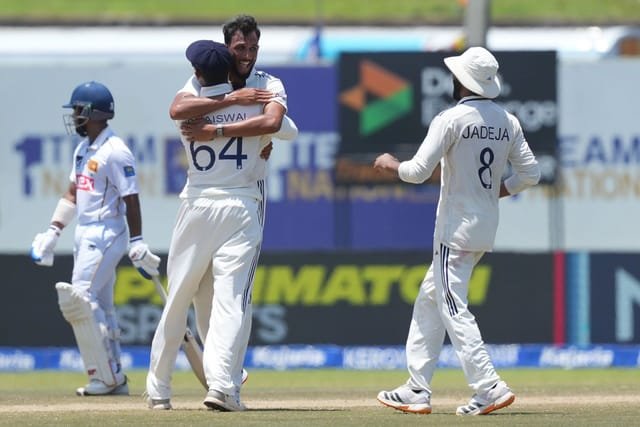
Niroshan Dickwella’s dismissal became another turning point on Day 5 of the first Test between India and Sri Lanka at the Galle International Stadium. With the hosts attempting to stay alive in a difficult chase, the experienced wicketkeeper-batter took an aggressive approach against Prasidh Krishna but paid the price for a rash stroke.
Dickwella had already played an important role earlier in the match, producing a valuable 80 in Sri Lanka’s first innings after the hosts had slipped to 90 for 5. His experience was expected to become equally important during the final-day resistance, particularly with Sri Lanka still needing a substantial number of runs to reach India’s target.
Instead, his second-innings stay lasted only 10 runs. The dismissal came after India had finally broken through following a period of patience, leaving the home side under increasing pressure as the visitors closed in on victory.
How Niroshan Dickwella lost his wicket
Dickwella began his second innings positively, collecting an early boundary against Kuldeep Yadav. However, Prasidh Krishna quickly identified an opportunity to attack him with the short ball.
The Indian fast bowler had already dismissed Dickwella with a more conventional delivery during the first innings. On Day 5, Krishna changed his approach and repeatedly tested the left-hander with deliveries directed toward his upper body.
The strategy created pressure around Dickwella, who was batting at a stage when Sri Lanka could ill afford another wicket.
Before the final ball of the over, Yashasvi Jaiswal moved closer from his square-leg position and exchanged a few words with the Sri Lankan batter.
According to the match account, Jaiswal jokingly challenged Dickwella to attack the short delivery and even teased him about hitting it for six and earning an opportunity in the Indian Premier League.
The next delivery produced exactly the kind of reaction India wanted.
Dickwella made room and attempted an aggressive stroke against another short-pitched delivery. Instead of clearing the field, he edged the ball through to the wicketkeeper, bringing his innings to an abrupt end.
Why Dickwella’s wicket was so important for India
The dismissal mattered because Sri Lanka were already operating under severe scoreboard pressure.
India had created a substantial target, and every partnership became increasingly important for the hosts. Dickwella was one of the last recognized batters capable of changing the tempo of the chase.
His experience also mattered because Sri Lanka needed players who could absorb pressure rather than simply attack every scoring opportunity.
Once Dickwella departed for 10, the responsibility shifted even more heavily onto Sonal Dinusha, who had emerged as Sri Lanka’s principal source of resistance.
Prasidh Krishna’s short-ball plan paid off
The dismissal was also a useful example of how fast bowlers can create wickets without constantly searching for the perfect full delivery.
Krishna’s repeated short balls forced Dickwella to make decisions under pressure. The objective was not necessarily to take the wicket with every bouncer. Instead, the sequence was designed to make the batter uncomfortable and eventually induce a mistake.
That is particularly effective on the fifth day of a Test match, when batters are already dealing with fatigue, scoreboard pressure and a deteriorating pitch.
By repeatedly asking Dickwella to deal with the short ball, India created the conditions for an attacking mistake.
The key was pressure rather than one delivery
It would be easy to describe Dickwella’s dismissal simply as a rash shot, but the larger story was the pressure created before it.
Krishna’s bowling, India’s field placement and the verbal exchange between Jaiswal and Dickwella all contributed to the moment.
Once the batter felt compelled to take on another short delivery, India had already achieved the tactical objective.
Dickwella had shown better judgment in the first innings
The contrast between Dickwella’s two innings was particularly striking.
In the first innings, he demonstrated considerable composure while Sri Lanka were in serious trouble at 90 for 5. His 80 came from 115 deliveries and helped prevent the innings from collapsing completely.
That performance showed why Sri Lanka valued his experience during a difficult Test match.
However, the second innings presented a different challenge.
With the target still distant, Sri Lanka needed survival first and scoring second. Dickwella’s aggressive response to Krishna’s short-ball strategy ultimately worked against the team’s broader objective.
Sri Lanka’s fight was increasingly dependent on Sonal Dinusha
With Dickwella gone, Sonal Dinusha became even more important to Sri Lanka’s hopes of extending the contest.
Dinusha had already produced a strong performance during the match and remained unbeaten on 65 from 112 deliveries at the lunch interval on Day 5.
His ability to remain at the crease was keeping India from completing the victory quickly.
For Sri Lanka, the equation was straightforward but extremely difficult: preserve wickets while finding enough runs to keep the chase alive.
For India, the priority was almost the exact opposite. The visitors needed to maintain pressure, prevent Dinusha from building another substantial partnership and remove the remaining batters.
Sri Lanka were 175 for 6 at lunch
At lunch on Day 5, Sri Lanka had reached 175 for 6 and still required another 197 runs to reach the target.
Dinusha was unbeaten on 65, while Keshara Nuwantha had successfully negotiated the closing stages of the opening session.
India, meanwhile, needed only four more wickets to secure a 1-0 lead in the two-Test series.
| Situation | Position at Lunch |
|---|---|
| Sri Lanka score | 175/6 |
| Runs required | 197 |
| Sonal Dinusha | 65* off 112 balls |
| India wickets required | 4 |
| Match | 1st Test, Galle |
| Series situation | India leading the contest |
India had to be patient before finding the breakthrough
India’s progress on Day 5 was not simply a matter of Sri Lanka collapsing immediately.
The visitors had to wait for important breakthroughs after Sri Lanka showed considerable resistance.
One of the major moments came when India finally removed captain Dhananjaya de Silva during the first session. That wicket opened the door for further pressure and eventually brought Dickwella to the crease with Sri Lanka still needing a huge number of runs.
This highlights an important feature of Test Cricket: even when the bowling side appears to be completely in control, one stubborn partnership can dramatically change the length of a chase.
India therefore needed to avoid becoming impatient.
Yashasvi Jaiswal’s role added another layer to the dismissal
Jaiswal’s involvement in the sequence also underlined the competitive nature of the final day.
Fielders close to the bat often try to create uncertainty through conversation, body language and aggressive positioning. The objective is not necessarily to provoke a mistake directly, but to keep the batter mentally engaged with something beyond the ball.
In Dickwella’s case, the timing of the exchange was notable.
After Jaiswal challenged him to attack the short ball, Dickwella attempted exactly that on the next delivery. Whether the conversation directly influenced the shot is impossible to establish, but the sequence certainly added drama to an already tense passage of play.
Why the short ball remained a dangerous option on Day 5
Short-pitched bowling can be especially effective late in a Test match because physical and mental fatigue begin to influence technique.
A batter must decide whether to duck, sway, defend, hook or pull. A small error in judgment can result in a top edge or glove.
For a wicketkeeper-batter such as Dickwella, the challenge becomes even more complicated because he had already spent long periods behind the stumps.
That workload can make concentration increasingly difficult during a long fourth-innings chase.
Krishna’s approach therefore made tactical sense. Rather than giving Dickwella easy opportunities to rotate the strike, he repeatedly asked the batter to respond to uncomfortable deliveries.
The bigger battle was India’s pace against Sri Lanka’s patience
The final day developed into a classic contest between India’s attacking bowling and Sri Lanka’s determination to survive.
India had the luxury of knowing that wickets, rather than time, were their primary requirement. Sri Lanka had the opposite problem.
The hosts needed to consume deliveries while also finding enough scoring opportunities to prevent the required run rate from becoming completely unrealistic.
That creates an awkward balance for a batting side.
Defending every ball can keep wickets intact but may leave the team too far behind the required target. Attacking too often can create wickets, as Dickwella’s dismissal demonstrated.
What Dickwella’s dismissal means for Sri Lanka
The wicket significantly reduced Sri Lanka’s batting resources at a critical stage.
Dickwella had already demonstrated during the first innings that he could produce a long and valuable contribution under pressure. Losing him for just 10 in the second innings meant Sri Lanka lost an experienced batter who could potentially have helped Dinusha construct another important partnership.
The pressure consequently shifted to the lower order.
For Dinusha, the challenge was now not only to continue scoring but also to protect the remaining wickets around him.
What India needed to do after lunch
India’s plan for the remaining sessions was relatively clear.
- Remove Sonal Dinusha: His wicket would eliminate Sri Lanka’s most established source of resistance.
- Attack the lower order: India could increase pressure once the remaining batters were exposed.
- Maintain disciplined bowling: With a large lead in the match, there was no reason to become unnecessarily aggressive.
- Use the short ball intelligently: Krishna’s success against Dickwella showed the value of changing lengths.
The biggest danger for India was allowing Dinusha to settle into another long partnership.
What Sri Lanka needed from Dinusha
From Sri Lanka’s perspective, Dinusha had become the centerpiece of the resistance.
His unbeaten 65 had already demonstrated that he was capable of absorbing pressure, but the challenge became significantly greater after Dickwella’s departure.
To keep the match alive, Sri Lanka needed Dinusha to combine patience with controlled aggression.
That meant choosing scoring opportunities carefully rather than attempting to force the pace.
Every additional 20 or 30 runs would increase India’s workload, while another wicket could bring the match rapidly toward its conclusion.
The contrast between Dickwella’s two innings tells the story
Dickwella’s match perfectly illustrates how quickly a batter’s fortunes can change in Test cricket.
His first-innings 80 was built around rescue work after Sri Lanka had lost half their side cheaply. His second innings ended with a much more aggressive shot while his team was still attempting to survive.
The difference was not simply technical.
Match situation, bowling tactics, fatigue and scoreboard pressure all influenced the second innings.
That is why the dismissal should be viewed as more than an isolated mistake. It was the product of a high-pressure situation in which India successfully forced Sri Lanka’s batters to make uncomfortable decisions.
Conclusion: India tighten their grip in Galle
Niroshan Dickwella’s dismissal gave India another crucial breakthrough on Day 5 of the first Test against Sri Lanka at Galle. After contributing a vital 80 in the first innings, the wicketkeeper-batter could manage only 10 in the second before attempting an aggressive stroke against Prasidh Krishna’s short-ball attack.
The moment came after a brief exchange with Yashasvi Jaiswal and highlighted the mental pressure surrounding Sri Lanka’s difficult chase.
At lunch, Sri Lanka were 175 for 6 and still needed 197 runs, while India required only four more wickets to secure a 1-0 series lead.
Sonal Dinusha remained the key obstacle for the visitors, unbeaten on 65 and continuing to provide resistance.
The larger lesson from the session was India’s ability to combine patience with targeted aggression. Rather than relying on one magical delivery, Krishna and the Indian attack built pressure until Dickwella finally took the risk they were inviting him to take.
With the match entering its decisive phase, the battle was now simple: could Dinusha and Sri Lanka’s lower order survive long enough to turn a seemingly one-sided chase into a genuine final-day contest?
For breaking news and live news updates, like us on Facebook or follow us on Twitter and Instagram. Read more on Latest Cricket on thefoxdaily.com.






COMMENTS 0