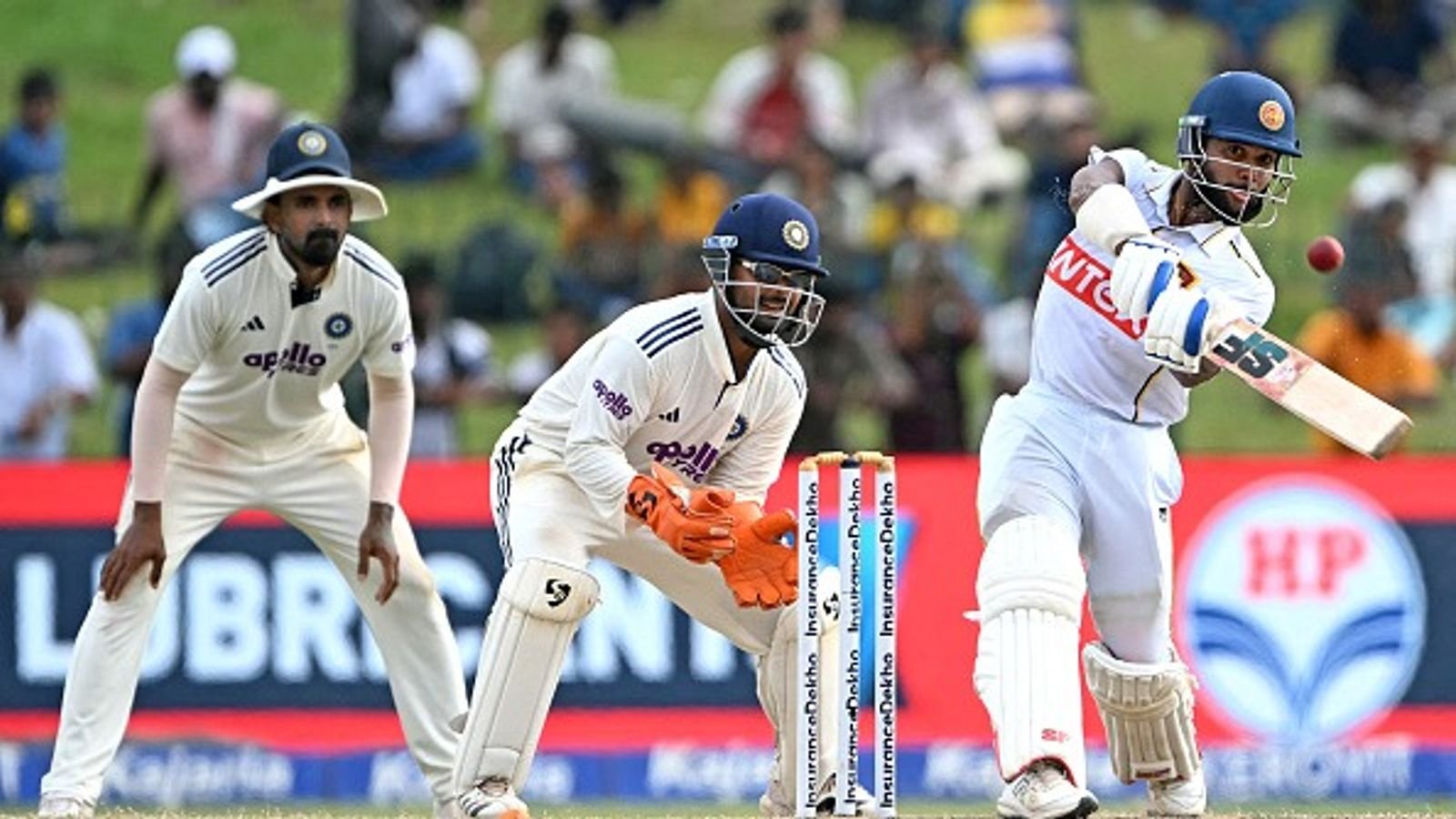
The IND vs SL second Test produced a remarkable turnaround in Colombo as Sri Lanka fought back from a huge first-innings deficit to force a draw against India. India had taken a commanding 213-run lead and enforced the follow-on, putting themselves in an excellent position to complete a 2-0 series victory.
However, Sri Lanka refused to collapse. Sonal Dinusha became the central figure in the resistance, producing an unbeaten 133 in the second innings after already scoring 103 in the first. His extraordinary consistency, combined with a crucial seventh-wicket partnership, allowed Sri Lanka to bat deep into the final day.
Sri Lanka eventually reached 429/9 before the match ended in a draw. India therefore missed out on victory despite dominating large portions of the Test, but they still finished the two-match series with a 1-0 win.
IND vs SL Second Test: How the Match Unfolded
India established their advantage during the first innings. After posting a massive 503/9, they bowled Sri Lanka out for just 290. The 213-run lead gave India complete control of the match and created the opportunity to put Sri Lanka straight back under pressure.
India chose to enforce the follow-on. The decision was designed to maximize the pressure on Sri Lanka and give the Indian bowlers enough time to take the remaining wickets required for victory.
At that stage, an Indian win appeared highly likely. Sri Lanka needed to survive another complete innings while India had a significant advantage on the scoreboard.
But the hosts gradually changed the nature of the contest. Rather than chasing an aggressive total, Sri Lanka concentrated on staying at the crease. That approach became increasingly effective as the innings progressed.
Sonal Dinusha’s Unbeaten 133 Became the Difference
Sonal Dinusha was the defining player of the Colombo Test. His unbeaten 133 in the second innings was particularly valuable because Sri Lanka were fighting to save the match rather than trying to win it.
Dinusha had already scored 103 in Sri Lanka’s first innings. Producing another century under even greater pressure demonstrated remarkable concentration and temperament.
His performance also continued an impressive run against India. After scoring a century in Galle in the previous Test, Dinusha followed it with centuries in both innings of the Colombo match.
The importance of his second-innings century goes beyond the statistic itself. India had the advantage of scoreboard pressure, the follow-on and a bowling attack determined to finish the game. Dinusha’s ability to remain unbeaten meant Sri Lanka always had a batter capable of holding one end together.
Why the Follow-On Failed to Produce an Indian Victory
Enforcing the follow-on was a logical move given India’s 213-run first-innings advantage. However, the decision also created a race against time.
India needed to take 10 wickets in Sri Lanka’s second innings. Sri Lanka, meanwhile, did not need to score at a particular rate. Their only requirement was to avoid losing all their wickets before the available playing time ended.
That difference in objectives became increasingly important.
India had to attack. Sri Lanka could defend.
As Dinusha settled in, every defensive over became useful to Sri Lanka. Every partnership reduced India’s remaining opportunity to take the final wickets. The match slowly shifted from an expected Indian victory into a survival exercise for the hosts.
The 112-Run Seventh-Wicket Partnership Changed Everything
The decisive passage of the final day came when Dinusha joined Keshara Nuwantha. The pair produced a crucial 112-run partnership for the seventh wicket.
Nuwantha scored 46, providing the support Dinusha needed to continue occupying the crease. The partnership was significant not only because of the runs but also because of the amount of time it consumed.
For India, the problem became increasingly straightforward: they needed wickets immediately.
For Sri Lanka, the equation was much simpler: keep batting.
That tactical contrast made the partnership enormously valuable. India could not afford to relax, while Sri Lanka could celebrate every additional over survived.
When the seventh-wicket stand crossed 100 runs, the possibility of a draw became much more realistic. By then, Dinusha had moved Sri Lanka into a position from which the hosts could seriously challenge India’s hopes of completing the clean sweep.
India’s Spinners Worked Hard in Colombo
India’s inability to take the final wicket should not be interpreted as a lack of effort from their bowling attack. The spin pair of Manav Suthar and Ravindra Jadeja carried a substantial workload during Sri Lanka’s second innings.
Suthar finished with figures of 3/121, while Jadeja returned 3/94. Together, they bowled nearly 80 overs as India searched for the breakthroughs needed to win the match.
The figures demonstrate how heavily India relied on spin as the pitch wore down. Yet a wearing fifth-day surface does not automatically guarantee wickets. Batters who remain disciplined can sometimes neutralize the threat by reducing attacking options and refusing to offer easy chances.
Dinusha’s approach was perfectly suited to that situation. He did not need to dominate every over. He needed to survive, score when opportunities appeared and maintain his concentration.
Why Dinusha’s Performance Matters for Sri Lankan Cricket
Dinusha’s performance could have implications beyond this individual Test. Sri Lanka needed a batter capable of handling prolonged pressure against a strong Indian side, and Dinusha provided exactly that.
Scoring 103 and 133 not out in the same Test is a significant achievement. Doing so while his team was under enormous pressure makes the performance even more valuable.
His recent sequence against India also suggests that the matchup has become an important part of his emerging Test story. Three centuries in four innings against the same opposition represent an extraordinary level of productivity.
The bigger question for Sri Lanka will be whether this performance can become the foundation for greater consistency. One outstanding Test can produce headlines, but sustained success requires repeated contributions across different conditions and against different bowling attacks.
India’s Series Win Still Matters Despite the Draw
Although India missed the opportunity to win the Colombo Test, the result does not erase their overall success on the tour. India won the two-match Test series 1-0.
The series result means India still leave the contest as the stronger side on the scoreboard. However, the Colombo draw provides Sri Lanka with considerable encouragement because they demonstrated that they could withstand sustained pressure from a powerful Indian attack.
For India, the match is a reminder that a dominant position does not always translate into a victory in Test Cricket. Taking 20 wickets is essential for an outright win, and Sri Lanka’s final-day resistance showed how difficult those last breakthroughs can become.
India vs Sri Lanka: The Key Numbers From the Colombo Test
| Team/Player | Key Figure | Significance |
|---|---|---|
| India | 503/9 | India’s first-innings total |
| Sri Lanka | 290 | Sri Lanka’s first-innings score |
| India | 213-run lead | Advantage that allowed India to enforce the follow-on |
| Sri Lanka | 429/9 | Second-innings score at the end of the match |
| Sonal Dinusha | 133* | Unbeaten second-innings century that helped save the match |
| Keshara Nuwantha | 46 | Important contribution in the seventh-wicket stand |
| Dinusha & Nuwantha | 112-run stand | Key partnership on the final morning |
| Manav Suthar | 3/121 | India’s spinner’s second-innings figures |
| Ravindra Jadeja | 3/94 | India’s other major spin contribution |
The Biggest Lesson From the Colombo Test
The most important lesson from the IND vs SL Test is that scoreboard dominance and match control are not always the same thing.
India controlled the scoreboard for much of the contest. A 213-run first-innings lead and the decision to enforce the follow-on placed them in a commanding position. Yet Sri Lanka controlled the final objective: preserving enough wickets to reach the end of the match.
This distinction is crucial in Test cricket. A team can dominate sessions and still fail to win if the opposition has enough time and resilience to survive.
Dinusha’s innings therefore represents more than an individual batting achievement. It is an example of how defensive batting can change the tactical balance of a Test match.
What This Draw Means for India and Sri Lanka
For India, the 1-0 series victory remains the primary outcome. However, the missed opportunity in Colombo will likely encourage discussions about how teams should manage a follow-on when the opposition has shown signs of resistance.
For Sri Lanka, the draw is a confidence-building result. They were placed under extreme pressure after conceding a 213-run lead, yet their second innings demonstrated enough resilience to avoid defeat.
The emergence of Dinusha as a major run-scorer is perhaps the most encouraging element. His consecutive hundreds in the match gave Sri Lanka a dependable presence in the middle order at precisely the moment they needed one.
IND vs SL Colombo Test: Final Verdict
The second Test between India and Sri Lanka will be remembered for the extraordinary contrast between India’s dominant position and Sri Lanka’s eventual escape.
India had the first-innings advantage, the follow-on and a clear route to victory. Sri Lanka had the pressure of batting again after falling 213 runs behind.
Yet Sonal Dinusha changed the story.
His unbeaten 133, following his first-innings 103, gave Sri Lanka the stability they desperately needed. The 112-run partnership with Keshara Nuwantha further strengthened the resistance, while India’s spinners were unable to secure the final wicket despite a huge workload.
The result was a draw, but the broader series belonged to India, who finished with a 1-0 victory.
For Sri Lanka, however, Colombo offered something almost as valuable as a win: evidence that they could absorb enormous pressure and refuse to surrender. And for Dinusha, this Test could prove to be the performance that turns an emerging name into one of Sri Lanka’s most important batting prospects.
For breaking news and live news updates, like us on Facebook or follow us on Twitter and Instagram. Read more on Latest Cricket on thefoxdaily.com.






COMMENTS 0