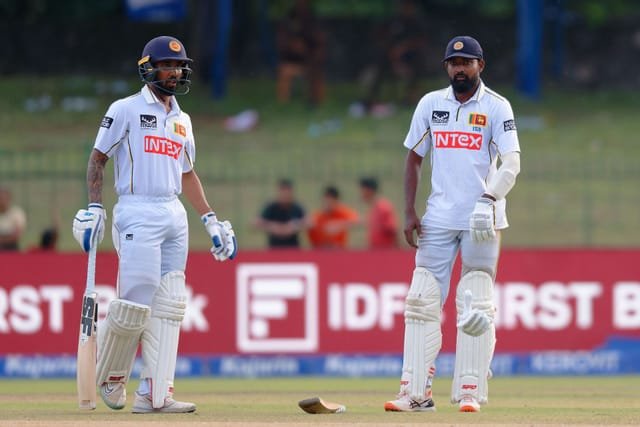
Prabath Jayasuriya has been handed one demerit point for a disciplinary offence during Sri Lanka’s second Test against India in Colombo, adding another difficult moment to a match in which the left-arm spinner has struggled to make an impact.
The incident occurred late on Day 2 when Jayasuriya was sent in as Sri Lanka’s night watchman. With the light deteriorating, the spinner’s task was primarily to survive until the close and protect the specialist batters from facing India’s bowlers at the end of the day.
Jayasuriya managed to survive most of the final over but was dismissed from the last delivery of the day. Frustrated by his dismissal, the Sri Lankan walked off visibly angry and struck the boundary wedges with his bat on his way back to the dressing room.
The International Cricket Council subsequently sanctioned him under Article 2.2 of the ICC Code of Conduct, relating to abuse of cricket equipment or clothing, ground equipment or fixtures and fittings during an international match. Jayasuriya admitted the offence and accepted the proposed penalty, meaning a formal hearing was not required.
The punishment is relatively minor in immediate sporting terms, but it adds another layer to a challenging Test for the experienced spinner as Sri Lanka fight to stay alive in the series.
Why was Prabath Jayasuriya given a demerit point?
Jayasuriya was penalised after striking the boundary wedges with his bat following his dismissal on the final ball of Day 2.
The incident came after the 34-year-old had been used as Sri Lanka’s night watchman. His job was to occupy the crease during a difficult period rather than play a major attacking innings.
When he was dismissed on the final delivery of the day, however, the disappointment got the better of him. His reaction resulted in a breach of the ICC Code of Conduct.
Jayasuriya accepted responsibility for the incident and agreed to the penalty proposed by match referee Andy Pycroft of the Emirates ICC Elite Panel of Match Referees.
Because he admitted the offence and accepted the sanction, the matter did not require a formal hearing.
What does one demerit point mean for Jayasuriya?
A single demerit point does not result in an immediate suspension. Instead, it is added to a player’s disciplinary record and can become relevant if further offences occur within the applicable monitoring period.
This was Jayasuriya’s first disciplinary offence in a 24-month period, meaning the immediate consequences are limited.
However, the incident serves as a reminder that international cricket has strict standards governing player behaviour. Even a moment of frustration following a dismissal can lead to an official sanction when equipment or playing-area fixtures are damaged or struck inappropriately.
For Jayasuriya, the best response will be to ensure that the incident remains an isolated moment rather than the beginning of a disciplinary pattern.
Jayasuriya’s dismissal came in an unusual role
The context of the incident is important because Jayasuriya was not playing his usual role when he was dismissed.
He was sent in as the night watchman, a tactical position used by teams when a wicket falls late in the day. The idea is generally to send a lower-order player into the middle so that a specialist batter does not have to face a small number of deliveries before stumps.
The strategy can protect the batting order, particularly when only a few overs remain.
But it also means the night watchman enters an extremely difficult situation. The player has little time to settle, the opposition is likely to attack aggressively and the conditions can favour the bowlers.
Jayasuriya survived until the final ball of the day, only to fall at the worst possible moment from Sri Lanka’s perspective.
India had already built a massive first-innings total
The disciplinary incident occurred against the backdrop of India’s commanding batting performance.
India declared their first innings at 503/9, putting Sri Lanka under enormous pressure.
A total above 500 creates a significant challenge in Test cricket because the batting side can attack without worrying about losing control of the match after a single collapse.
India’s large score also meant Sri Lanka needed a substantial response simply to avoid the follow-on.
At the time of the reported match situation, Sri Lanka were struggling at 216/7 and still required additional runs to avoid the follow-on target.
Jayasuriya has found the second Test much tougher
The disciplinary issue is only one part of Jayasuriya’s difficult outing in Colombo.
The left-arm spinner had entered the second Test after producing an impressive performance in the series opener, where he finished with match figures of 7/152.
That performance made him one of Sri Lanka’s key bowling weapons heading into the next match.
However, India’s batting lineup has made life considerably harder for him in the second Test.
Jayasuriya claimed only two wickets from 42 overs in India’s first innings. His economy rate remained below 3.20, showing that he was not being attacked freely, but the lack of wickets reduced his ability to break partnerships.
That distinction is important in Test cricket.
A bowler can maintain excellent control while still struggling to influence the overall direction of an innings if wickets do not arrive at crucial moments.
Economy rate was not the problem — penetration was
Jayasuriya’s second-Test figures illustrate why bowling analysis cannot be reduced to one statistic.
Keeping the scoring rate under control is valuable, particularly in a Test match. It allows the captain to build pressure and encourages batters to take risks.
But spin bowling becomes especially dangerous when control is combined with regular breakthroughs.
India’s ability to build a huge total suggests that Jayasuriya’s control alone was not enough to disrupt the batting lineup. The Indian batters were able to absorb pressure for long periods while continuing to accumulate runs.
For Sri Lanka, that meant the spinner’s contribution was unable to replicate the impact he had produced in the first Test.
India’s batting depth has put Sri Lanka under pressure
India reaching 503/9 declared reflects more than one individual contribution. It demonstrates the ability of the batting unit to continue scoring even after Sri Lanka managed to claim wickets.
That depth becomes particularly important in Test cricket because an opposition bowling attack can work extremely hard without necessarily receiving an immediate reward.
Once India crossed the 400-run mark, Sri Lanka’s margin for error became increasingly small.
The hosts needed a strong first innings simply to keep the match competitive. Instead, their batting problems placed them in a position where avoiding the follow-on became a major objective.
Sri Lanka are facing a serious series situation
The pressure on Sri Lanka extends beyond the second Test.
They had already suffered a 165-run defeat in the first Test. A second defeat would therefore give India a 2-0 series victory and leave Sri Lanka facing a home-series whitewash.
That makes the remaining stages of the Colombo Test extremely important.
Sri Lanka need not only runs but also a way to stop India’s bowlers from dictating the match. With more than two days remaining in the contest at the point described in the match update, the hosts still had an opportunity to change the direction of the game.
But the scoreboard had placed India firmly in control.
Jayasuriya is still one of Sri Lanka’s key Test spinners
Despite his difficult performance in the second Test, Jayasuriya remains an important part of Sri Lanka’s red-ball setup.
His performance in the first Test demonstrated his ability to influence a match when conditions and execution come together.
Left-arm spin can be particularly valuable in Test cricket because it provides a different angle to right-handed batters and can become increasingly effective as a pitch deteriorates.
The challenge for Jayasuriya is to regain the penetration he showed earlier in the series while maintaining the control that has remained evident in Colombo.
The wider disciplinary picture in the Test
Jayasuriya became the third player to receive an ICC sanction during the series after India’s Yashasvi Jaiswal and Sri Lanka’s Asitha Fernando were both fined earlier in the match.
Jaiswal and Fernando were fined 25 percent of their match fees after an on-field confrontation that involved physical contact.
Jayasuriya’s punishment is different in nature, with the spinner receiving a demerit point rather than the same financial sanction.
The sequence highlights how the ICC Code of Conduct covers a broad range of behaviour, from confrontations between players to inappropriate treatment of equipment or fixtures.
Why discipline matters even in moments of frustration
Cricket is an emotional sport, particularly at Test level. Players can spend hours under pressure before a single delivery changes the game.
However, professional players are expected to control their reactions even after moments of disappointment.
Jayasuriya’s incident demonstrates how quickly frustration can turn into an official disciplinary matter. The action itself may have lasted only a moment, but the demerit point remains on his record.
For experienced players, managing those moments is part of the responsibility that comes with representing their country.
What Sri Lanka need from Jayasuriya next
For Sri Lanka, the priority should now be cricket rather than the disciplinary issue.
Jayasuriya needs to regain his effectiveness with the ball and help the team create breakthroughs if India are forced to bat again.
His experience could become valuable if the pitch begins to offer greater assistance to spin later in the match.
The first Test already showed that he can produce a significant bowling performance against India. A return to that level could give Sri Lanka a route back into the contest.
But first, the hosts must survive the immediate pressure created by India’s huge first-innings score.
Conclusion: A difficult Test gets worse for Jayasuriya
Prabath Jayasuriya’s one-demerit-point sanction adds a disciplinary footnote to what has otherwise been a challenging second Test for the Sri Lankan spinner.
His frustration came after he was dismissed as the night watchman on the final ball of Day 2, prompting him to strike the boundary wedges with his bat. He admitted the offence and accepted the proposed penalty, avoiding a formal hearing.
On the field, Jayasuriya has also struggled to reproduce his impact from the first Test. After taking seven wickets in the series opener, he managed only two wickets in 42 overs during India’s first innings in Colombo.
With India having declared on 503/9 and Sri Lanka fighting to avoid the follow-on, the hosts are under enormous pressure to keep the series alive.
For Jayasuriya, the immediate challenge is simple: put the disciplinary incident behind him, rediscover his wicket-taking threat and help Sri Lanka fight back before India turn a dominant position into a 2-0 series sweep.
For breaking news and live news updates, like us on Facebook or follow us on Twitter and Instagram. Read more on Latest Cricket on thefoxdaily.com.






COMMENTS 0