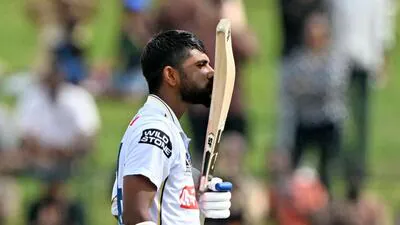
Sonal Dinusha emerged as the defining figure of Sri Lanka’s resistance against India in the 2026 Test series. The left-hander’s remarkable batting, especially his command of the sweep shot, left India’s spin attack struggling to create consistent opportunities during the Colombo Test.
Dinusha finished the series with 420 runs, including three centuries, and spent 1,139 minutes at the crease while facing 722 deliveries. His ability to repeatedly use conventional and reverse sweeps was particularly damaging, allowing him to neutralise India’s spin threat when the visitors were pushing for a series-clinching victory.
Dinusha scores 173 runs through sweeps
The most striking aspect of Dinusha’s performance was his extraordinary efficiency with the sweep shot. He accumulated 173 runs through conventional and reverse sweeps without being dismissed while playing those strokes.
That tally is reported to be the highest by a batter in the DRS era, surpassing Joe Root’s 164 sweep-shot runs during England’s 2021 tour of Sri Lanka.
Dinusha’s approach was particularly effective during his unbeaten 133 in Colombo, an innings that ultimately helped Sri Lanka bat through the final day and save the Test.
India have faced sweep-shot challenges before
Dinusha’s success was not an isolated example of a batter using aggressive sweeps to disrupt India’s spin-heavy bowling strategy. Indian teams have previously encountered opponents who have used the shot effectively against quality spinners.
Joe Root was one of the more recent examples, while Ollie Pope and Ben Duckett also used conventional and reverse sweeps extensively during England’s 2024 tour of India.
Earlier generations also produced notable sweep-shot specialists. Graham Gooch, Jimmy Adams, Andy Flower and Matthew Hayden all demonstrated at different times how disciplined use of the sweep could challenge Indian spin attacks.
Dinusha trusted his defence before sweeping
The effectiveness of Dinusha’s strategy was not simply about playing the sweep frequently. His ability to judge the ball’s length and maintain confidence in his defence allowed him to select the right deliveries to attack.
Gautam Gambhir had previously highlighted the importance of trusting a batter’s defence before attempting the sweep. That principle was evident in Dinusha’s approach, as he did not simply swing at every delivery from the spinners.
India captain Shubman Gill also acknowledged Dinusha’s solid defence, which prevented India’s spinners from creating the mistakes they needed to break his resistance.
Colombo conditions helped Dinusha’s strategy
The Colombo pitch continued to offer turn, but the nature of that turn changed as the match progressed. Gill suggested that the spin became slower, reducing the effectiveness of traditional methods of dismissal such as lbw and bowled.
For a batter who had already developed confidence in his sweeping game, predictable bounce and consistent spin created an ideal environment to keep attacking.
Dinusha was able to judge the line and length of deliveries before deciding whether to play the conventional sweep or reverse sweep. That variation made it difficult for India’s spinners to establish a consistent attacking line.
Manav Suthar struggled to contain Dinusha
Manav Suthar was among India’s most promising spin options during the Colombo Test, but Dinusha identified opportunities against the young left-arm spinner.
The Sri Lankan batter repeatedly used the reverse sweep to disrupt Suthar’s rhythm. Despite the spinner generating overspin, Dinusha remained confident enough to take on the delivery and find scoring opportunities.
At Galle, Dinusha had also used slog sweeps effectively against Kuldeep Yadav. In Colombo, Sarnash Jain was unable to produce enough sustained pressure against him after replacing Kuldeep.
Jain had dismissed Dinusha in the first innings by having him caught at slip, but the second innings proved much more difficult. Dinusha regularly used conventional sweeps against the off-spinner and prevented him from building a threatening spell.
India missed the craft of Ravichandran Ashwin
The Colombo Test also highlighted the value of experience when dealing with a batter who is comfortable against spin. The absence of Ravichandran Ashwin was particularly noticeable as India searched for a way to unsettle Dinusha.
While India had several capable spinners, Dinusha repeatedly demonstrated that he had solutions for the different angles and variations offered to him.
Instead of allowing the spinners to dictate terms, he forced them to adjust their plans by attacking deliveries that might otherwise have been used to build pressure.
Sri Lanka’s lower order added to India’s frustration
One of the most revealing aspects of the final stages was Dinusha’s ability to rely on Sri Lanka’s lower order. India’s five specialist bowlers were unable to consistently remove the tailenders alongside him.
On Days 4 and 5, Sri Lanka’s batters at positions eight through eleven faced 292 deliveries, compared with 264 deliveries faced by Dinusha during the same period.
Once Dinusha became confident that his partners could survive at the other end, he was free to continue attacking the Indian spinners. His repeated sweeps gradually shifted the pressure back onto the bowling side.
India’s five-man attack could not finish the job
India had five specialist bowlers available, yet Sri Lanka’s lower order managed to frustrate them for extended periods. The inability to remove the tail meant that India could not isolate Dinusha and force him into increasingly risky shots.
As the match progressed, India eventually had to rely on part-time spin to complete the required overs, underlining how difficult the final stages had become for the main bowling attack.
Dinusha leaves India with a major tactical lesson
India ultimately won the Test series 1-0, but the Colombo draw exposed an important tactical weakness. Dinusha showed that a batter with a reliable defence, strong length judgment and an effective sweep can significantly reduce the impact of a quality spin attack.
For India, the challenge will be to find ways of countering such methods in future Tests. Merely generating turn may not be enough when batters can predict the bounce, trust their defence and repeatedly score through sweeps.
Dinusha’s performance therefore stands as more than just an individual batting achievement. His 420 runs, three centuries and record-breaking 173 runs through sweep shots provided a blueprint for how determined batting can neutralise India’s spin strength and turn a seemingly lost Test into a memorable draw.
For breaking news and live news updates, like us on Facebook or follow us on Twitter and Instagram. Read more on Latest Cricket on thefoxdaily.com.






COMMENTS 0