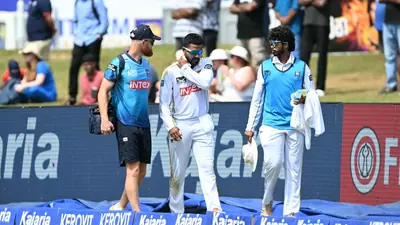
Dinesh Chandimal ruled out of Galle Test became a major development on Day 4 of the first Test between India and Sri Lanka after the experienced Sri Lankan batter suffered an injury while fielding. Chandimal was assessed by the team’s medical staff and later failed a concussion assessment, forcing him to take no further part in the match.
The incident occurred during the opening session at the Galle International Stadium when Chandimal attempted to prevent the ball from reaching the boundary. The 36-year-old dived while trying to make the stop but landed awkwardly, hitting his shoulder and head against the ground.
Chandimal immediately appeared to be in discomfort and was seen holding the area around his neck while remaining on the field. Sri Lanka’s medical team quickly attended to him before he was taken for precautionary scans.
The initial scans provided some relief because they showed no signs of internal injury. However, Chandimal subsequently underwent a concussion assessment by the team’s doctor and physiotherapist. He was ruled out after that evaluation.
Sri Lanka Cricket then confirmed that Pasindu Sooriyabandara had been approved as Chandimal’s concussion replacement. The replacement was cleared by the match referee, allowing Sooriyabandara to enter the contest with Sri Lanka facing a difficult fourth-innings chase.
What Happened to Dinesh Chandimal?
Chandimal’s injury occurred toward the end of the fourth over on Day 4. He reacted quickly to a ball heading toward the boundary and attempted to stop it with a diving effort.
The attempt ended badly as Chandimal landed heavily, with his shoulder and head making forceful contact with the ground.
He was visibly uncomfortable immediately afterward, prompting medical attention on the field. Because the impact involved the head, the Sri Lankan medical team had to follow the appropriate concussion assessment process rather than simply determining whether Chandimal could continue based on the absence of an obvious external injury.
That distinction is important in modern cricket.
A player can appear physically capable of continuing while still showing signs of a concussion. Head injuries therefore require medical evaluation before a decision is made about returning to play.
Why Chandimal Was Ruled Out Despite Clear Initial Scans
One of the most important details in the Chandimal incident is that the initial precautionary scan did not show internal injury.
That was positive news, but it did not automatically clear him to return to the match.
Concussion assessment is separate from checking for structural or internal injuries. A player who suffers a significant blow to the head can still be diagnosed with concussion even when scans do not reveal a major internal problem.
In Chandimal’s case, the medical team subsequently assessed him for concussion and ruled him out.
This is why the decision should not be interpreted as contradictory. The scan addressed one set of medical concerns, while the concussion assessment addressed another.
For Sri Lanka, the priority was therefore not simply keeping an experienced batter on the field. It was ensuring that the player was not exposed to additional risk after a head impact.
Pasindu Sooriyabandara Approved as Concussion Replacement
With Chandimal unavailable, Sri Lanka needed an approved replacement to complete the Test match.
Pasindu Sooriyabandara was selected as the concussion replacement, and the match referee approved the substitution. He is now expected to bat at No. 3 for Sri Lanka as the hosts attempt to chase India’s substantial target.
The concussion replacement rule is particularly significant because it allows a player who suffers a qualifying head injury to be replaced without leaving the affected team with a major disadvantage.
In a Test match, losing an established batter can have enormous consequences, particularly when the player occupies an important position in the batting order.
Sooriyabandara’s introduction therefore gives Sri Lanka another specialist option at a crucial moment of the game.
How Serious Is Chandimal’s Injury?
The available information indicates that the initial precautionary scan was clear and showed no signs of internal injury. However, Chandimal was ruled out because of the subsequent concussion assessment.
That means the immediate concern is his head injury and recovery rather than evidence of a major internal injury.
The exact timeline for his return should depend on further medical evaluation and the established concussion protocols rather than the initial scan alone.
For a player with Chandimal’s experience, there is little reason for Sri Lanka to take unnecessary risks. The Test is important, but player safety has to take priority.
Chandimal’s Injury Comes at a Bad Time for Sri Lanka
The timing could hardly be worse for the hosts.
Sri Lanka entered their fourth innings needing to chase a target of 372 runs against India. Losing one of their experienced middle-order batters early in the innings makes the challenge even more demanding.
Chandimal had also endured a difficult first innings, scoring only four runs. However, his importance to Sri Lanka cannot be judged solely by that single score.
His experience in Test cricket provides stability in situations where the opposition has a large lead and the pressure of a fourth-innings chase becomes increasingly intense.
Without him, Sri Lanka have one fewer established option to absorb pressure and build a partnership.
India’s 372-Run Target Changes the Entire Equation
India’s second innings produced a dramatic shift in the match.
The visitors were eventually bowled out for 193, setting Sri Lanka a target of 372. Asitha Fernando led the Sri Lankan bowling attack with four wickets, but India’s overall lead remained large enough to put the hosts under significant pressure.
The target is challenging not only because of its size but also because Sri Lanka have to score those runs in the fourth innings of a Test match.
Fourth-innings batting can become increasingly difficult as the pitch changes and bowlers attack with the knowledge that every wicket brings them closer to victory.
That makes the loss of an experienced batter particularly significant.
Rishabh Pant’s 66 Made India’s Position Stronger
One of the defining moments of India’s second innings was Rishabh Pant’s aggressive 66 from 69 balls.
Pant’s innings accelerated India’s scoring at a critical stage and helped push the lead beyond 350.
His performance was even more notable because he reached the milestone of 100 Test sixes during the innings, becoming the first Asian batter to reach that landmark.
Pant’s attacking approach was ideally suited to India’s situation. With the match affected by lost playing time earlier in the Test, India needed to score quickly rather than simply accumulate runs slowly.
His ability to change the tempo allowed India to establish a large target while preserving valuable time for their bowlers to attempt to dismiss Sri Lanka.
Why the Concussion Replacement Matters in Test Cricket
Concussion replacements have become an important part of modern cricket because they recognize that head injuries require different treatment from ordinary injuries.
Previously, losing a batter because of a head injury could leave a team with a significant disadvantage. Modern protocols attempt to balance player safety with competitive fairness.
The principle is straightforward: if a player is ruled out because of a concussion or suspected concussion under the applicable regulations, an approved replacement can take their place.
That does not mean teams can freely substitute players whenever they want. The replacement must meet the relevant criteria and receive approval from the match referee.
In Chandimal’s case, those conditions were satisfied, allowing Sooriyabandara to replace him.
Why Sri Lanka Needed Chandimal’s Experience
At 36, Chandimal is one of the more experienced members of Sri Lanka’s batting group.
Experience becomes especially valuable when chasing a difficult fourth-innings target because the challenge is often as much mental as technical.
A batter needs to understand when to defend, when to rotate the strike and when to attack. Against an Indian bowling attack trying to close out a Test victory, disciplined decision-making becomes essential.
Chandimal’s absence therefore removes more than one batting position from the scorecard. It removes an experienced player who could have helped younger teammates manage the pressure.
Sooriyabandara now has an opportunity to contribute in a situation where every partnership could determine whether Sri Lanka mount a serious challenge or fall to India’s bowling attack.
India’s Bowlers Have a Major Opportunity
The Chandimal injury also changes India’s tactical outlook.
India already have the advantage of a 371-run lead going into the fourth innings, and removing an experienced batter from Sri Lanka’s lineup makes the task of taking 10 wickets potentially easier.
However, India cannot afford to become complacent.
Fourth-innings chases can produce unexpected momentum, particularly if one or two batters settle in and build a large partnership. Sri Lanka will know that a strong start could shift pressure back toward the visitors.
India’s bowlers will therefore need to remain disciplined rather than simply chasing wickets.
The Bigger Lesson From Chandimal’s Injury
The incident also highlights why modern cricket has placed greater emphasis on concussion protocols.
A head impact does not have to result in a visible injury to be serious. The fact that Chandimal’s precautionary scan showed no internal injury does not eliminate the possibility of concussion.
His case demonstrates why medical assessment has become a central part of professional cricket following head impacts.
From a sporting perspective, Sri Lanka lose an important batter. From a player-safety perspective, the decision to remove him ensures that the immediate focus remains on his recovery.
What Happens Next for Dinesh Chandimal?
The immediate priority for Chandimal will be recovery and further medical monitoring.
Because he has been ruled out following a concussion assessment, his return to competitive cricket should be determined by medical protocols rather than the importance of Sri Lanka’s next match.
The two-match Test series against India means Sri Lanka will also have to consider his availability beyond the opening Test, but any decision should come after appropriate medical clearance.
For now, the most important positive development is that the initial scan showed no signs of internal injury.
India vs Sri Lanka Galle Test: Key Developments
| Development | Impact |
|---|---|
| Dinesh Chandimal injured while fielding | Sri Lanka lost an experienced middle-order batter. |
| Initial precautionary scan was clear | No signs of internal injury were detected. |
| Chandimal failed concussion assessment | He was ruled out for the remainder of the Test. |
| Pasindu Sooriyabandara approved as replacement | Sri Lanka received a concussion replacement. |
| India set a target of 372 | Sri Lanka face a major fourth-innings challenge. |
| Rishabh Pant scored 66 | India accelerated their second innings and strengthened their position. |
Conclusion: Chandimal’s Absence Adds to Sri Lanka’s Galle Test Challenge
Dinesh Chandimal’s Galle Test injury has added another major complication to Sri Lanka’s attempt to survive against India. The experienced batter suffered a heavy impact while diving to stop the ball during the fourth day’s opening session and was subsequently ruled out after failing a concussion assessment.
The initial precautionary scan found no signs of internal injury, which was encouraging, but the concussion assessment meant Chandimal could not continue. Sri Lanka Cricket approved Pasindu Sooriyabandara as his replacement, giving the hosts another batting option for the remainder of the match.
The timing is particularly difficult because Sri Lanka are chasing 372 after India were dismissed for 193 in their second innings. Rishabh Pant’s aggressive 66 played a crucial role in helping India build the imposing target while also allowing him to reach 100 Test sixes.
For Sri Lanka, Chandimal’s absence removes valuable experience at exactly the point when composure is most needed. For India, it presents another opportunity to exploit a weakened batting lineup.
Yet the biggest issue remains Chandimal’s health. The clear initial scan is encouraging, but concussion concerns must be handled carefully. Cricket’s result can wait; a player’s recovery cannot.
For breaking news and live news updates, like us on Facebook or follow us on Twitter and Instagram. Read more on Latest Cricket on thefoxdaily.com.






COMMENTS 0