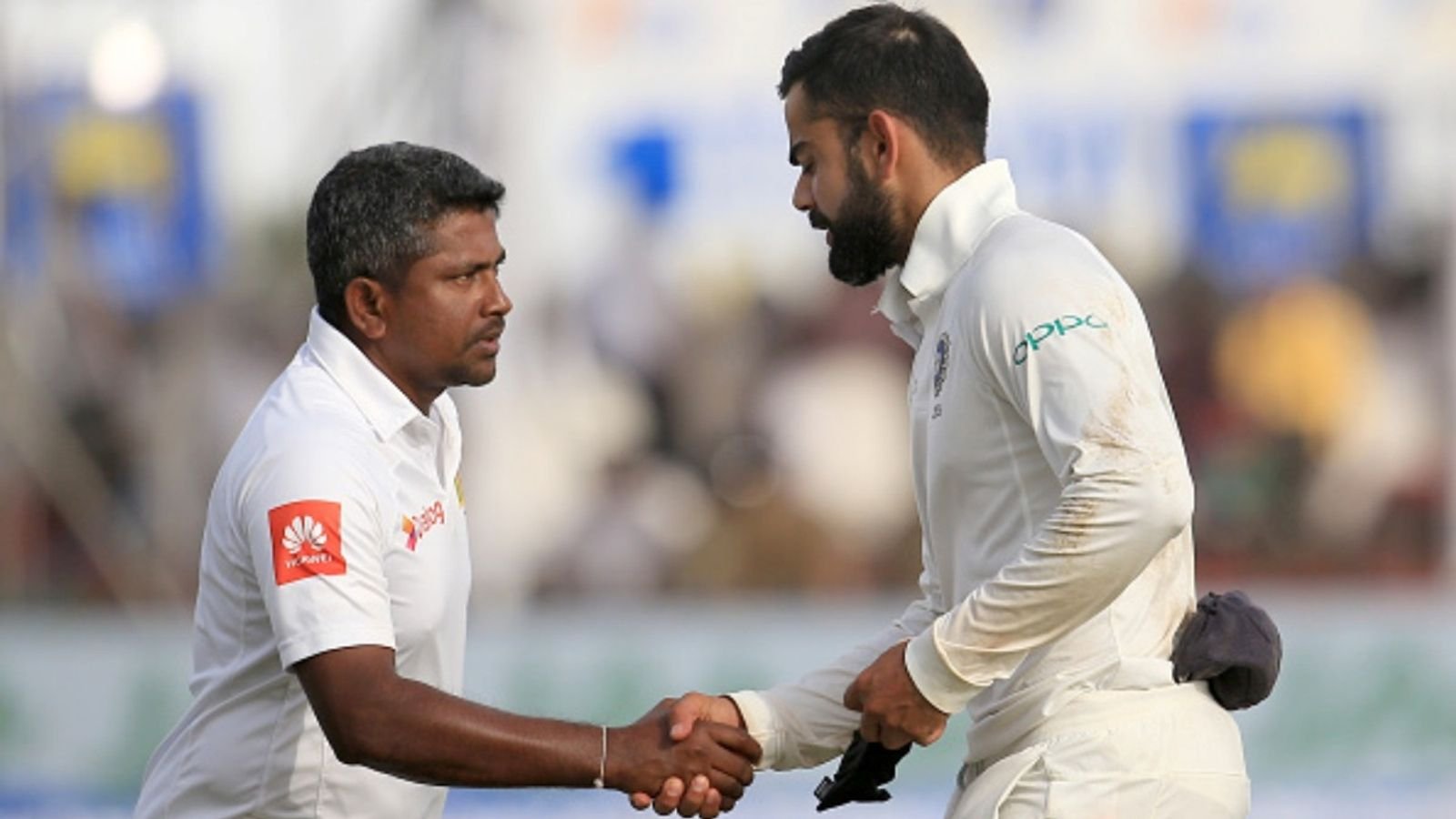
India vs Sri Lanka in Galle carries an intriguing piece of recent history as Shubman Gill’s team prepares to return to the venue for the opening Test of the 2026 series. India will begin its WTC 2025-27 campaign against Sri Lanka at Galle International Stadium on August 19, and the last meeting between the two sides at this ground produced one of India’s most convincing victories in the island nation.
The previous India-Sri Lanka Test at Galle took place in July 2017, when Virat Kohli’s Indian side produced a commanding all-round performance to win by 304 runs. Shikhar Dhawan’s spectacular 190 and Cheteshwar Pujara’s patient 153 laid the foundation for a massive first-innings total, while Kohli later added a century in the second innings.
Sri Lanka responded with 291 in their first innings and were eventually bowled out for 245 while chasing 550. Ravichandran Ashwin and Ravindra Jadeja then completed the job with three wickets apiece as India secured one of its biggest Test wins by runs.
India’s Last Galle Test Was a Statement Victory
The 2017 Test is particularly relevant because Galle had previously been a difficult venue for India.
Before that match, Sri Lanka had beaten India at the ground in 2001, 2010 and 2015. The 2015 defeat was especially painful because India, chasing only 176 in the fourth innings, were bowled out for 112 as Rangana Herath produced a match-defining spell.
Four years after that setback, India returned to Galle with a different level of confidence and completely changed the narrative.
Kohli won the toss and elected to bat first. The decision immediately paid dividends as India’s batting lineup put Sri Lanka under pressure for virtually the entire opening innings.
Shikhar Dhawan Produced a Stunning 190
India’s innings initially suffered an early setback when Abhinav Mukund was dismissed, but Shikhar Dhawan transformed the contest with an aggressive display of opening batting.
Dhawan scored 190 from 168 deliveries and struck 31 fours. He fell only 10 runs short of what would have been a memorable double century, but his innings had already given India enormous control over the match.
His approach was particularly important because Galle has traditionally offered assistance to spin bowlers as a Test progresses. By scoring quickly and putting pressure back on the Sri Lankan attack, Dhawan prevented the hosts from settling into a comfortable rhythm.
His 190 was eventually enough to earn him the Player of the Match award.
Cheteshwar Pujara Provided the Perfect Contrast
At the other end, Cheteshwar Pujara played the kind of innings that complemented Dhawan perfectly.
Pujara scored 153 from 265 deliveries, providing stability after India’s early wicket. While Dhawan attacked, Pujara absorbed pressure and ensured that India’s innings did not lose momentum.
The partnership between contrasting batting styles was a major feature of India’s first innings. Dhawan’s attacking intent forced Sri Lanka to defend, while Pujara’s patience gave India the platform to build a huge score.
Virat Kohli, however, did not enjoy the same success in the first innings. He was dismissed cheaply by Nuwan Pradeep, who finished with six wickets.
That dismissal mattered little in the larger picture because India had already established a dominant position through its top order and middle-order contributions.
India Reached a Massive 600
After Dhawan and Pujara’s centuries, India continued accumulating runs.
Ajinkya Rahane and Hardik Pandya contributed half-centuries, while Ravichandran Ashwin added 47. Several other contributions ensured that Sri Lanka’s bowlers could not quickly end the innings.
India eventually reached 600 before being bowled out.
The significance of the total was not simply its size. It also placed enormous pressure on Sri Lanka’s batting lineup because the hosts had to spend long periods in the field before even beginning their own innings.
Sri Lanka Fell Short Despite Important Contributions
Sri Lanka’s first innings began poorly as three wickets fell relatively early.
Upul Tharanga was dismissed for 64 after being involved in a run-out, but Angelo Mathews then provided resistance with an 83-run innings. Dilruwan Perera also played an important role, remaining unbeaten on 90.
Despite those efforts, Sri Lanka were bowled out for 291 in 78.3 overs.
At that stage, India had already secured a first-innings lead of 309 runs.
Virat Kohli had the option of enforcing the follow-on, but chose instead to send his batsmen back out. That decision ultimately turned the match into an even greater demonstration of India’s dominance.
Kohli Answered With a Century in the Second Innings
India’s second innings began with Dhawan and Pujara both departing relatively early.
Dhawan scored 14, while Pujara made 15. The early wickets could have given Sri Lanka a small opening, but Abhinav Mukund and Virat Kohli ensured that the hosts did not get back into the contest.
The pair shared a 133-run partnership for the third wicket.
Mukund played a valuable innings of 81 from 116 deliveries but narrowly missed out on a century. Kohli continued beyond him and reached three figures.
Rahane then added a useful contribution before Kohli declared India’s innings at 240 for 3.
That declaration gave Sri Lanka a target of 550 runs.
Why Kohli’s Declaration Was Important
The decision to declare rather than continue batting reflected India’s position of complete control.
India did not need to chase an enormous lead for statistical reasons. The priority was to give its bowlers sufficient time to take 10 wickets while still leaving Sri Lanka with a target that was practically beyond reach.
A 550-run target also meant Sri Lanka could not realistically focus on simply surviving without eventually facing scoreboard pressure.
That combination of time and pressure became decisive.
Ashwin and Jadeja Finish the Job
Sri Lanka’s chase never developed into a realistic attempt at reaching 550.
Upul Tharanga and Danushka Gunathilaka were dismissed early, although Dimuth Karunaratne tried to provide resistance.
Karunaratne eventually found support from Niroshan Dickwella, with the pair adding 101 runs for the fifth wicket.
Dickwella scored 67 before Ravichandran Ashwin dismissed him. Karunaratne then followed, also falling to Ashwin after reaching 97.
It was another reminder of how India’s spin attack could exploit the pressure created by a huge target.
Dilruwan Perera once again remained unbeaten, but Sri Lanka were eventually bowled out for 245.
Jadeja and Ashwin finished with three wickets each as India completed a 304-run victory.
India’s 2017 Galle Win Changed the Venue’s Narrative
The victory was more significant than the margin alone suggests.
Galle had been a venue where Sri Lanka enjoyed considerable success against India. The hosts had won three of the first four Tests between the sides at the ground, including the 2015 match when Herath’s seven-wicket haul helped Sri Lanka defend 176.
India’s 2017 performance therefore demonstrated that the visitors could dominate in conditions traditionally associated with Sri Lankan spin.
The result also established a tactical template: score heavily, create scoreboard pressure and then allow the spinners to attack a team forced into a high-risk fourth-innings chase.
India vs Sri Lanka Head-to-Head in Galle
| Year | Result | Key Match Detail |
|---|---|---|
| 2001 | Sri Lanka won by 10 wickets | India suffered a heavy defeat in the first Test between the sides at Galle. |
| 2008 | India won by 170 runs | Virender Sehwag scored an unbeaten double century. |
| 2010 | Sri Lanka won by 10 wickets | Sri Lanka again dominated India at the venue. |
| 2015 | Sri Lanka won by 63 runs | Rangana Herath took seven wickets as India failed to chase 176. |
| 2017 | India won by 304 runs | Dhawan scored 190, Pujara made 153 and Kohli hit a second-innings century. |
What the Record Says About Galle
Sri Lanka still have the better overall record between the teams at Galle, with three victories from five Tests before the upcoming 2026 meeting.
That statistic provides an important counterpoint to India’s huge 2017 win.
One dominant victory does not automatically make Galle an easy venue for India. The ground has historically produced matches in which momentum can shift rapidly, particularly once the pitch begins offering more assistance to spin.
India therefore cannot simply rely on its previous success. The conditions, players and tactical requirements will be different in 2026.
Why the 2017 Blueprint Could Still Matter in 2026
There is one obvious lesson India can take from the previous Galle Test: first-innings runs have enormous value.
India’s 600 in 2017 allowed the bowlers to attack without worrying about protecting a modest lead. The huge total also forced Sri Lanka’s batsmen to spend long periods under pressure.
For the 2026 team, the names may be different, but the underlying principle remains relevant.
If India can establish a significant first-innings advantage, its spinners could become increasingly influential as the Test progresses.
The challenge will be balancing aggression with patience. Galle can reward attacking strokeplay, but batsmen also need to understand when the conditions demand a more conservative approach.
Shubman Gill’s India Faces a Different Challenge
The upcoming series will also mark a new phase for India’s Test side under Shubman Gill’s leadership.
Gill’s team cannot replicate the 2017 side simply by following the same scorecard. Modern Test Cricket has changed, and so have India’s personnel and tactical options.
India’s current batting group includes players capable of scoring quickly, while the bowling attack has a mixture of pace and spin options. The management will have to determine how much emphasis to place on batting depth, spin combinations and conditions-specific selections.
The availability of key players is another factor. India’s recent injury concerns have already affected its preparation, making team selection one of the biggest talking points before the first Test.
The Biggest Tactical Battle Could Be Against Spin
Galle is likely to make spin an important part of the contest, particularly as the Test progresses.
That does not mean the pitch will automatically turn sharply from the first session. Test matches are dynamic, and the effectiveness of spin depends on pitch conditions, bowling accuracy and how batsmen respond.
India’s own spin resources could become one of its biggest advantages.
The visitors will need their spinners to control the scoring rate while also attacking when Sri Lanka’s batsmen are under pressure. At the same time, India’s batters must avoid giving Sri Lanka’s spinners cheap wickets through unnecessary aggression.
The 2017 Test Also Shows the Value of Partnerships
Another overlooked feature of India’s 2017 victory was the way different batting partnerships complemented each other.
Dhawan attacked. Pujara absorbed pressure. Kohli later controlled the second innings. Mukund provided stability, while contributions from Rahane, Pandya and Ashwin pushed the first-innings total beyond 600.
That depth made Sri Lanka’s task considerably harder.
For the 2026 side, the same principle will be important. One batter producing a hundred may not be enough in Galle. India will need multiple players to contribute if it wants to control the Test from the first innings.
India’s Recent Record Adds Confidence
India’s last Test defeat against Sri Lanka came at Galle in 2015. Since then, India have not lost a Test to Sri Lanka.
The 2017 Galle victory was followed by two more wins in that three-Test tour, with India completing a 3-0 series sweep under Kohli.
That history provides confidence, but it also creates expectations.
The 2026 team will be judged on its own performance rather than the achievements of a previous generation. The conditions may be familiar, but the challenge remains new.
What to Watch When India Returns to Galle
- India’s first-innings batting: The ability to build a substantial total could determine the direction of the Test.
- Spin selection: India’s combination of specialist spinners and all-rounders could become crucial as the pitch wears.
- Sri Lanka’s middle order: The hosts will need to avoid the kind of collapses that made the 2017 contest one-sided.
- Fourth-innings pressure: A large target could allow India’s bowlers to attack aggressively.
- Leadership under Shubman Gill: Field placements, declaration timing and bowling changes could prove decisive.
Conclusion
The last time India played Sri Lanka in a Test at Galle, the visitors produced a near-complete performance. Shikhar Dhawan’s 190 and Cheteshwar Pujara’s 153 powered India to 600, while Virat Kohli added a century in the second innings after Sri Lanka were restricted to 291.
India then set a massive target of 550 and bowled Sri Lanka out for 245, with Ashwin and Jadeja taking three wickets each. The 304-run victory overturned India’s previous struggles at the venue and became one of the defining results of the 2017 tour.
Now, almost a decade later, India returns to Galle with a new captain and a different generation of players. The old scorecard provides confidence, but it also offers a tactical lesson: dominate the first innings, manage the conditions intelligently and make the opposition bat under pressure.
Whether Gill’s India can reproduce that formula will be one of the central storylines when the first Test begins on August 19.
For breaking news and live news updates, like us on Facebook or follow us on Twitter and Instagram. Read more on Latest Cricket on thefoxdaily.com.






COMMENTS 0