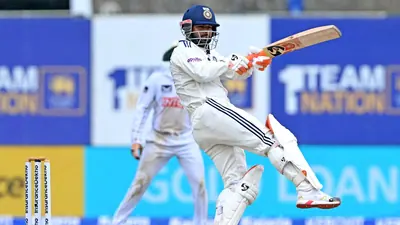
Rishabh Pant 100 Test sixes milestone has added another remarkable record to the India wicketkeeper-batter’s already extraordinary career. Pant reached the landmark during the second innings of the first Test against Sri Lanka in Galle on Tuesday, becoming the fastest batter in Test history to hit 100 sixes.
The achievement came during an aggressive Indian batting effort on Day 4, with India looking to build a sufficiently large lead after rain had disrupted the match earlier in the contest. Pant entered the day with 98 Test sixes and needed only two more maximums to enter an exclusive group of players who have reached the century mark in sixes in the longest format.
He eventually reached the milestone against Lahiru Kumara, clearing the boundary over long leg with a powerful shot. The moment placed Pant alongside Adam Gilchrist, Brendon McCullum and Ben Stokes as the only batters to have reached 100 Test sixes.
But the record is even more significant because Pant needed just 89 innings to achieve it. That makes him not only the fourth player to reach 100 sixes but also the quickest by a substantial margin.
Rishabh Pant Reaches 100 Test Sixes in Just 89 Innings
Pant’s journey to 100 sixes reflects the attacking philosophy that has become one of the defining characteristics of his Test career.
When the Indian wicketkeeper arrived at the crease during the second innings in Galle, he already had 98 sixes in the format. The first of his two required maximums came against Kumara when Pant launched a length delivery high over long-off.
He did not have to wait long for number 100.
After lunch, Kumara delivered a fuller ball angled toward the left-hander. Pant moved inside the line, positioned himself underneath the delivery and pulled it over long leg for the historic maximum.
The shot was fitting because it demonstrated exactly what makes Pant such a unique Test batter. Rather than treating the longest format as a contest that must always be played defensively, he has repeatedly used attacking strokes to put pressure back on bowlers.
The result is a record that would have seemed extraordinary even by the standards of modern Test Cricket.
How Pant’s Record Compares With the Previous 100-Six Club
| Batter | Test sixes | Innings to 100 sixes |
|---|---|---|
| Rishabh Pant | 100 | 89 |
| Adam Gilchrist | 100 | 130 |
| Ben Stokes | 100 | 151 |
| Brendon McCullum | 100 | 170 |
The comparison makes Pant’s achievement particularly striking.
According to the milestone figures, Pant reached 100 sixes 41 innings faster than the previous record-holder, Australia’s Adam Gilchrist. Gilchrist was already famous for revolutionising the role of the attacking wicketkeeper-batter, making the comparison especially appropriate.
Ben Stokes required 151 innings to reach 100 sixes, while Brendon McCullum reached the mark in 170 innings.
Pant therefore did not merely enter the same statistical club. He reached the landmark at a pace that separates him dramatically from the other three members.
Pant Is the First Asian Batter to Reach 100 Test Sixes
The record has another important dimension for Indian and Asian cricket.
Pant became the first batter from Asia to reach 100 sixes in Test cricket. That is particularly notable because Asian teams have produced generations of technically gifted Test batters, but none had previously combined longevity and six-hitting at this level in the longest format.
Test cricket has traditionally placed greater value on patience, concentration and occupying the crease for long periods. Pant’s approach challenges that conventional image without abandoning the fundamentals required to succeed over five days.
His ability to score rapidly has made him particularly valuable when India need to change the tempo of a Test.
The Numbers Behind Pant’s Six-Hitting Record Are Even More Impressive
The innings count is not the only statistic that makes Pant’s record remarkable.
He reached 100 Test sixes after facing just 4,918 deliveries, giving him the lowest number of balls faced among the four players who have reached the landmark.
This reinforces the central feature of Pant’s batting: he does not need an enormous amount of time at the crease to make an impact.
His scoring approach can change the rhythm of a Test match within a short period. A few boundaries can force fielding captains to move defensive players into unusual positions, while repeated attacks against certain bowlers can disrupt carefully constructed plans.
That makes Pant particularly dangerous when India are trying to set up a declaration or build a fourth-innings target quickly.
Why Pant’s Six-Hitting Matters More in Test Cricket
A six in Test cricket is not simply another scoring shot.
Because Test matches are built around long periods of accumulation, a batter who can consistently clear the boundary can alter the tactical equation. A team can reach a competitive total faster, increase the pressure on bowlers and create additional time to dismiss the opposition.
This becomes especially valuable when a match has lost playing time.
That was precisely the situation in Galle. India had lost around one and a half sessions to rain on Day 2, meaning the remaining time available to force a result was reduced.
In such circumstances, Pant’s attacking approach becomes more than entertainment. It becomes a tactical weapon.
India Needed Speed After Building a 178-Run Lead
The match situation provided the perfect environment for Pant’s style.
India had bowled Sri Lanka out for 284 on the third evening, giving themselves a 178-run first-innings advantage. The objective in the second innings was therefore not simply to accumulate as many runs as possible.
India needed to balance two competing priorities: build a sufficiently large target while leaving enough time to take 10 Sri Lankan wickets.
Pant’s rapid 66 from 69 balls helped India move the game forward quickly.
His innings included the landmark six and delivered the kind of acceleration that can transform a Test match. Instead of spending many overs adding runs at a conventional pace, India could increase the lead rapidly and place Sri Lanka under pressure in the fourth innings.
Pant’s 66 Was More Important Than the Record Alone
Although the 100th six naturally became the headline moment, Pant’s overall contribution was arguably more important from India’s perspective.
He scored 66 runs from just 69 deliveries before his innings ended, giving India a rapid injection of runs at a crucial stage of the match.
His dismissal came when Kumara changed tactics and bowled shorter. Pant shuffled across and attempted to play the pull shot but could not control the stroke. The resulting top edge looped behind the wicketkeeper, where Niroshan Dickwella completed the catch.
That dismissal ended the innings, but the damage had already been done.
Pant had helped India push the lead beyond 350, creating a substantial target for Sri Lanka and giving the Indian bowlers an opportunity to attack with time still remaining.
The Gilchrist Comparison Is Impossible to Avoid
Whenever Pant’s Test batting achievements are discussed, Adam Gilchrist naturally enters the conversation.
Gilchrist transformed expectations of what a wicketkeeper could contribute with the bat. His aggressive approach allowed Australia to maintain extraordinary scoring rates while still possessing a player capable of producing match-changing innings.
Pant represents a different generation of the same broader idea.
Like Gilchrist, he can turn a Test match through attacking strokeplay. But Pant’s route to 100 sixes has been even faster, both in innings and deliveries faced.
The comparison should not be treated as a declaration that one player is universally better than the other. Their careers, teams, eras and conditions are different.
Instead, the comparison shows how dramatically the role of the attacking wicketkeeper-batter has evolved.
Pant’s Record Reflects the Evolution of Modern Test Cricket
Test cricket has changed considerably in recent years.
Teams increasingly understand the value of positive scoring, aggressive declarations and attacking fields. The emergence of shorter-format cricket has also influenced how players approach the longest format.
Pant is one of the clearest examples of that evolution.
He does not simply transfer a T20 approach into Test cricket. His best performances show an understanding of match situations, allowing him to choose when aggression can produce the greatest advantage.
The 100-six milestone is therefore not just a personal record. It represents how modern Test batting can combine traditional endurance with calculated aggression.
Galle Provides the Perfect Setting for Another Pant Record
The Galle International Stadium has hosted numerous memorable Test performances, but Pant’s latest achievement adds another unique chapter to its history.
Conditions in Sri Lanka can challenge batters with spin, variable bounce and changing match situations. Producing rapid runs while protecting a team’s position requires confidence and adaptability.
Pant’s ability to attack in those circumstances makes his record even more valuable.
He reached the milestone against a pace bowler in Lahiru Kumara, demonstrating that his six-hitting is not restricted to one particular type of bowling. His range allows him to attack length deliveries, fuller balls and shorter bowling when he gets into position.
Why This Record Could Stand for a Long Time
The most fascinating question is what happens next.
Pant has already reached 100 sixes at an extraordinarily young stage of his Test career compared with the other members of the 100-six club. That means the record is unlikely to stop here.
Provided he remains healthy and continues playing Test cricket, Pant could significantly extend the gap between himself and the other players on the list.
The eventual number could become more important than the milestone itself.
Reaching 100 sixes was once a rare achievement associated with some of the most aggressive batters in Test history. Pant has now made it look like the beginning of another statistical chapter.
The Bigger Impact on Indian Cricket
For India, Pant’s ability to score quickly provides a tactical advantage that few wicketkeeper-batters can replicate.
When India are setting a target, Pant can accelerate the scoring rate without requiring a specialist lower-order hitter. When India are chasing, his attacking ability can reduce the number of overs required to reach a target.
That flexibility is particularly valuable in Tests affected by rain or poor weather.
In Galle, where lost time had already reduced the available opportunity to force a result, his rapid scoring directly suited India’s match situation.
This is why the record should not be viewed only through the lens of entertainment. Pant’s six-hitting can fundamentally affect India’s Test strategy.
What the 100-Six Record Says About Rishabh Pant
- Explosive scoring: Pant has reached 100 Test sixes faster than any batter in history.
- Asian milestone: He is the first batter from Asia to reach the landmark.
- Wicketkeeper impact: His batting adds extraordinary attacking value to India’s wicketkeeping position.
- Match acceleration: His rapid scoring can help India create time to take 20 wickets.
- Future potential: His pace to 100 sixes suggests the final total could become significantly larger.
Sri Lanka Now Face a Difficult Fourth-Innings Challenge
The immediate importance of Pant’s innings was reflected in the match situation.
India pushed their lead beyond 350, leaving Sri Lanka with a daunting fourth-innings target. Chasing large totals at Galle is notoriously difficult, although the venue has witnessed at least one successful chase above 300.
Pakistan famously chased 342 against Sri Lanka in 2022, winning with four wickets remaining.
That precedent means a large target is not automatically an impossible one. However, India’s position after Pant’s rapid contribution gave their bowlers a strong opportunity to attack Sri Lanka’s batting lineup with scoreboard pressure on their side.
Conclusion: Rishabh Pant Has Added Another Record to an Extraordinary Test Career
Rishabh Pant’s 100 Test sixes are more than a landmark statistic. They provide another illustration of how dramatically the Indian wicketkeeper-batter has changed the expectations surrounding Test cricket.
He reached the milestone in only 89 innings and after facing just 4,918 deliveries, making him the fastest batter to reach 100 Test sixes. He also became the first Asian batter to join the exclusive club alongside Adam Gilchrist, Brendon McCullum and Ben Stokes.
His achievement came at exactly the right moment for India. With the first Test against Sri Lanka moving into its decisive stages and valuable playing time already lost to rain, India’s priority was to score quickly and create enough time to force a result.
Pant’s 66 from 69 balls did precisely that.
The 100th six will remain the defining image, but the larger story is his impact on India’s Test strategy. His ability to transform the scoring rate means that aggression can become a practical weapon rather than merely a source of entertainment.
At 100 Test sixes, Pant has reached a milestone that only a handful of batters have achieved. Given the speed at which he got there, however, the more interesting question may no longer be whether Pant can reach 100.
It is how far beyond 100 he can go.
For breaking news and live news updates, like us on Facebook or follow us on Twitter and Instagram. Read more on Latest Cricket on thefoxdaily.com.






COMMENTS 0