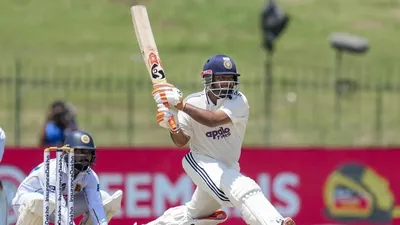
Rishabh Pant’s injury update has become one of the biggest concerns for India during the second Test against Sri Lanka in Colombo. Pant did not take the field on either Day 2 or Day 3 after being struck during the opening day, leaving Dhruv Jurel to handle wicketkeeping duties as India defended a substantial first-innings total.
India bowling coach Morne Morkel provided the clearest update after the third day’s play, explaining that Pant had suffered significant bruising around his shoulder and was experiencing restricted movement during the morning warm-up. The Indian team planned to monitor him overnight, with the hope that he would be fit enough to return behind the stumps on the following day.
The development is particularly important because Pant had already returned to the crease after his initial injury and produced a valuable 63-run innings. His ability to bat through the discomfort initially offered encouragement, but his absence from wicketkeeping duties for two consecutive days indicates that the medical team is still managing the problem carefully.
For India, the situation is about more than one player’s availability. Pant’s wicketkeeping, batting impact and ability to read the game make him a central figure in the Test side. His absence therefore creates both a tactical and workload-management challenge at a crucial stage of the match.
What Happened to Rishabh Pant?
Pant was injured during the first day of the Colombo Test when Sri Lanka fast bowler Lahiru Kumara delivered a short ball. The incident occurred early in the 58th over as Pant attempted to play the delivery aggressively.
The ball appeared to catch his glove as he attempted the pull shot, immediately causing him discomfort. Pant reacted by holding his wrist before the Indian support staff came onto the field to assess him.
The physio treated the affected area and applied an ice pack, while Pant discussed the situation with the officials and medical staff. He eventually left the field to receive further treatment.
At that stage, the initial concern centered around his wrist. However, the subsequent update from Morkel highlighted bruising around Pant’s shoulder and restrictions in his movement.
That difference is important because the impact and subsequent discomfort can affect both batting and wicketkeeping, two roles that require significant upper-body movement.
Pant Returned to Bat Despite the Injury
The fact that Pant returned to the field on the second day initially appeared encouraging.
Rather than ending his involvement in the innings, he batted for India and scored 63 runs from 89 deliveries. His innings included six fours and two sixes, demonstrating that the injury did not prevent him from making a meaningful contribution with the bat.
Pant’s ability to resume batting also highlighted his importance to India’s first-innings total. India eventually declared at 503/9, putting Sri Lanka under significant pressure.
However, batting and wicketkeeping place different demands on the body. A batter can sometimes manage discomfort while remaining relatively stationary between deliveries, whereas a wicketkeeper must repeatedly squat, move laterally, catch, throw and react instantly to deflections.
That distinction helps explain why Pant could bat but still be unavailable for wicketkeeping.
Why Dhruv Jurel Has Been Keeping Wickets
With Pant unavailable behind the stumps, Dhruv Jurel has taken over wicketkeeping duties.
Jurel handled the gloves during the final stages of Day 2 and continued throughout Day 3. His role has therefore become particularly important as India attempt to capitalize on their first-innings advantage.
Jurel’s presence gives India a specialist wicketkeeping option rather than forcing Pant to perform a role that could aggravate his injury.
It also provides India with some tactical flexibility. The priority is not simply getting Pant back onto the field as quickly as possible but ensuring that he can safely perform his responsibilities without worsening the problem.
| Development | What happened |
|---|---|
| Day 1 | Pant was struck while attempting to play a short delivery from Lahiru Kumara and left the field for treatment. |
| Day 2 | Pant returned to bat and scored 63 runs but did not take over wicketkeeping duties. |
| India’s declaration | India declared at 503/9, with Dhruv Jurel handling the gloves. |
| Day 3 | Jurel continued as wicketkeeper while Pant remained unavailable. |
| Post-Day 3 update | Morne Morkel said Pant was badly bruised around the shoulder and had restricted movement during warm-up. |
| Next assessment | India planned to monitor Pant overnight with the hope that he could return behind the stumps. |
Morne Morkel Provides the Latest Pant Injury Update
Morkel’s comments after Day 3 offered the clearest indication yet of why Pant has remained away from wicketkeeping.
“He is quite badly bruised. He was just a little bit restricted in his movement this morning during warm-up.”
The bowling coach also emphasized the importance of having Pant available because of his ability to understand the game.
“Hopefully, he will be behind the stumps for us tomorrow. I think it is important to have him there. His reading of the game is exceptional.”
The wording is encouraging in one sense because the team was hopeful of Pant returning. However, it also confirms that his condition was serious enough to require continued monitoring.
Importantly, Morkel did not suggest that Pant’s return was guaranteed. The decision would depend on how the player responded to treatment and assessment.
Why Pant’s Wicketkeeping Matters So Much to India
Pant is not simply India’s first-choice wicketkeeper who also bats. His ability to influence a Test match in multiple ways makes him strategically valuable.
Behind the stumps, Pant provides constant communication with India’s bowlers and fielders. His reading of batters’ movements can influence field placements, bowling plans and tactical decisions.
Morkel’s reference to Pant’s “reading of the game” reflects this broader contribution.
Wicketkeeping is also physically demanding. The role requires repeated movement over long periods, particularly when spinners are operating and the keeper must remain close to the stumps.
That makes a shoulder injury particularly relevant. Even if a player feels capable of participating, the repetitive nature of wicketkeeping can place additional stress on an injured area.
The Tactical Problem India Faces
India’s immediate challenge is balancing two competing priorities: maximizing Pant’s contribution and protecting his fitness.
The visitors entered the match in a strong position after declaring on 503/9. Centuries from Devdutt Padikkal and Dhruv Jurel helped India build a commanding total.
That advantage means India does not necessarily need to take unnecessary risks with Pant.
At the same time, wicketkeeping becomes increasingly important as a Test progresses. A keeper can be involved in catches, stumpings, edges and tactical communication at any moment.
India therefore need to assess whether Pant is physically ready rather than simply whether he wants to return.
Could Pant’s Batting and Wicketkeeping Recovery Follow Different Timelines?
Yes, and that distinction is important when interpreting injury updates.
Pant’s 63 runs show that he was capable of batting despite discomfort. But it would be incorrect to assume that being able to bat automatically means being ready to keep wickets for an entire day.
The physical requirements are different.
Batting involves short bursts of movement separated by periods of relative inactivity. Wicketkeeping involves hundreds of repeated actions over several hours, including crouching, standing, lateral movement and rapid reactions.
Therefore, the Indian team’s decision to use Jurel behind the stumps can be viewed as a precautionary measure rather than evidence that Pant is unable to contribute at all.
India’s Strong Position Makes Pant’s Management Easier
India’s first-innings score gives the team some breathing room.
After declaring at 503/9, India had established a significant advantage over Sri Lanka. At the end of Day 3, Sri Lanka were 265/8, still 238 runs behind.
That position is relevant to Pant’s injury management because India can prioritize his fitness without necessarily compromising the entire match strategy.
If the team believes Pant needs additional time to recover, Jurel can continue behind the stumps while India rely on their bowlers to finish the innings.
The bigger concern would arise if Sri Lanka began to create a realistic fourth-innings chase or if India required Pant’s specific skills to change the game.
Why the Timing of Pant’s Injury Is Significant
The injury has arrived during an important stage of the two-match series. India and Sri Lanka are competing in the second Test, meaning every session can influence the final series result.
For India, maintaining wicketkeeping stability is especially important because the team needs to convert its strong first-innings position into a result.
The good news is that Pant was able to bat and contribute 63 runs. The concern is whether the bruising will allow him to complete the other half of his role.
This is why the overnight monitoring mentioned by Morkel becomes significant. The next assessment could determine whether Pant returns to wicketkeeping or whether Jurel continues for another spell.
What India Will Be Watching Closely
The Indian management will likely focus on Pant’s range of movement, comfort during warm-ups and ability to perform basic wicketkeeping movements.
They will also need to consider whether discomfort changes his reactions. A wicketkeeper has very little time to respond to edges, deflections and chances around the stumps.
Even a relatively small restriction in movement can become important in such situations.
The key question is therefore not simply whether Pant can stand behind the wickets. It is whether he can perform the role at his normal level without putting his recovery at risk.
The Bigger Picture for Rishabh Pant
Pant has become one of the most important players in India’s Test setup because of the combination of wicketkeeping and aggressive batting he provides.
His ability to change the tempo of an innings can put pressure on opposition bowlers and alter the direction of a Test match. His wicketkeeping role adds another layer to his value.
That is why even a temporary absence attracts significant attention.
However, the current situation also reinforces an important principle in Test cricket: players cannot always be judged simply by whether they are willing to continue.
Medical management, workload and long-term fitness matter, particularly for a player expected to contribute in multiple disciplines.
Prediction: India Are Unlikely to Rush Pant Back
Based on Morkel’s comments, the most sensible expectation is that India will continue assessing Pant rather than automatically restoring him to wicketkeeping duties.
The team’s hope that he can return suggests there is optimism, but the mention of significant bruising and restricted movement indicates that caution remains necessary.
With Jurel already performing the role effectively, India have a practical alternative available.
That could allow the management to make a decision based on Pant’s actual recovery rather than the pressure of getting their preferred wicketkeeper back immediately.
Conclusion: Pant’s Recovery Is Now India’s Main Concern
Rishabh Pant’s injury update has provided both encouragement and concern for India. The wicketkeeper-batter was able to return after his initial blow and score a valuable 63, but he subsequently missed two days of wicketkeeping.
Morne Morkel’s latest comments confirmed that Pant is dealing with significant bruising around his shoulder and experienced restricted movement during warm-up. India will continue monitoring him before deciding whether he can return behind the stumps.
For now, Dhruv Jurel remains an important part of India’s plans, while Pant’s fitness is being managed carefully.
With India holding a substantial first-innings advantage, the priority should be clear: get Pant back only when he is physically ready, rather than risking a worsening injury for the sake of one Test match.
For breaking news and live news updates, like us on Facebook or follow us on Twitter and Instagram. Read more on Latest Cricket on thefoxdaily.com.






COMMENTS 0