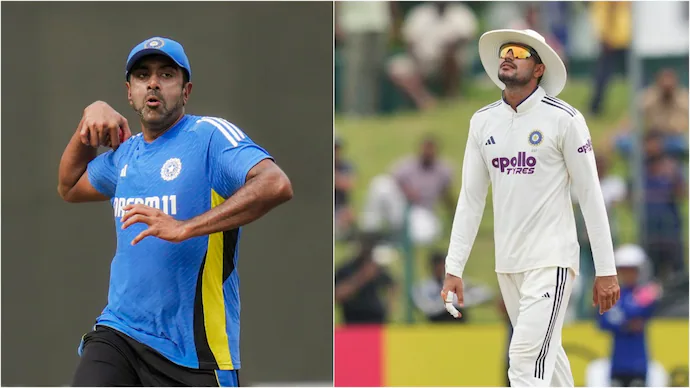
Former India spinner Ravichandran Ashwin has criticised India’s approach on the final day of the drawn Wellington Test against New Zealand, arguing that Shubman Gill‘s team lacked the urgency and belief required to push for a victory. Ashwin questioned the decision to shake hands with New Zealand with 15 overs still remaining, saying India should have continued attacking rather than accepting a draw.
India had established a commanding position by declaring their first innings at 720 for nine, securing a massive 352-run lead. However, New Zealand resisted the bowling attack in their second innings, finishing at 239 for five after batting for 120 overs at Basin Reserve on Monday.
Despite India’s dominance with the bat, the visitors could not take the remaining five wickets needed for victory. New Zealand batters Daryl Mitchell and Glenn Phillips held firm, frustrating the Indian bowlers until the two teams agreed to end the contest.
Ashwin acknowledged that India might not have secured the win even if they had continued playing. His criticism was directed at the team’s attitude and intensity, particularly when a Test victory remained mathematically possible.
Ashwin Questions India’s Decision to End Wellington Test Early
Ashwin felt India should have used the final 15 overs to continue searching for wickets instead of settling for a draw. According to the former spinner, the team needed to demonstrate that it was prepared to take risks and fight until the scheduled end of the match.
“I didn’t see the belief in them to win the match,” Ashwin said, highlighting what he considered a lack of urgency in India’s approach during the final stages.
For Ashwin, the issue was not simply whether India could have dismissed New Zealand’s remaining batters. He wanted the visitors to maintain an aggressive mindset and make the opposition work harder to preserve the draw.
India’s first-innings performance had put them in a position of considerable advantage. But New Zealand’s resistance exposed the difficulty of converting that dominance into a result, particularly as the pitch became slower and increasingly less helpful to the bowlers.
Ashwin’s comments have also raised questions about the balance between managing players’ workloads and pursuing victories in demanding overseas Test matches.
Virat Kohli’s Captaincy Used as an Example of Urgency
While discussing India’s approach, Ashwin referred to former captain Virat Kohli’s leadership as an example of the intensity he wanted to see from the current team. He was careful not to claim that Kohli or another captain would necessarily have secured victory from the same position.
“There is one thing you can learn from Virat Kohli’s captaincy. I will never say that another captain or another bowler would have won you the Test match from that situation. But, urgency helps,” Ashwin said.
The distinction was important: Ashwin was not arguing that a different captain would automatically have taken the five remaining wickets. Instead, he suggested that India’s body language, field placements and willingness to keep attacking could have communicated a stronger desire to win.
He also questioned how comfortably New Zealand batter Daryl Mitchell appeared to be operating during the closing stages of the match. Ashwin recalled moments when Mitchell interacted with Indian players and seemed relaxed despite his team’s position.
Ashwin Criticises India’s Fielding Approach Against Daryl Mitchell
Ashwin specifically pointed to Mitchell’s interactions with Indian fielders, including an incident involving the New Zealand batter attempting to adjust the sight screen. He felt the Indian players allowed Mitchell to settle into a comfortable rhythm rather than applying constant pressure.
“I noted Daryl Mitchell wasting time by trying to fix the sight screen. He was talking to our captain, our players. He was laughing and sharing jokes with our fielders. These things never happened in our team,” Ashwin said.
He explained that India’s approach in similar situations during their stronger periods had been different. When the team was chasing a result, he expected players to remain focused and make the batting side feel the pressure.
“Yes, when we had the upper hand, we would find time to enjoy. But, when we are chasing a result, we were always ready for a fight. You can’t let the batter go into his comfort zone. The fielders were not coming close.”
His criticism was therefore about more than individual bowling decisions. Ashwin wanted India to create a more intimidating atmosphere through close fielders, sustained pressure and a sharper approach between deliveries.
In Test cricket, a batting side defending a draw can benefit when the fielding team loses intensity. Constant pressure can force batters into mistakes, while relaxed field settings and a slower tempo may allow them to concentrate on survival. Ashwin believed India had not done enough to disrupt New Zealand’s comfort.
Slow Wellington Pitch Made Taking Wickets Difficult
Ashwin also recognised that the conditions at Basin Reserve had become increasingly challenging for India’s bowling attack. The pitch had slowed considerably, reducing the assistance available to the bowlers as New Zealand continued to defend their wickets.
He suggested that India could not expect sharp turn from the surface at that stage of the match, making it necessary to find alternative ways to create wicket-taking opportunities.
“The pitch had slowed down a lot. I have seen this in New Zealand. You would have got sharp turn only if this Test went onto Day 8,” he said.
The observation underlined the difficulty of India’s position. A large first-innings lead does not guarantee a victory if the pitch becomes easier to bat on and the opposition has enough time to defend. India needed either exceptional bowling, pressure-induced mistakes or a more inventive tactical approach to break through New Zealand’s resistance.
Ashwin’s argument was that difficult conditions should have encouraged India to experiment with field placements and use the remaining overs creatively rather than bring the contest to an early conclusion.
Ashwin Responds to Shubman Gill’s Workload Argument
India captain Shubman Gill had defended the decision to end the match by pointing to the workload of the fast bowlers. The quicks had already bowled close to 50 overs, and the team faced a relatively short turnaround before the next Test.
Ashwin accepted that player workload was a legitimate consideration but argued that the demands of Test cricket sometimes require teams to push through difficult periods when a result is still possible.
“Sometimes you have to be realistic, yes. But, this is the demand of Test cricket. Test players have to be prepared for this. If you thought Bumrah was overworked, then bowl seven overs with the spinners, crowd the batters. Show the urgency to win the Test,” he said.
His suggestion was that India could have relied more heavily on the spinners for the remaining overs, while bringing fielders closer to the bat to increase pressure on the New Zealand batters. Rather than asking the fast bowlers to continue carrying the workload, the team could have adjusted its bowling strategy.
Ashwin also questioned whether India’s overall dominance should be considered sufficient when the team had failed to secure the result it wanted.
“Yes, we dominated the Test match, but we didn’t nail it. You won’t win a Test match for dominating, no?”
The remark captured the central point of his criticism. India had controlled significant parts of the match, but the inability to finish the job meant that their strong first-innings performance did not translate into a full victory.
Ashwin Says India Did Not Have to Take All Five Wickets
Ashwin clarified that he was not claiming India would definitely have won if the players had stayed on the field for the final 15 overs. He understood that the remaining wickets could have been difficult to secure, particularly with the pitch offering limited assistance.
His expectation was that India should at least have continued trying to force a result and made New Zealand earn the draw through the remaining overs.
“I am not even saying India should have taken those five wickets. But, they needed to show the urgency. When you travel overseas and play Tests, you often don’t get into such dominant positions. After coming here, taking a backfoot should irritate you.”
The comments reflect the importance of converting strong positions into victories during overseas tours. Matches in challenging conditions can offer limited opportunities to dominate an opponent, making it particularly frustrating when a team cannot capitalise on a substantial advantage.
For Ashwin, India’s performance was therefore a missed opportunity. He wanted the players to show greater determination in the closing stages, even if the chances of completing a victory were limited.
Wellington Draw Deals Blow to India’s World Test Championship Hopes
The drawn result has also affected India’s position in the World Test Championship race. Instead of collecting the 12 points available for a Test victory, India secured only four points from the Wellington contest.
In the World Test Championship, a win earns a team 12 points, a draw provides four points and a tie gives six points. The difference between a draw and a victory can become significant as teams compete for a place in the final.
India’s inability to take New Zealand’s remaining wickets therefore carries consequences beyond the result of a single match. Every lost opportunity to collect maximum points can make the qualification campaign more difficult, particularly when the competition involves several teams with limited opportunities to improve their standings.
The visitors will now turn their attention to the second Test against New Zealand at Hagley Oval in Christchurch, scheduled from November 27 to December 1. The match gives Gill’s side an opportunity to respond after the Wellington draw and strengthen its position in the series.
India Must Turn Dominance Into Results in Christchurch
Ashwin’s assessment places the spotlight on India’s ability to maintain attacking intent when a match enters its decisive stages. The Wellington Test demonstrated that a substantial first-innings lead can still end without a victory if the opposition manages to bat out the available time.
Gill’s explanation focused on the physical demands placed on the fast bowlers and the need to manage resources ahead of the next match. Ashwin, meanwhile, argued that India should have explored alternative bowling options and continued applying pressure rather than accepting the draw with overs remaining.
Neither approach changes the outcome at Basin Reserve, but the disagreement highlights a familiar challenge in Test cricket: deciding when to pursue a difficult victory and when to protect players for the matches ahead.
For India, the next Test in Christchurch will be an opportunity to demonstrate that the Wellington experience has not weakened the team’s competitive edge. As Ashwin’s comments make clear, dominating periods of a Test match is not enough. The ability to sustain pressure, adapt to conditions and finish strong positions remains essential to winning overseas.
For breaking news and live news updates, like us on Facebook or follow us on Twitter and Instagram. Read more on Latest Cricket on thefoxdaily.com.






COMMENTS 0