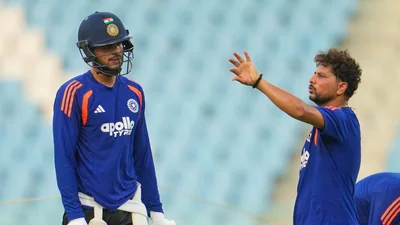
India’s 2-1 ODI series defeat against England has left fans discussing more than just the result. One of the biggest talking points from the tour is the complete absence of Kuldeep Yadav from the playing XI throughout the three-match series.
The left-arm wrist-spinner, who has often been one of India’s most effective wicket-taking options in limited-overs cricket, remained on the bench while India experimented with combinations built around pace bowlers and spin-bowling all-rounders. The decision became even more controversial after England’s spinners played a significant role in the series decider.
Following India’s defeat, captain Shubman Gill defended the team management’s approach, explaining that the pitches appeared more favorable for fast bowlers and offered limited assistance to specialist spinners. However, the explanation has not fully convinced many observers, especially given how the match unfolded.
The debate is no longer just about one player missing a game. It has become a discussion about India’s evolving ODI philosophy, squad balance, and the role of specialist bowlers in modern white-ball cricket.
Why Did Kuldeep Yadav Not Play Against England?
According to Shubman Gill, India’s assessment of the conditions played a major role in team selection.
The Indian management believed that pace bowlers were generating more opportunities and creating greater pressure than spinners throughout the series. As a result, they prioritized seam options and relied on spin-bowling all-rounders rather than selecting an additional specialist spinner.
The strategy reflected a broader tactical belief that wickets would be more likely to come through pace rather than turn.
From a planning perspective, the decision was logical. However, cricket often has a way of challenging pre-match assumptions.
The Match That Changed the Argument
The strongest criticism of India’s selection policy emerged during the final ODI.
While India felt the pitch would not assist spinners significantly, England’s spin attack proved highly effective during the chase. Adil Rashid, Will Jacks, and Jacob Bethell collectively slowed India’s scoring rate and created crucial breakthroughs.
Bethell’s dismissal of Rohit Sharma, who was playing a magnificent innings, proved particularly significant.
As the match progressed, the surface appeared to slow down, making stroke-making more difficult and increasing the value of spin bowling.
This development immediately led to questions about whether Kuldeep Yadav could have made a meaningful difference.
Shubman Gill’s Explanation: Did the Pitch Change?
Gill later acknowledged that the surface behaved differently than expected.
According to the Indian captain, the wicket did not initially appear likely to slow down to the extent it eventually did. When India bowled first, there were fewer indications that spin would become such a major factor later in the match.
This admission is important because it suggests India’s decision may not have been entirely wrong—it may simply have been based on a reading of conditions that evolved differently as the game progressed.
Cricket strategy often depends on predicting how pitches will behave over 100 overs, and even experienced teams occasionally get those predictions wrong.
The Bigger Issue: India’s Growing Preference for All-Rounders
While pitch conditions explain part of the story, the larger reason behind Kuldeep’s omission may be India’s current team-building philosophy.
Under the present management structure, versatility has become increasingly valuable.
Players who can contribute in multiple departments provide greater tactical flexibility. This is especially important in ODI cricket, where teams constantly seek deeper batting line-ups without significantly weakening their bowling attack.
As a result, spin-bowling all-rounders such as Axar Patel and Washington Sundar often gain an advantage during selection meetings.
Their ability to contribute runs lower down the order allows captains to maintain batting depth while still including spin options.
Why Specialist Bowlers Are Finding It Harder to Secure Places
Modern ODI cricket has changed dramatically over the past decade.
Teams increasingly prioritize flexibility because:
- Batting depth is considered essential.
- Lower-order runs often decide close matches.
- Multiple bowling options provide tactical variety.
- Fielding standards have become increasingly important.
- Squad balance frequently outweighs individual specialization.
This trend has created challenges for specialist bowlers who do not offer substantial batting contributions.
Kuldeep Yadav finds himself in exactly that situation.
Kuldeep’s Unique Value to India’s Attack
Despite the emphasis on all-rounders, Kuldeep possesses qualities that few bowlers in world cricket can replicate.
As a left-arm wrist-spinner, he brings variation that most teams rarely encounter.
His bowling offers:
- Unpredictable turn.
- Ability to attack both right-handers and left-handers.
- Wicket-taking potential in middle overs.
- Control through deception rather than speed.
- A genuine match-winning threat on suitable surfaces.
Unlike many defensive spinners, Kuldeep’s primary strength lies in taking wickets rather than simply containing runs.
That attribute can be especially valuable in major ICC tournaments where breakthroughs often determine outcomes.
Recent Form: Was Kuldeep’s Omission Performance-Based?
Selection decisions rarely depend on a single factor.
Recent performances may also have influenced the management’s thinking.
Before the England series, Kuldeep endured a mixed run in ODI cricket. His returns against Afghanistan and New Zealand were not particularly impressive compared to the high standards he has previously established.
While those performances alone should not define his future, they may have reduced the pressure on selectors to include him automatically.
In elite international cricket, even established players must continuously compete for places.
Should Kuldeep Have Played At Least One Match?
This is arguably the strongest criticism of India’s approach.
Even supporters of the team management’s strategy acknowledge that leaving Kuldeep out of all three matches feels harsh.
If India believed conditions favored pace, rotating him into one match could still have provided valuable information ahead of future tournaments.
Series are not only about winning individual games. They also serve as opportunities to evaluate players, test combinations, and prepare for larger objectives.
Given Kuldeep’s experience and past success, many analysts believe he deserved at least one opportunity.
Comparing India’s Spin Options
| Player | Primary Strength | Batting Contribution | Role in Team |
|---|---|---|---|
| Kuldeep Yadav | Wicket-taking wrist-spin | Limited | Specialist spinner |
| Axar Patel | Control and consistency | Strong | Spin all-rounder |
| Washington Sundar | Economy and versatility | Reliable | Batting all-rounder |
| Ravindra Jadeja | Experience and fielding | Excellent | Three-dimensional player |
The table highlights the challenge Kuldeep faces. While his wicket-taking ability may be unmatched among India’s spin options, his batting limitations reduce flexibility elsewhere in the lineup.
What This Means for India’s ODI Future
The Kuldeep debate reflects a broader strategic question facing Indian cricket.
Should teams prioritize specialists capable of winning matches through one exceptional skill, or should they favor multi-dimensional players who contribute across departments?
There is no universal answer.
Different conditions, opponents, and tournament situations require different combinations. The most successful teams often strike a balance between specialists and all-rounders rather than committing entirely to one approach.
For India, finding that balance will be crucial as preparations continue for future ICC events.
A Selection Question That Won’t Go Away
Kuldeep Yadav’s omission is unlikely to be forgotten quickly.
If India’s spin department struggles in future matches, questions about his absence will re-emerge. Conversely, if the all-rounder-heavy strategy delivers consistent success, the management’s decision will appear more justified.
Selection debates often look different depending on results.
What is clear, however, is that Kuldeep remains one of India’s most unique bowling talents, and keeping a player of his quality out of the playing XI indefinitely could become increasingly difficult to justify.
Conclusion: More Than Just One Selection Decision
Shubman Gill’s explanation for leaving out Kuldeep Yadav provides insight into India’s thinking, but it does not completely end the debate.
The decision was shaped by pitch assessments, tactical preferences, and a growing emphasis on all-rounders. Yet England’s success with spin in the series decider exposed the risks of relying too heavily on pre-match assumptions.
Ultimately, the controversy is about more than Kuldeep himself. It reflects the evolving identity of India’s ODI team and the difficult choices selectors must make between flexibility and specialization.
For now, Kuldeep remains on the outside looking in. But if history has shown anything, it is that quality wrist-spinners rarely stay out of the spotlight for long. One strong opportunity could quickly change the conversation—and remind everyone why he has been such an important weapon in India’s white-ball arsenal.
For breaking news and live news updates, like us on Facebook or follow us on Twitter and Instagram. Read more on Latest Sports on thefoxdaily.com.






COMMENTS 0