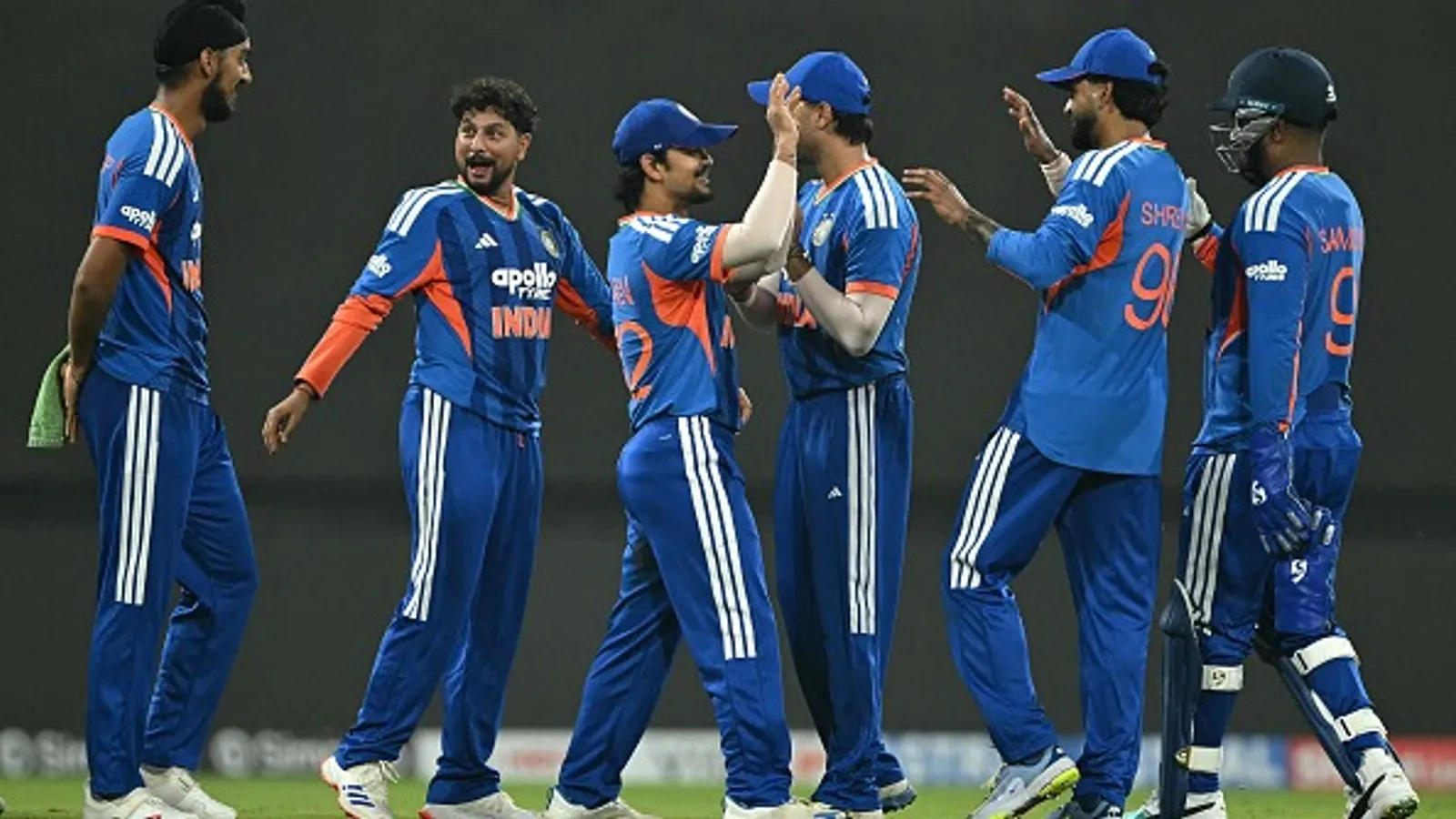
Former India spinner Ravichandran Ashwin has questioned the team management’s decision to leave Kuldeep Yadav out of the playing XI during the ongoing T20I Series against the West Indies. With the five-match contest level at 2-2 following India’s 24-run defeat in Hyderabad, the decision to sideline the experienced wrist-spinner has come under renewed scrutiny.
India’s bowling attack has struggled to contain the West Indies’ aggressive batters, repeatedly conceding more than 200 runs during the series. The fourth T20I provided another example of those difficulties, as the visitors posted 247/3 before restricting India to 223/9. The defeat left the hosts facing a must-win series decider, intensifying questions about their bowling combinations and selection strategy.
Ashwin believes Kuldeep’s ability to deceive batters with his googly and leg-spin could have made a significant difference. Speaking on his YouTube channel, the former India international argued that leaving the wrist-spinner out against a West Indies batting lineup that had struggled to read his variations was difficult to justify.
R Ashwin Questions India’s Decision to Drop Kuldeep Yadav
Ashwin did not hide his disappointment with India’s handling of Kuldeep during the T20I series. He questioned why the team management would leave out a specialist wicket-taking spinner when the opposition’s batters had shown difficulty picking his deliveries.
Explaining his concerns, Ashwin highlighted the conditions and Kuldeep’s potential impact on the contest.
“It is very surprising because, on a ground where you expect to get some bounce… the West Indies batters are struggling to pick his googly and leg-spin. So, if you are leaving Kuldeep out against them, it lacks a bit of common sense. It is very surprising because I think his presence could have made a difference of 15-20 runs,” Ashwin said.
The former spinner’s argument centres on the value of having a bowler who can produce wickets rather than simply attempting to restrict the scoring rate. Against a powerful West Indies batting lineup, India’s ability to break partnerships in the middle overs could prove decisive.
Kuldeep’s variations offer a different challenge from conventional finger-spin and pace bowling. His ability to turn the ball in different directions, disguise his googly and change his pace can make it difficult for aggressive batters to commit early to their shots.
However, Ashwin’s criticism does not mean Kuldeep should automatically be selected regardless of conditions. Instead, his comments raise a broader question about whether India are making selection decisions based on specific match conditions and tactical requirements or reacting too strongly to individual performances.
Why Ashwin Defended the Decision to Rest Kuldeep in Indore
Although Ashwin criticised Kuldeep’s exclusion, he also made it clear that he could understand why India might consider leaving the spinner out at a venue with particularly short boundaries.
Discussing the selection debate, Ashwin referred to the possibility of resting Kuldeep in Indore, where the ground dimensions could influence the team’s bowling strategy. He argued that such a decision could be defended on tactical grounds, unlike treating the spinner’s absence as a reaction to India’s earlier defeat.
“I was surprised. Kuldeep was not picked in Indore, and I would still endorse that decision because I can understand that the ground is small. But you are almost making an issue out of it by suggesting that India’s loss in Ranchi was because of Kuldeep. That, in itself, is wrong,” Ashwin further stated.
Ashwin’s comments highlight the distinction between selecting a bowling combination to suit a particular venue and blaming one player for a collective failure. Short boundaries can increase the risk associated with spin bowling, especially when batters are prepared to attack from the beginning of an innings.
Nevertheless, an expensive spell does not necessarily mean a bowler has become ineffective. In high-scoring T20 matches, even experienced wicket-takers can concede runs when batters enjoy favourable conditions or execute their attacking plans successfully.
According to the supplied report, Kuldeep played the first two matches of the series in Lucknow and Ranchi. He took two wickets for 33 runs in one outing, while the other match proved more expensive, with 53 runs conceded. Ashwin’s objection was that the latter performance should not automatically make Kuldeep the target of criticism for India’s wider bowling problems.
India’s Bowling Problems Continue Against West Indies
India’s difficulty in containing the West Indies has become one of the central talking points of the series. The visitors have consistently demonstrated their ability to score quickly, putting pressure on the home side’s bowlers and making even substantial totals difficult to defend.
The fourth T20I in Hyderabad was the latest example. West Indies finished their innings at 247/3, establishing a formidable target. India responded with 223/9 but fell 24 runs short, leaving the series level at 2-2.
The earlier matches also exposed India’s struggles to control the opposition’s scoring. The supplied report notes that West Indies chased India’s 249/5 in the second T20I, while the third match saw the Caribbean side post 209/7 during a chase of 224.
These results suggest that India’s bowling concerns extend beyond one player or one disappointing performance. The team has struggled to consistently limit boundaries, create breakthroughs and prevent the opposition from building momentum.
Flat pitches and dew add to the challenge
Batting-friendly surfaces and heavy dew can make life difficult for bowlers in T20 cricket. When the ball becomes wet, spinners may find it harder to maintain a reliable grip, while fast bowlers can struggle to execute yorkers and changes of pace consistently.
Flat pitches also reduce the margin for error. Deliveries that might be difficult to score from on a slower surface can disappear towards the boundary when the ball comes onto the bat comfortably.
These factors help explain why high scores have featured prominently in the series, but they do not remove the need for tactical adjustments. Bowlers must still vary their lengths, use changes of pace effectively and identify when to attack the stumps rather than offer batters room to free their arms.
India’s challenge is to find a combination capable of adapting to those conditions. A specialist wrist-spinner such as Kuldeep could provide an additional wicket-taking option, particularly if the team believes the West Indies batters are struggling to read his variations.
Why Kuldeep Yadav Could Make a Difference in the Middle Overs
Kuldeep is a left-arm wrist-spinner whose bowling style gives India a different option from conventional finger-spinners. His stock delivery, googly and changes in pace can force batters to make decisions under pressure, especially when they are trying to maintain a high scoring rate.
In T20 cricket, the middle overs often determine whether a batting side can build towards a total above 200. If the bowling team can take wickets during this period, the opposition may be forced to rebuild rather than attack continuously.
Kuldeep’s principal value lies in his ability to create that uncertainty. Rather than relying exclusively on defensive fields and tight lines, a wrist-spinner can challenge batters to attack deliveries they have not read correctly.
His googly can disrupt aggressive batters
The googly is particularly important because it turns in the opposite direction to the conventional leg-break. When a bowler disguises the variation effectively, a batter may misjudge the direction of the turn and play the wrong line.
For a side such as West Indies, whose approach often involves aggressive strokeplay, that uncertainty can create opportunities for wickets. A mistimed shot, an outside edge or a misjudged attempt to hit over the boundary can change the momentum of an innings.
Ashwin specifically pointed to West Indies batters struggling to pick Kuldeep’s googly and leg-spin. His argument is that India should consider that tactical advantage when deciding their playing XI rather than judging the spinner solely by the number of runs conceded in an earlier match.
A wicket-taking option rather than a defensive selection
When a team repeatedly concedes big totals, it can be tempting to select bowlers primarily to contain runs. However, defensive bowling alone may not be enough against a batting lineup capable of accelerating throughout the innings.
Taking wickets can be just as important as reducing the run rate. Removing established batters forces new players to settle in and can disrupt plans to attack particular bowlers.
Kuldeep offers India the possibility of creating that pressure through variation and deception. His selection would not guarantee a better result, but it could give the captain another way to break partnerships when the opposition begins to dominate.
Has Kuldeep Yadav Been Made a Scapegoat for India’s Defeat?
Ashwin’s criticism also focuses on how teams respond to individual performances after a loss. In a high-scoring contest, it is easy to single out the bowler who conceded the most runs or the player whose contribution appears less effective in the final scorecard.
However, T20 matches are shaped by several interconnected factors, including fielding, bowling execution, pitch conditions, batting partnerships and the captain’s tactical decisions. Holding one player responsible for a defeat can overlook problems elsewhere in the team.
According to Ashwin, the suggestion that India’s loss in Ranchi was caused by Kuldeep was itself misplaced. His argument is that the team should assess the overall performance rather than turn one bowler into the explanation for a collective defeat.
That distinction matters when a team is trying to establish a settled bowling combination. If players are dropped after every expensive spell, the management risks creating uncertainty around selection and making it harder for individuals to develop confidence in their plans.
At the same time, selection competition remains an essential part of international cricket. Players must continue to earn their places, and team management has to consider form, conditions, match-ups and balance. The challenge is to make those decisions consistently rather than allowing the result of one match to dictate the next selection.
Kuldeep’s Recent ODI Form Strengthens His Case
Kuldeep’s case for selection is also supported by his reported performance in the ODI series against the West Indies before the T20I leg. The supplied report states that he claimed seven wickets across three ODI matches, underlining his ability to trouble batters in the longer white-ball format.
Although ODI and T20 cricket demand different tactical approaches, strong performances in one format can still provide useful evidence of a player’s rhythm, control and confidence. Kuldeep’s recent ODI returns suggest that he remained an important wicket-taking option heading into the T20I series.
His experience also gives India a bowler who can be trusted to operate in challenging situations. Wrist-spin can be particularly valuable when batters are looking to accelerate, as the threat of a wicket may force them to reconsider an aggressive approach.
However, ODI statistics cannot by themselves settle the question of T20 selection. Shorter formats require bowlers to manage risk differently, and the effectiveness of a particular combination depends on the surface, opposition and match situation. The strongest argument for Kuldeep’s inclusion is therefore not simply his previous record but the specific challenge his variations could pose to West Indies.
What India’s Team Management Must Consider Before the Series Decider
With the five-match series level at 2-2, India have little room for error in the final encounter. The team management must assess whether its existing bowling combination has the tools required to contain the West Indies batting lineup or whether a change could offer a better balance.
Kuldeep’s potential inclusion is one part of that decision. India also need to examine how their bowlers have executed their plans, particularly when defending large totals or bowling against set batters in the closing overs.
Identify the biggest weakness in the bowling attack
India’s repeated struggles to contain West Indies suggest that the problem cannot be reduced to a single selection call. The management needs to consider whether the attack is taking enough wickets in the middle overs, how effectively the pacers are executing their plans and whether the field placements support the bowlers’ strengths.
Adding Kuldeep could improve the variety available to the captain, but the other bowlers would still need to perform their roles. A wrist-spinner cannot compensate entirely for missed yorkers, predictable lengths or poor execution at the death.
Choose bowlers according to match-ups and conditions
Selection should also account for how individual bowlers match up against the opposition. If West Indies are finding it difficult to read Kuldeep’s variations, that becomes a relevant tactical consideration.
Ground dimensions, the amount of turn available, dew and the expected role of each bowler should also influence the final combination. Ashwin’s comments do not rule out resting Kuldeep under certain circumstances; instead, they question the logic of excluding him when his specific strengths could help India.
Avoid reactive decisions after individual failures
Consistency in selection does not mean guaranteeing a place to every established player. It means evaluating performances in context and making changes for clear tactical reasons.
India’s management will need to balance accountability with confidence in its leading players. If Kuldeep is selected, the team must give him a clear role and use his strengths effectively. If he is left out, the decision should reflect a considered match strategy rather than an attempt to find an individual to blame for the series’ bowling problems.
Frequently Asked Questions
Why did R Ashwin criticise India’s decision to drop Kuldeep Yadav?
Ashwin questioned the decision because he believes West Indies batters have struggled to read Kuldeep’s googly and leg-spin. He argued that the wrist-spinner could have made a difference of 15-20 runs and that excluding him under those circumstances lacked common sense.
What did Ashwin say about Kuldeep Yadav’s exclusion?
Ashwin said it was surprising that India left Kuldeep out when his variations could trouble the West Indies batters. He also argued that it was wrong to suggest India’s defeat in Ranchi was caused by Kuldeep.
What is India’s position in the T20I series against West Indies?
According to the supplied report, the five-match T20I series is level at 2-2 following India’s 24-run defeat in the fourth match in Hyderabad.
How did West Indies perform in the fourth T20I?
West Indies scored 247/3 in their innings. India managed 223/9 in reply, falling 24 runs short of the target.
Why is Kuldeep Yadav important to India’s bowling attack?
Kuldeep is a left-arm wrist-spinner who uses a googly, leg-spin and changes of pace to deceive batters. His ability to take wickets in the middle overs could help India disrupt partnerships and slow the opposition’s momentum.
How many wickets did Kuldeep take in the preceding ODI series against West Indies?
The supplied report states that Kuldeep took seven wickets across three matches in the ODI series before the T20I contest.
Does Ashwin believe Kuldeep should always be selected?
No. Ashwin acknowledged that resting Kuldeep at a venue with very short boundaries, such as Indore, could be a reasonable tactical decision. His criticism was directed at leaving the spinner out when his skills could be particularly useful against the West Indies lineup.
Conclusion
Ravichandran Ashwin’s criticism has brought India’s handling of Kuldeep Yadav back into focus at a crucial stage of the T20I series against West Indies. With the contest level at 2-2 and the bowling attack struggling to contain the opposition, the question is whether India are making the best use of their available wicket-taking options.
Kuldeep’s variations could provide a valuable weapon against batters who have found it difficult to read his deliveries. Nevertheless, his inclusion alone would not solve every problem in India’s bowling attack. The team must also improve its execution, adapt to the conditions and avoid treating individual players as scapegoats for collective failures.
As India prepare for the decisive match, the management’s challenge is to make a selection based on tactical needs, trust its specialist bowlers and find a way to prevent West Indies from repeatedly dominating with the bat.
For breaking news and live news updates, like us on Facebook or follow us on Twitter and Instagram. Read more on Latest Cricket on thefoxdaily.com.






COMMENTS 0