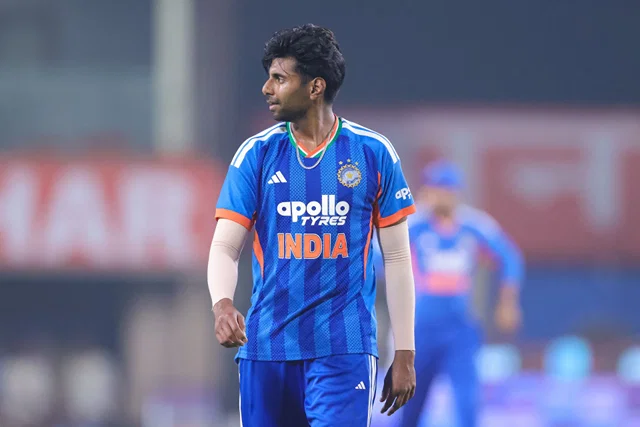
Former India batter Wasim Jaffer has criticised Mayank Yadav‘s bowling approach following India’s 24-run defeat against the West Indies in the fourth T20I at the Rajiv Gandhi International Stadium in Hyderabad on Wednesday, October 14. Jaffer believes the young fast bowler relied too heavily on short-pitched deliveries, allowing the opposition batters to settle into their innings and build momentum.
The defeat levelled the five-match T20I series at 2-2, leaving India with everything to play for in the final encounter. West Indies produced an impressive batting performance to post 247/3, putting India’s bowling attack under considerable pressure. The hosts fought back during the chase but eventually managed 223 in 19.3 overs, falling 24 runs short of the target.
Mayank, known for his pace and ability to trouble batters with aggressive deliveries, endured a difficult outing. After beginning with an economical over, he struggled to contain the West Indies batters in his second over. Jaffer identified the overuse of short balls as a key tactical mistake and questioned India’s execution with the new ball.
Wasim Jaffer Criticises Mayank Yadav’s Short-Ball Strategy
Mayank Yadav began the fourth T20I on a promising note, conceding just three runs in his opening over. However, his next over proved expensive, as the West Indies batters took advantage of his approach and collected 20 runs.
According to Jaffer, that expensive over gave the visitors the momentum they needed to establish control over the innings. He argued that Mayank attempted the short ball too frequently, even though the opposition appeared prepared for that particular delivery.
Speaking in a video on his YouTube channel, the former India and Royal Challengers Bengaluru batter explained his assessment of the young pacer’s performance.
“He overdid the short ball. There were five wides too when he tried to bowl a short ball. It looked like they were expecting it, and they got a kick-start with the 20-run over. We did not bowl the way we should have with the new ball. The short ball was overused, especially by Mayank Yadav.”
Jaffer’s comments point towards a tactical issue rather than simply a lack of pace or ability. Short-pitched bowling can be effective in T20 cricket, particularly when a fast bowler can surprise a batter with extra bounce or force an uncomfortable shot. However, repeatedly attempting the same delivery can make the bowler predictable.
When batters anticipate a short ball, they can position themselves accordingly and look to score through the pull, hook or other attacking strokes. Deliveries that miss their intended line can also result in wides, increasing the pressure on the bowler and offering the batting side additional runs.
Mayank eventually finished with figures of 0/52 from four overs. Although the figures reflect an expensive spell, Jaffer’s main concern was the frequency with which the pacer relied on the short ball and the impact that approach had on India’s ability to control the powerplay.
Mayank Yadav’s Expensive Over Helped West Indies Build Momentum
In T20 cricket, the early overs can significantly influence the direction of an innings. Bowling teams aim to restrict the scoring rate while creating opportunities for wickets, whereas batters attempt to establish a strong platform before accelerating in the middle and death overs.
Mayank’s opening over suggested that India could keep the scoring under control. However, the 20-run over that followed changed the momentum and allowed West Indies to attack with greater confidence.
Jaffer believes the short-ball strategy played an important role in that shift. If batters recognise a predictable pattern early in an innings, they can begin anticipating deliveries instead of reacting to them. That can reduce the effectiveness of even a genuinely quick bowler.
Why variation matters for fast bowlers
Fast bowlers need more than raw speed to succeed consistently at the international level. Changes in length, line and pace help prevent batters from settling into a rhythm. A well-directed short ball can be a useful weapon, but it becomes less effective when the batter knows it is coming.
Mixing short deliveries with fuller balls can create uncertainty and make it harder for batters to commit to attacking strokes. Yorkers, hard lengths and deliveries aimed at the stumps can also force different responses, depending on the conditions and the batter’s position at the crease.
Jaffer’s criticism suggests that Mayank did not use enough variation during his difficult spell. Rather than repeatedly challenging the West Indies batters with short balls, India could have benefited from a more varied approach with the new ball.
The challenge for Mayank will be to learn from the experience without abandoning one of his natural strengths. Short-pitched bowling remains an important part of a fast bowler’s arsenal, but its effectiveness depends on timing, accuracy and the ability to surprise the opposition.
West Indies Post 247/3 as Shai Hope Leads the Batting Charge
West Indies captain Shai Hope was the standout performer with the bat in Hyderabad, finishing unbeaten on 102 off 50 balls. His century gave the visitors a strong foundation and helped them reach 247/3, a total that put India under pressure throughout the chase.
Hope’s innings demonstrated the importance of combining control with attacking intent. By remaining at the crease and scoring quickly, he ensured that West Indies could maintain their momentum even as the innings progressed.
The visitors’ total was reported as the second-highest first-innings score against India in T20 internationals. It reflected the difficulties India faced in controlling the scoring rate and preventing the West Indies batters from dominating the contest.
For India, the problem was not limited to Mayank’s spell. Jaffer also criticised the team’s overall execution with the new ball, suggesting that the bowling unit failed to deliver the disciplined performance required against an aggressive batting lineup.
When a team concedes close to 250 runs, several aspects of the bowling performance deserve scrutiny. The ability to execute plans, vary deliveries and create breakthroughs becomes particularly important against batters who are scoring freely.
Mayank’s figures made his spell a prominent talking point, but India’s wider bowling strategy will also need attention as the team prepares for the series decider.
Sanju Samson’s Explosive Fifty Gives India a Flying Start
India’s chase began with considerable promise, thanks to an aggressive innings from Sanju Samson. The wicketkeeper-batter scored 56 off just 23 balls, giving the hosts the early momentum they needed to pursue a challenging target.
Samson’s quick scoring helped India make an attacking start during the powerplay. His ability to find boundaries reduced the pressure of chasing such a large total and gave the home side a chance to remain in contention.
Jaffer praised Samson’s contribution and suggested that his dismissal was a significant moment in the chase. The former India batter believed Samson had provided the momentum India needed but was disappointed that the innings could not develop into an even bigger contribution.
“Sanju batted brilliantly. Unfortunately, he got out; otherwise, he rarely gets out after scoring 50-55. Sanju gave us the momentum we needed in the powerplay, but unfortunately, Abhishek could not kick on. Abhishek likes to have the strike in the powerplay.”
Samson’s innings showed how quickly a batter can change the tempo of a T20 chase. However, maintaining that scoring rate throughout the innings requires support from the other end and partnerships that can keep the required run rate under control.
India ultimately finished on 223 in 19.3 overs. Despite Samson’s rapid half-century, the hosts could not sustain the chase long enough to overhaul the target.
Wasim Jaffer Explains Abhishek Sharma’s Unusual 29 off 24 Balls
Another talking point from India’s innings was Abhishek Sharma’s relatively slow scoring rate. The aggressive left-handed opener is known for taking advantage of the powerplay, when fielding restrictions create opportunities to attack the bowling. Against West Indies, however, he faced just eight deliveries during the first six overs.
Samson dominated the scoring during that period, leaving Abhishek with fewer opportunities to take control of the innings. Jaffer believes the lack of strike affected the opener’s usual rhythm, as Abhishek generally prefers to face a larger share of the deliveries during the powerplay.
Abhishek finished with 29 runs from 24 balls, a contribution that was slower than his usual attacking approach. He was dismissed in the 12th over after being caught at long-off by Shamar Springer off Gudakesh Motie.
Jaffer’s assessment highlighted the importance of understanding a batter’s preferred role within a partnership. Abhishek’s strength lies in putting pressure on bowlers early, but his opportunities were limited while Samson was scoring freely.
Samson’s dominance changed the distribution of strike
When one opener scores rapidly, the other batter may naturally face fewer deliveries. That can be beneficial for the team if the partnership continues to score quickly, but it can also leave the second batter with less time to settle into an attacking rhythm.
In this match, Samson’s aggressive start was a positive for India, but Abhishek was unable to turn his limited opportunities into a substantial contribution. Once Samson was dismissed, India needed the remaining batters to maintain the scoring rate while managing the pressure of a demanding chase.
Jaffer’s comments do not suggest that Samson should have scored more slowly. Instead, they underline how the distribution of strike can influence a partnership, particularly when both batters have attacking instincts and specific roles in the batting order.
For India, the broader lesson is that a successful chase requires contributions from multiple players. An explosive start can create an opportunity, but partnerships and sustained scoring are necessary to complete the job against a target as high as 248.
India’s Bowling and Batting Must Improve Before the Final T20I
India’s defeat in Hyderabad exposed challenges in both departments. The bowling attack conceded 247/3, while the batting lineup fell short despite Samson’s rapid half-century and a strong start to the chase.
Jaffer’s comments focus particularly on the need for better tactical execution from the bowlers. Mayank’s overuse of short balls was one concern, but India’s collective approach with the new ball also came under criticism.
The team will need to assess how best to balance attacking intent with control. Against a power-hitting opposition, bowlers cannot afford to become predictable, especially when batters are already anticipating a particular length or line.
India’s batting unit, meanwhile, must find ways to maintain momentum after an explosive start. Samson provided the platform, but the team could not keep pace with the required rate throughout the innings.
Abhishek’s role will also attract attention after his 29 off 24 balls. His preference for facing more deliveries in the powerplay is an important consideration for India’s opening combination, although the team must balance individual preferences with the needs of the partnership.
With the series level at 2-2, India have an opportunity to respond in the final match. The management and players will need to learn from the Hyderabad defeat and make the necessary adjustments to their bowling plans and batting approach.
India vs West Indies 5th T20I: Date, Venue and Series Situation
The fifth and final T20I between India and West Indies is scheduled to take place at the M. Chinnaswamy Stadium in Bengaluru on Saturday, October 17, according to the supplied report.
The series is tied at 2-2 following West Indies’ 24-run victory in Hyderabad. The final match will determine which side finishes the five-match contest with the series win.
For India, the immediate priority will be to improve their bowling execution and prevent the opposition from building another imposing total. Mayank Yadav’s approach with the short ball is likely to remain a talking point, particularly after Jaffer’s assessment of his expensive spell.
West Indies, meanwhile, will take confidence from their powerful batting performance and their ability to defend a total of 247. With the series on the line, both teams will have strong reasons to produce a more complete performance in Bengaluru.
Frequently Asked Questions
What did Wasim Jaffer say about Mayank Yadav’s bowling?
Jaffer said Mayank overused the short ball during the fourth T20I against West Indies. He also pointed out that the strategy resulted in five wides and argued that the opposition appeared prepared for the delivery.
What were Mayank Yadav’s figures in the fourth T20I?
Mayank finished with figures of 0/52 in four overs as West Indies scored 247/3 in Hyderabad.
How many runs did West Indies score against India in the fourth T20I?
West Indies posted 247/3 in their 20 overs, with captain Shai Hope remaining unbeaten on 102 off 50 balls.
How did Sanju Samson perform in the fourth T20I?
Samson scored 56 runs off 23 balls, giving India an aggressive start during their chase of 248.
Why did Wasim Jaffer discuss Abhishek Sharma’s innings?
Jaffer noted that Abhishek faced only eight deliveries during the powerplay while Samson dominated the scoring. He explained that Abhishek generally prefers to have more of the strike during the fielding restrictions.
How many runs did Abhishek Sharma score?
Abhishek scored 29 off 24 balls before being caught at long-off by Shamar Springer off Gudakesh Motie in the 12th over.
What is the series score after the fourth T20I?
The five-match T20I series is level at 2-2 after West Indies defeated India by 24 runs in Hyderabad.
When and where will the fifth India vs West Indies T20I take place?
According to the supplied report, the final T20I is scheduled for Saturday, October 17, at the M. Chinnaswamy Stadium in Bengaluru.
Conclusion
Wasim Jaffer’s assessment of Mayank Yadav’s expensive spell has highlighted the importance of tactical discipline in T20 cricket. While the short ball can be an effective weapon for a fast bowler, repeatedly using it can allow batters to anticipate the delivery and take advantage of predictable bowling.
Mayank’s figures of 0/52 reflected a difficult outing, but India’s problems extended beyond one bowler. West Indies scored 247/3, while India’s chase ended at 223 despite Sanju Samson’s explosive 56 off 23 balls.
Jaffer also highlighted how Abhishek Sharma’s limited involvement during the powerplay affected his usual approach at the crease. As India prepare for the series decider in Bengaluru, improved bowling variation, better execution with the new ball and sustained contributions from the batting lineup will be crucial to their hopes of winning the series.
For breaking news and live news updates, like us on Facebook or follow us on Twitter and Instagram. Read more on Latest Cricket on thefoxdaily.com.






COMMENTS 0