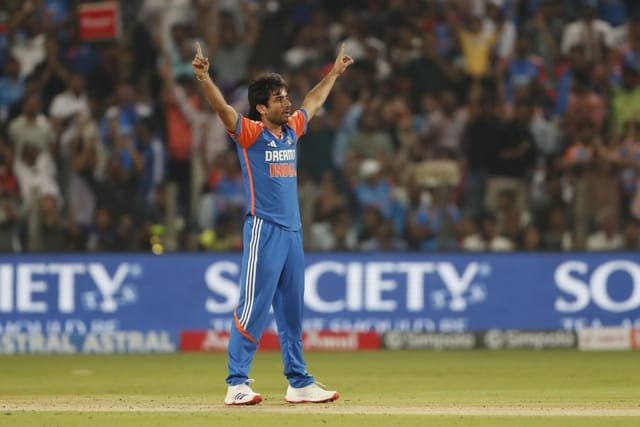
AFG vs IND 2nd T20I will give India an immediate opportunity to strengthen its combination after Varun chakaravarthy was reportedly ruled out of the remainder of the three-match series because of an injury. Former India opener Aakash Chopra believes the change should be straightforward, with Ravi Bishnoi coming into the playing XI.
India will face Afghanistan in the second T20I in Delhi on Tuesday, September 15. The hosts won the series opener by seven wickets, but Chakaravarthy’s absence means the team management must make at least one change before the second game.
Chopra has backed Bishnoi as the natural replacement and believes India should resist making unnecessary alterations to a side that already secured a convincing victory in the opening match. His prediction would mean Bishnoi returns to the playing XI while the rest of the combination remains unchanged.
Ravi Bishnoi Is the Straightforward Replacement for Varun
According to Aakash Chopra, there is little reason for India to overcomplicate the selection decision. With no replacement for Chakaravarthy announced and the matches taking place on alternate days, Bishnoi appears to be the most logical option.
The leg-spinner has experience in India’s T20I setup and can provide a specialist spin option in the middle overs. Replacing one spinner with another also allows India to preserve the overall balance of the XI instead of changing multiple positions because of one injury.
Chopra’s preferred combination is therefore simple: Bishnoi replaces Chakaravarthy and the remaining players retain their places.
This approach would also give the Indian management an opportunity to judge Bishnoi in a competitive situation without disrupting the batting order or the team’s broader strategy. After winning the first T20I comfortably, stability could be particularly valuable in a series being played within a short period.
India Have Little Reason to Make Multiple Changes
The biggest point in Chopra’s selection prediction is not simply the inclusion of Bishnoi. It is his belief that India should make only one change.
When a team loses an important player through injury, there can be a temptation to make several adjustments at the same time. However, India already demonstrated in the first T20I that the combination can produce a strong result against Afghanistan.
Keeping the remaining XI intact would allow the players to continue developing familiarity with their roles. It also avoids creating additional selection questions before the third match of the series.
For a team preparing for a busy international schedule, clarity around roles can be just as important as individual talent. Bishnoi would therefore enter the side with a clear responsibility rather than forcing India to restructure its entire bowling attack.
Sanju Samson Will Remain Under the Spotlight
While the bowling change appears straightforward, Sanju Samson could attract significant attention during the AFG vs IND 2nd T20I. Chopra highlighted the Kerala wicketkeeper-batter as one of the players under pressure to deliver with the bat.
Samson’s position has become a talking point because he has not produced a significant run of scores in the matches he has played since the World Cup. Chopra acknowledged that the situation has not always been easy for the batter, but he also stressed that sympathy alone cannot guarantee a place in India’s playing XI.
That creates an interesting situation for Samson. A player can have strong support from fans and former cricketers, but international selection ultimately depends on performances and team requirements.
Against Afghanistan, Samson has an opportunity to answer those questions with his bat. A meaningful contribution would not only help India in the second T20I but could also provide greater security around his place in the side.
The pressure becomes more significant because India has other young batting options waiting for opportunities. Chopra specifically pointed to Vaibhav Suryavanshi as a player who could eventually enter the conversation if existing opportunities are not converted into runs.
Why Sanju Samson’s Performance Matters
Samson’s situation is not simply about one innings. India’s T20I selection is becoming increasingly competitive, with several players capable of filling different batting roles.
For Samson, the challenge is therefore to make his opportunities count. If he produces runs consistently, the discussion around his place becomes much quieter. If he continues to struggle, questions about alternative options will naturally become louder.
Chopra’s comments underline that distinction. He expressed sympathy for Samson’s difficult run but also recognized the practical reality of international cricket: selection decisions eventually have to be based on performance and team balance.
The second T20I could consequently become an important personal game for Samson even if the wider focus remains on India’s series strategy.
Aakash Chopra Identifies India’s Fifth-Bowler Problem
Chopra also raised a broader tactical concern surrounding India’s fifth bowling option under captain Shreyas Iyer. While the team has plenty of bowling resources, the part-time options have not consistently delivered economical spells.
Shivam Dube has been used sparingly, according to Chopra, and when he has bowled, his economy rate has been expensive. The former India opener specifically pointed to the final over of the first T20I, when Dube conceded 21 runs.
That particular over is important because the 20th over can dramatically change the momentum of a T20 innings. Using a fifth or sixth bowling option at that stage carries greater risk if the player is not a specialist death bowler.
Chopra’s criticism is therefore less about one individual and more about how India distributes its bowling responsibilities.
India’s Part-Time Bowlers Have Been Expensive
Chopra highlighted several statistics to explain why the fifth-bowler issue deserves attention. He noted that Suryansh Shedge has conceded at an economy rate of 11.28 runs per over, while Abhishek Sharma has bowled only 5.5 overs.
Washington Sundar has also conceded 38 runs from two overs, while Nitish Kumar Reddy has bowled two overs in an innings and conceded 30 runs. Tilak Varma has contributed some overs as well, but Chopra believes the overall numbers reveal an obvious weakness.
According to his assessment, India’s fifth and sixth bowling options have conceded 335 runs from 33 overs under the current leadership setup.
Those numbers show why the team management may need to think carefully about when and how its part-time bowlers are used. The objective is not necessarily to remove them from the attack, but to place them in situations where they have the best chance of succeeding.
Should India Avoid Using Dube in the Final Over?
Chopra’s comments suggest that India should be more careful with its bowling matchups. The 20th over is generally a specialist’s responsibility because batters are prepared to attack every delivery and even a small mistake can result in a large number of runs.
Dube can still provide value as a fifth bowling option, particularly when India needs a change of pace or a matchup-based over. But asking him to bowl the final over can expose the team if he is not one of the preferred death-bowling options.
The same principle applies to Nitish Kumar Reddy and Abhishek Sharma. Their ability to contribute with the ball is useful because it gives India greater flexibility, but the captain and management must decide when those overs are most appropriate.
A well-managed fifth bowler can make an XI much more balanced. A poorly timed over, however, can quickly undo the work of the specialist bowlers.
Ravi Bishnoi Could Add More Spin Control
The potential return of Ravi Bishnoi could also help India manage its bowling workload. As a specialist spinner, Bishnoi gives the captain a clearly defined option rather than relying heavily on part-time bowlers.
His presence could allow India to use its main bowling attack more efficiently while reducing the pressure on players such as Dube, Abhishek and Tilak to complete important overs.
That does not automatically solve the fifth-bowler problem, but it could give Iyer more flexibility when deciding how to construct the innings.
The conditions in Delhi will also be worth watching. Afghanistan possess several dangerous T20 batters, meaning India cannot afford to give away easy runs through poorly timed bowling changes. Bishnoi’s inclusion would provide another specialist option capable of operating during the middle phase.
India’s Winning Combination Faces a New Test
The first T20I result gives India confidence, but the second match presents a slightly different challenge because of Chakaravarthy’s injury. Afghanistan will also have the opportunity to assess India’s revised bowling attack.
For India, the ideal outcome would be to replace Chakaravarthy without weakening the team’s overall balance. That is precisely why Chopra’s recommendation of Bishnoi makes sense.
The bigger tactical question will be how Iyer uses the fifth bowler. India cannot always expect its specialist bowlers to complete every over, so the part-time options remain important. But their overs need to be carefully selected.
At the same time, India’s batting group will want a stronger contribution from players such as Samson. The team may have won the opening match comfortably, but individual competition for places means every opportunity carries significance.
What to Watch in AFG vs IND 2nd T20I
- Ravi Bishnoi’s return: The leg-spinner is expected to replace the injured Varun Chakaravarthy.
- Sanju Samson’s batting: The wicketkeeper-batter will be under pressure to turn his opportunity into a substantial score.
- Shivam Dube’s bowling role: India must decide when his overs provide the greatest value.
- Fifth-bowler management: Iyer’s use of part-time options could influence Afghanistan’s scoring opportunities.
- Series momentum: India can take an unassailable 2-0 lead by winning in Delhi.
Final Verdict
Ravi Bishnoi is the most logical candidate to replace Varun Chakaravarthy in India’s playing XI for the AFG vs IND 2nd T20I, according to Aakash Chopra. His selection would allow India to make a direct change without disturbing the combination that delivered a seven-wicket victory in the series opener.
However, the bigger discussion may revolve around Sanju Samson and India’s fifth-bowling option. Samson needs runs to strengthen his position, while the management must find better ways to use players such as Dube, Abhishek Sharma and Nitish Kumar Reddy.
India’s immediate objective is simple: win in Delhi and seal the series. But the match also provides an opportunity to solve some of the tactical questions that could become more important during a longer T20I campaign.
For breaking news and live news updates, like us on Facebook or follow us on Twitter and Instagram. Read more on Latest Cricket on thefoxdaily.com.






COMMENTS 0