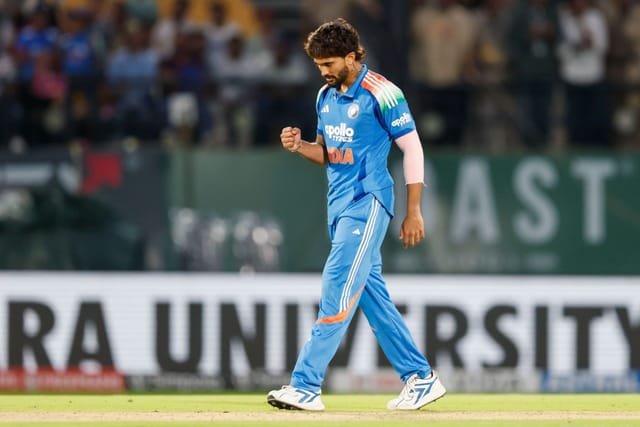
India’s seven-wicket victory over Afghanistan in the opening ODI of the three-match series was filled with encouraging performances, but few carried as much long-term significance as Nitish Kumar Reddy’s contribution with the ball. The young all-rounder delivered a disciplined and impactful spell, claiming two crucial wickets and helping India regain control after Afghanistan’s explosive start.
While Shubman Gill’s unbeaten chase and Rahmanullah Gurbaz’s century dominated headlines, Nitish’s performance highlighted a larger conversation within Indian cricket—the ongoing search for a dependable seam-bowling all-rounder capable of contributing across formats and major tournaments.
Former India cricketer Aakash Chopra emphasized the importance of Nitish’s emergence, noting that India has spent years searching for players who can provide the balance traditionally offered by elite fast-bowling all-rounders.
Why Nitish Kumar Reddy’s Performance Matters Beyond One Match
In the rain-curtailed ODI at Dharamshala, Afghanistan looked dangerous thanks to a breathtaking century from Rahmanullah Gurbaz. The wicketkeeper-batter attacked relentlessly and threatened to take the game away from India.
That is when Nitish Kumar Reddy made his impact.
After conceding an early six, the all-rounder showed impressive composure and bounced back strongly. He dismissed the in-form Gurbaz with a superb delivery and later removed veteran all-rounder Mohammad Nabi, helping India restrict Afghanistan to a chaseable total.
His final figures of 2 for 31 from four overs reflected both control and wicket-taking ability—qualities India desperately values in modern ODI cricket.
More importantly, he delivered under pressure, a trait that often separates international-level players from domestic performers.
India’s Long Search for the Ideal Pace-Bowling All-Rounder
For decades, Indian cricket has searched for genuine seam-bowling all-rounders who can contribute meaningfully with both bat and ball.
Such players are among the rarest commodities in world cricket because they offer team balance without compromising either department.
India has historically produced outstanding batters and spinners, but genuine pace-bowling all-rounders have been relatively uncommon.
The search has evolved through different eras:
| Era | Key All-Rounder | Impact |
|---|---|---|
| 1980s | Kapil Dev | World-class pace-bowling all-rounder and World Cup-winning captain |
| 1990s | Manoj Prabhakar | Provided balance but with a different skill profile |
| 2000s | Irfan Pathan | Promising all-round package before injuries affected progress |
| 2010s-Present | Hardik Pandya | Dynamic batting and seam-bowling option in white-ball cricket |
| Future Generation | Nitish Kumar Reddy | Emerging candidate for a long-term all-round role |
The emergence of Nitish Kumar Reddy therefore represents more than a good performance—it represents hope for an important position in India’s future squads.
Hardik Pandya’s Importance and the Need for Backup Options
Hardik Pandya remains one of India’s most valuable white-ball cricketers. His ability to bat in the middle order while providing seam bowling creates enormous flexibility in team selection.
However, modern cricket’s demanding schedule has highlighted the importance of squad depth.
Injuries, workload management, and format specialization mean teams can no longer rely on a single player to fill a critical role indefinitely.
This reality has made India’s search for additional seam-bowling all-rounders increasingly urgent.
Having multiple options provides:
- Greater squad flexibility.
- Protection against injuries.
- Improved workload management.
- Better tactical matchups.
- Stronger tournament depth.
Nitish Kumar Reddy’s development could help India address all these areas simultaneously.
How Nitish Kumar Reddy Improved His Bowling
One of the most encouraging aspects of Nitish’s recent rise has been the noticeable improvement in his bowling.
Over the past year, observers have seen significant growth in several areas:
- Improved seam position.
- Higher average pace.
- Better control under pressure.
- More effective yorkers.
- Greater consistency in line and length.
These developments were evident during IPL 2026, where he showcased a more refined bowling action and greater confidence in executing plans against top-quality batters.
The Afghanistan ODI suggested those improvements are now translating successfully to the international stage.
The Importance of Dismissing Rahmanullah Gurbaz
Statistics alone do not fully capture the value of Nitish Kumar Reddy’s spell.
The timing of his wickets was crucial.
Rahmanullah Gurbaz had already produced one of the most destructive innings of the match, reaching a rapid century and putting India under immense pressure.
Removing a batter in such dominant form often changes the entire momentum of a game.
Once Gurbaz departed, Afghanistan struggled to maintain the same scoring intensity and eventually lost wickets in clusters.
That breakthrough helped India regain control and ultimately laid the foundation for victory.
Modern ODI Cricket Demands Multi-Skilled Players
The role of an all-rounder has become more valuable than ever in modern cricket.
Unlike previous eras, teams now require players who can contribute in multiple phases of a match.
A successful modern all-rounder must often:
- Bat aggressively in the middle order.
- Accelerate during the death overs.
- Deliver overs with the new ball.
- Bowl in pressure situations.
- Field at a high athletic standard.
Nitish Kumar Reddy appears well-suited to these demands because of his versatility and athleticism.
That versatility could become increasingly valuable as India prepares for future ICC tournaments.
Why Team Balance Is Crucial for Major Tournaments
Successful World Cup teams often possess one common characteristic: balance.
The ability to field six genuine bowling options without weakening the batting lineup gives captains significantly more tactical flexibility.
All-rounders make this possible.
When a seam-bowling all-rounder performs effectively, teams gain:
| Benefit | Impact on Team Strategy |
|---|---|
| Extra Bowling Option | Allows captains to rotate bowlers more effectively |
| Batting Depth | Strengthens lower-middle order |
| Match Flexibility | Adapts better to changing conditions |
| Squad Balance | Creates stronger overall combinations |
| Injury Protection | Reduces reliance on specialist players |
This explains why India’s management continues investing in players like Nitish Kumar Reddy.
Could Nitish and Hardik Play Together?
An intriguing possibility is that India’s future may not involve choosing between Nitish Kumar Reddy and Hardik Pandya.
Instead, both players could potentially feature in the same XI.
Such a combination would provide India with:
- Additional seam-bowling depth.
- Extended batting resources.
- Greater tactical flexibility.
- Improved balance across conditions.
Several successful international teams have benefited from fielding multiple all-rounders, particularly in ODI and T20 cricket.
If Nitish continues developing, India could eventually adopt a similar approach.
The Mental Side of Nitish Kumar Reddy’s Rise
Technical skills are only part of the equation in international cricket.
Mental resilience often determines whether talented players establish themselves at the highest level.
Against Afghanistan, Nitish displayed several encouraging psychological traits:
- Composure after being hit for boundaries.
- Confidence in executing attacking deliveries.
- Patience under pressure.
- Willingness to bowl difficult overs.
These characteristics are often difficult to teach and frequently separate successful international cricketers from those who struggle to adapt.
What This Means for India’s 2027 World Cup Planning
Although the 2027 ODI World Cup remains some distance away, team-building begins years before major tournaments.
Every bilateral series helps management identify players capable of contributing on the biggest stage.
Nitish Kumar Reddy’s performance against Afghanistan will likely strengthen his case as a serious contender for India’s long-term ODI plans.
Selectors and coaches will be encouraged not only by the wickets but also by the manner in which he earned them.
Performing under pressure against international opposition is one of the most important indicators of future success.
The Bigger Picture for Indian Cricket
India’s victory over Afghanistan showcased more than individual brilliance.
It highlighted the success of the country’s growing talent pipeline.
Players such as Nitish Kumar Reddy, Gurnoor Brar, and Harsh Dubey represent a new generation being groomed for international cricket through a combination of domestic competition, IPL exposure, and structured development programs.
This depth is becoming one of India’s greatest strengths.
As senior players manage workloads and approach different stages of their careers, emerging talents will play an increasingly important role in maintaining India’s competitiveness across formats.
Conclusion
Nitish Kumar Reddy’s impactful spell against Afghanistan was more than a useful contribution in a bilateral ODI—it was a reminder of how important genuine all-rounders remain in modern cricket. His ability to take key wickets, handle pressure, and provide balance makes him an exciting prospect for India’s future.
Aakash Chopra’s assessment reflects a broader reality: India’s search for seam-bowling all-rounders is ongoing, but Nitish Kumar Reddy appears to be one of the most promising candidates to emerge in recent years. Whether as a backup to Hardik Pandya or eventually as a partner in the same XI, his continued development could become a major factor in India’s plans leading into future ICC tournaments.
If performances like the one in Dharamshala become a regular feature, Nitish Kumar Reddy may soon transition from a promising prospect into a crucial pillar of India’s white-ball setup.
For breaking news and live news updates, like us on Facebook or follow us on Twitter and Instagram. Read more on Latest Sports on thefoxdaily.com.






COMMENTS 0