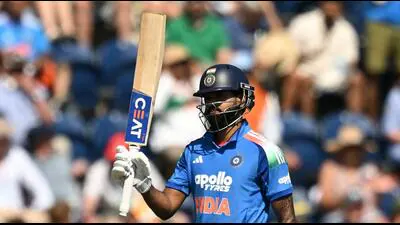
India’s three-match T20I series against Zimbabwe may not carry the global attention of an ICC tournament or a high-profile rivalry, but it could prove to be one of the most important assignments in the team’s recent transition period. Following successive T20I series defeats against Ireland and England, questions have emerged about India’s team balance, leadership direction, batting approach and long-term planning.
Amid increasing scrutiny, captain Shreyas Iyer has delivered a clear message to his squad: play without the fear of failure.
It is a simple statement, but one that reveals a broader vision for India’s future. Rather than focusing on recent setbacks, Iyer wants his players to embrace learning, take calculated risks and develop the confidence needed to succeed in modern T20 cricket.
As India begins its Zimbabwe tour in Harare, the series represents more than an opportunity to secure victories. It offers a chance to redefine the team’s identity, evaluate emerging talent and establish a foundation for future international success.
Why the Zimbabwe Series Matters More Than It Appears
On paper, Zimbabwe may not be viewed as one of the world’s strongest cricketing nations. However, international cricket has become increasingly competitive, and bilateral series against developing teams often provide valuable opportunities for experimentation and growth.
For India, this tour arrives at a critical time.
The team is attempting to recover from disappointing performances in Ireland and England, where batting collapses, inconsistent execution and pressure-induced mistakes exposed several weaknesses. While defeats naturally attract criticism, they also provide important information about areas requiring improvement.
The Zimbabwe series gives India an opportunity to test solutions in a competitive environment without the overwhelming pressure associated with major tournaments.
In many ways, these matches could serve as the first step toward building India’s next successful T20 side.
Shreyas Iyer’s Leadership Philosophy Is Becoming Clear
Since taking over leadership responsibilities, Shreyas Iyer has emphasized adaptability, team unity and positive intent.
His comments ahead of the Zimbabwe series suggest he believes confidence is one of the most important ingredients in successful T20 cricket.
Fear often creates hesitation. Hesitation leads to poor decision-making. In a format where matches can change within a few deliveries, even small moments of uncertainty can prove costly.
Iyer’s insistence on removing the fear of failure reflects a modern approach embraced by several successful teams around the world.
Rather than punishing mistakes, progressive cricket cultures encourage players to focus on process, preparation and execution. The objective is not to eliminate errors completely but to ensure that fear does not prevent players from expressing their natural abilities.
The Lessons India Learned from Ireland and England
Although India suffered disappointing results in both series, those defeats exposed valuable lessons.
The challenges faced by the team highlighted several areas that require attention:
- Decision-making under pressure
- Adaptability to different conditions
- Middle-order stability
- Powerplay execution
- Handling momentum shifts
- Mental resilience during difficult phases
Successful teams often emerge stronger after setbacks because defeats force honest self-assessment. Winning can sometimes hide underlying issues, while losses frequently accelerate improvement.
India’s management appears determined to use those experiences as learning opportunities rather than sources of frustration.
Adaptability Has Become Cricket’s Most Important Skill
One of the most revealing aspects of Iyer’s comments was his emphasis on adaptability.
Modern international cricket requires players to adjust quickly to changing conditions, opposition strategies and match situations. Teams often travel across continents within days, encountering entirely different pitches, climates and playing styles.
The ability to adapt rapidly has become one of the defining characteristics of elite teams.
For India, the recent schedule has been particularly demanding. Moving from Ireland to England and now Zimbabwe has presented unique challenges that test both technical skills and mental flexibility.
Players who adapt fastest often become the most valuable members of international squads.
How Zimbabwe Has Become a More Competitive Opponent
Zimbabwe is no longer viewed as a team that simply participates in international cricket. Over recent years, the nation has invested heavily in player development and gained valuable experience through increased exposure to franchise leagues and international competitions.
Several Zimbabwean players have featured in major T20 tournaments around the world, enhancing their understanding of modern cricket strategies.
This experience has improved:
- Tactical awareness
- Pressure management
- Power-hitting capabilities
- Bowling variations
- Fielding standards
As a result, Zimbabwe has become increasingly capable of challenging higher-ranked teams, particularly in home conditions.
India therefore cannot afford complacency despite entering the series as favorites.
The Importance of Building Team Identity
One of the biggest challenges facing any transitional side is establishing a clear identity.
Successful teams generally possess a shared understanding of how they want to play. Whether aggressive, defensive or balanced, clarity helps players make better decisions under pressure.
India’s current T20 side is still defining that identity.
The Zimbabwe series provides an opportunity to reinforce key principles such as:
- Positive intent
- Fearless batting
- Aggressive fielding
- Collective responsibility
- Adaptability across conditions
Developing these habits now could produce significant benefits over the next few years.
Vaibhav Sooryavanshi and the Next Generation of Indian Talent
The Zimbabwe tour also serves as a platform for several emerging players seeking to establish themselves at international level.
Among the most closely watched names is teenage batter Vaibhav Sooryavanshi, whose introduction to international cricket proved challenging during the England series.
Young cricketers often require time to adjust to international standards. The pace, pressure and quality of opposition can create a steep learning curve even for highly talented players.
Zimbabwe offers a fresh opportunity for Sooryavanshi to apply lessons learned from recent experiences and demonstrate his ability to respond positively to setbacks.
His development could become an important storyline throughout the series.
The Excitement Around India’s Emerging Fast Bowlers
India’s pace-bowling depth has expanded significantly in recent years, and the Zimbabwe tour provides another opportunity to evaluate future prospects.
Fast bowlers such as Mayank Yadav and Ashok Sharma have generated considerable interest because of their potential to add new dimensions to India’s attack.
Modern T20 cricket increasingly rewards bowlers who can combine pace, accuracy and variation.
Young fast bowlers must learn to:
- Control pressure situations
- Execute yorkers consistently
- Adapt lengths based on conditions
- Manage workload effectively
- Respond to aggressive batting
Series like Zimbabwe provide valuable opportunities to gain that experience.
Why Fear of Failure Can Hurt Performance
Sports psychologists have long argued that fear-based thinking can limit performance.
When athletes become preoccupied with avoiding mistakes, they often stop focusing on execution. This shift in attention can reduce confidence and increase hesitation.
In T20 cricket, hesitation can be particularly damaging because the format demands proactive decision-making.
| Fear-Based Approach | Freedom-Based Approach |
|---|---|
| Playing cautiously | Playing with intent |
| Avoiding mistakes | Creating opportunities |
| Overthinking decisions | Trusting preparation |
| Reactive cricket | Proactive cricket |
| Short-term survival | Long-term growth |
Iyer’s message reflects an understanding that confident players generally perform better than players focused solely on avoiding failure.
How Injuries Changed Shreyas Iyer’s Perspective
Another interesting aspect of Iyer’s comments was his reflection on injury setbacks.
Many athletes describe injury rehabilitation as one of the most challenging periods of their careers. Extended time away from competition often forces players to evaluate their strengths, weaknesses and long-term goals.
Iyer believes those experiences have made him mentally stronger.
His comments suggest that overcoming adversity has improved his resilience and confidence—qualities that can significantly influence leadership effectiveness.
Captains who have experienced personal challenges often develop a deeper understanding of how teammates respond to pressure and setbacks.
What Success Would Look Like for India in Zimbabwe
Winning the series would obviously be important, but success should not be measured solely through results.
India’s management will likely evaluate several broader indicators:
- Improved adaptability
- Positive team culture
- Player development
- Clear tactical execution
- Growth of young talent
- Consistency under pressure
If progress becomes visible in these areas, the tour can be considered valuable regardless of individual performances.
Future Outlook: Building Toward the Next T20 World Cup
Although the next T20 World Cup remains some distance away, preparation for major tournaments begins years before the event itself.
The most successful teams gradually develop combinations, roles and strategies through bilateral series and overseas tours.
India’s current phase appears focused on experimentation, learning and long-term development.
The Zimbabwe series therefore represents an important piece of a much larger puzzle. Every match offers information that could influence future squad selections, tactical approaches and leadership decisions.
For emerging players, these opportunities can become career-defining moments.
Conclusion
Shreyas Iyer’s call for India to play without fear of failure captures the mindset required during a rebuilding phase. Following difficult series against Ireland and England, the Zimbabwe tour provides a valuable opportunity to reset, learn and move forward.
Beyond wins and losses, the series offers India a chance to strengthen team culture, accelerate player development and establish a clearer identity in T20 cricket. Emerging talents such as Vaibhav Sooryavanshi, Mayank Yadav and Ashok Sharma will gain valuable experience, while Iyer continues shaping the team’s long-term direction.
If India embraces adaptability, confidence and collective growth, the Zimbabwe series could ultimately be remembered as more than just another bilateral assignment. It may become an important milestone in the evolution of India’s next generation of T20 cricket.
For breaking news and live news updates, like us on Facebook or follow us on Twitter and Instagram. Read more on Latest Sports on thefoxdaily.com.






COMMENTS 0