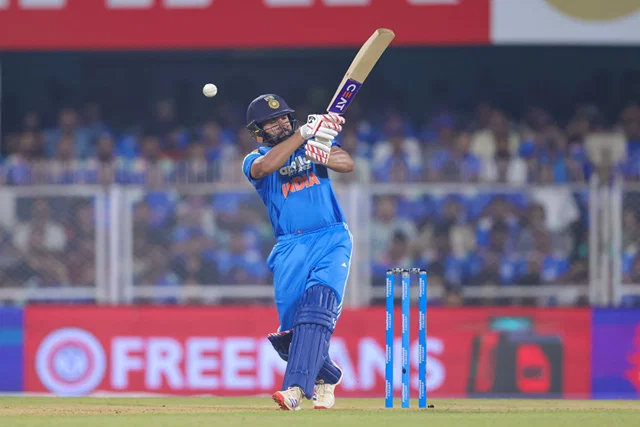
New Zealand captain Mitchell Santner believes his team must dismiss Rohit Sharma and Virat Kohli early if they want to restrict India’s batting strength in the five-match ODI Series. Ahead of the opening match against India, Santner discussed the challenge of facing the experienced duo and explained why New Zealand may need to rethink its previous plans against Rohit.
The left-arm spinner acknowledged that bowling short deliveries was once a tactic used by teams to trouble the Indian opener. However, Rohit’s improved ability to attack that length, particularly by hitting short balls for six, has made the approach far less effective.
Speaking to reporters in Auckland ahead of the series opener, Santner indicated that New Zealand would prefer to put pressure on India’s senior batters during the early stages rather than allow them to settle and control the innings.
Mitchell Santner explains New Zealand’s plan against Rohit Sharma and Virat Kohli
Santner understands the influence Rohit and Kohli can have on an ODI match. Both players bring extensive experience to India’s top order, and their ability to build an innings while maintaining the scoring rate makes them important targets for opposition bowlers.
The New Zealand captain suggested that his team would aim to break India’s opening partnership early. He believes allowing the senior batters to establish themselves could make the challenge considerably harder during the middle and final overs.
“I guess we’ll try to stop them pretty early in every game, ideally. Their role is to go pretty hard at the top, then set up a good score in the middle and then let their power kind of come in at the end.
Teams have tried to go short at Rohit before, but he hits those for six now. Kohli’s obviously an anchor for them. We know how good they are and, you know. I guess they’re getting on, but they’re still playing very well… I’ve seen it for a long time,” Santner said, via RevSportz.
His comments highlight the difficulty of finding a reliable bowling plan against Rohit. The Indian opener has developed into a powerful player against short deliveries, meaning New Zealand cannot depend on an approach that opponents have previously attempted.
Santner also recognised Kohli’s role as an anchor in the Indian batting order. While Rohit can provide an aggressive start, Kohli’s ability to control an innings and build partnerships gives India stability through the middle overs.
New Zealand will therefore look to create early breakthroughs against both batters rather than allow them to dictate the pace of the contest. Removing either player early could help the hosts put pressure on India’s middle order.
Why Rohit Sharma’s short-ball weakness is no longer an easy target
For several years, opposition teams have attempted to use short-pitched bowling against Rohit as a way to restrict his scoring and create opportunities for dismissals. The idea was to challenge him with deliveries around the body and force mistakes through aggressive field placements.
However, Santner’s assessment suggests that New Zealand recognise how much Rohit’s approach against short balls has changed. Instead of simply defending or struggling against the delivery, the right-hander can now use his timing and power to send it over the boundary.
That improvement creates a tactical problem for bowlers. A short delivery that might once have been considered a useful attacking option can become a scoring opportunity if Rohit gets into position and connects cleanly.
New Zealand will need to consider its lengths, field settings and bowling variations carefully. Rather than repeatedly testing Rohit with the same delivery, the bowlers may look to mix their approach and prevent him from settling into a comfortable rhythm.
Rohit’s record in ODI cricket also explains why Santner’s team cannot afford to give him too many opportunities. He is one of the format’s most destructive batters, with an ability to score quickly and produce substantial innings once he finds his timing.
Rohit Sharma’s ODI record against New Zealand
Rohit has produced important performances against New Zealand throughout his ODI career. Across 34 matches against the Black Caps, he has scored 1,134 runs at an average of 36.58 and a strike rate of 85.26.
His record against New Zealand includes two centuries and six half-centuries. Those hundreds came in two memorable performances: a score of 147 in Kanpur in 2017 and an unbeaten? 101 in Indore in 2023. The supplied statistics identify the Indore innings as 101 but do not specify whether it was not out.
These performances demonstrate Rohit’s ability to produce substantial scores against the Black Caps, even though his record in New Zealand itself has been more modest.
Rohit’s record in New Zealand presents a different challenge
Despite his overall success against New Zealand, Rohit has not scored an ODI century on New Zealand soil. In 14 ODIs in the country, he has accumulated 437 runs at an average of 36.41 and a strike rate of 72.95.
His record includes four half-centuries, with a highest score of 87. That innings came at Mount Maunganui in January 2019.
New Zealand remains the only SENA country where Rohit has not registered an ODI hundred. SENA refers to South Africa, England, New Zealand and Australia, countries where visiting teams often face different playing conditions from those found in the subcontinent.
The upcoming series will give Rohit another opportunity to improve that record. However, New Zealand’s bowling attack will be aware that his overall performances against the team make him a significant threat, regardless of his previous results in the country.
Rohit Sharma’s overall ODI numbers underline his importance
Rohit’s overall ODI career places him among the most productive batters in the history of the format. He has scored 12,120 runs in 291 matches at an average of 49.26, including 35 centuries and 63 half-centuries.
His highest ODI score remains 264, an innings that reflects his ability to turn a strong start into a remarkable individual total. Rohit has also hit 381 sixes in ODI cricket, the most by any player in the format.
That six-hitting record provides further context to Santner’s comment about the short ball. Rohit’s ability to clear the boundary consistently means that bowlers must be careful when choosing deliveries intended to challenge him with bounce.
His numbers in the current year have also been impressive. Rohit has scored 604 runs in 12 innings at an average of 50.33 and a strike rate of 104.67, including one century.
Another century in the upcoming series would carry additional significance. It would make Rohit the fourth Indian batter to score ODI hundreds in all four SENA countries.
Virat Kohli’s role as India’s batting anchor
While Santner specifically highlighted Rohit’s ability against short deliveries, he also identified Kohli as the anchor of India’s batting order. Kohli’s role is particularly important because he can manage the innings after an aggressive start and keep the scoreboard moving during the middle overs.
His experience and consistency make him another major challenge for New Zealand’s bowlers. If Kohli gets time at the crease, he can build partnerships, rotate the strike and accelerate when the situation demands it.
For the hosts, dismissing both experienced batters early would reduce the pressure on their bowling attack. However, if Rohit and Kohli establish a partnership, India’s middle-order batters could benefit from a strong platform and attack during the closing overs.
India enter ODI series after winning the T20I series
The five-match ODI series begins at Eden Park on Wednesday, November 4, with India arriving after securing a 3-2 victory in the preceding T20I series.
The change from T20Is to ODIs will bring different demands for both teams. The longer format gives batters more time to build innings, while bowling sides must maintain discipline across a greater number of overs.
For New Zealand, the opening match will provide an opportunity to respond after losing the T20I series. Santner’s comments indicate that the hosts are particularly focused on India’s experienced top-order pair and the importance of taking wickets early.
India, meanwhile, will look to carry their recent success into the ODI format. Rohit and Kohli remain central to the batting plans, with their experience offering the team the ability to approach different match situations.
Early wickets could shape the India vs New Zealand ODI series
Santner’s assessment makes the opening overs an important part of New Zealand’s strategy. The hosts know that allowing Rohit and Kohli to settle could give India control of the innings, particularly if the pair build a strong partnership at the top.
Rohit’s improved response to short-pitched bowling means New Zealand may need to use a more varied approach instead of relying on a tactic that has become less effective against him. Kohli’s ability to anchor the innings presents another challenge for the bowlers.
With India coming into the series after a 3-2 T20I victory, the opening ODI at Eden Park will offer New Zealand a chance to respond. Whether the hosts can execute their early-wicket strategy against two of India’s most experienced batters will be one of the key talking points of the series.
For breaking news and live news updates, like us on Facebook or follow us on Twitter and Instagram. Read more on Latest Cricket on thefoxdaily.com.






COMMENTS 0